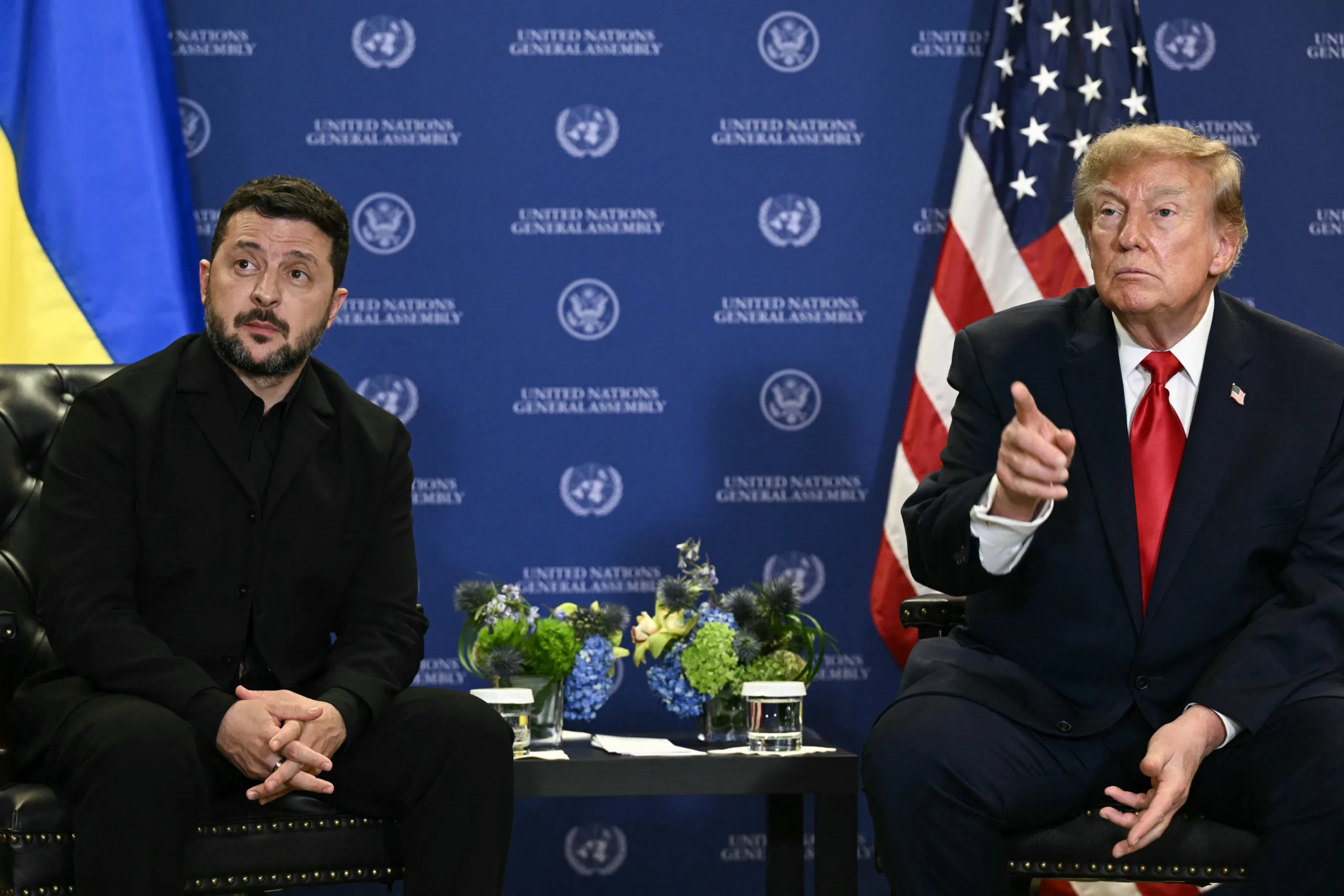
The last week was marked by the return of negotiations on the war in Ukraine to the center of the diplomatic agenda. The movement was evident during the meeting between Donald Trump and Volodymyr Zelensky, held on the sidelines of the UN General Assembly, and the consequent reactions from the Kremlin.
But, in addition to the statements about the resumption of dialogue, attacks between Moscow and Kiev continue, Europe raises the tone of criticism of Russia and the Russian government is counting on a new electoral result to guide the next steps of the war.
These events are not isolated. The elections for the State Duma, the lower house of the Russian Parliament, held between September 18th and 20th, had repercussions that went beyond the country’s internal politics.
On the one hand, Ukraine carried out one of the largest drone attacks against Moscow since the start of the war. Russian authorities reported more than 1,600 drones shot down, including the 450 that were headed toward Moscow. On the other hand, the official results of the election gave the ruling United Russia party a large majority in the Duma. The result increases the political room for maneuver of Vladimir Putin’s government to conduct the war and negotiations, although its concrete effects on Russian strategy are yet to be observed.
In an interview with Brazil in factthe professor of International Relations at the Federal University of Rio Grande do Sul, Fabiano Mielniczuk, who was in Moscow as an international observer of the Russian elections, points out that the Russian strategy has not shown any change, regardless of diplomatic movements and statements from the USA and Ukraine. According to him, the tendency is that, with the end of the parliamentary elections, the Kremlin will have more authority to continue achieving its objectives in the conflict.
“It’s still too early for us to assess this. But what it seems to me is that Russia hasn’t changed its position, it hasn’t changed its stance. From what we know, in Witkoff and Kushner’s negotiations with Putin, what Russia said in terms of conditions to achieve peace. They are the same conditions that had already been given back then. And it was this message that they took to Kiev to talk to Zelensky. And it doesn’t seem like Russia is changing its strategy because of that. Now let’s see how is that it will be after the results of the elections here, which will obviously give more power to the government to make decisions”, he argues.
During the meeting between Donald Trump and Volodymyr Zelensky, on the sidelines of the UN General Assembly, the US president defended a truce in attacks on energy infrastructure between Moscow and Kiev.
When commenting on these movements, the Kremlin demonstrated caution. According to Russian presidential spokesman Dmitry Peskov, the continued supply of weapons from Europe to Ukraine hinders the negotiation process.
“In fact, the militarization of Ukraine continues. European states are trying to find more and more money to buy weapons. […] To date, there are no preconditions for resolving this issue or for the start of peace negotiations. Although we, Russia, remain open to peace negotiations, there are still no concrete plans for high-level meetings,” the spokesperson said.
The Kremlin’s statement reinforces Russia’s well-known position in diplomatic negotiations on the conflict. While Ukraine demands the adoption of an immediate ceasefire in the war, Moscow points out that the parties must first negotiate political terms, and only then sign the terms of a truce. Meanwhile, Russia says it will continue its military operations.
In an interview with Brazil in factthe professor of International Relations at the Moscow Higher School of Economics, Ana Lívia Esteves, points out that the Russian position in the negotiations is linked to the search for a broader solution to the conflict, which goes beyond a specific ceasefire. According to the analyst, the Kremlin demands that negotiations address security issues and the so-called “underlying causes” of the war.
“The idea is that, as the jargon of the Russian Foreign Ministry says, the ‘root causes’ of the conflict are addressed by the parties before any kind of agreement is reached. […] On the one hand, this implies much more complicated negotiations, negotiations that will require many more actors and many more topics. But, on the other hand, in the Russians’ view, it would be these negotiations that would achieve more lasting results precisely because they address all the pending issues on the agenda”, he explains.
In this context, one of the main topics being discussed is the possibility of a ceasefire on attacks on energy infrastructure between Russia and Ukraine. The proposal seeks to stop, in a limited way, attacks against installations linked to the generation and supply of energy in both countries.
The proposal gained strength after the meeting between Donald Trump and Volodymyr Zelensky, during the UN General Assembly. Zelensky said Kiev would be willing to stop attacks on energy facilities, as long as the measure was bilateral. According to US Secretary of State Marco Rubio, both Russia and Ukraine have shown interest in some type of limited ceasefire for energy and other sectors.
Researcher Ana Lívia Esteves assesses that a truce restricted to the energy sector would hardly be enough to unlock the negotiations, because Moscow continues to defend a broader discussion on the conditions to end the conflict.
“It does not seem to me that a ceasefire strictly in the energy sector is a viable possibility for Russia, which will insist on maintaining the conflict agenda, the regulation of the Ukrainian conflict, the solution of the Ukrainian conflict as a broad agenda that deals, as they say, with the underlying causes of the conflict”, points out the expert.
Moscow’s position of caution and skepticism reflects the limitations of the proposals for an energy truce and resumption of negotiations. The day after the meeting between Trump and Zelensky, the Kremlin stated that there are still no conditions for a peaceful conclusion to the conflict and defended that a possible high-level meeting be preceded by diplomatic and technical work.
“Currently, there are no preconditions for the negotiations to reach a peaceful conclusion. However, we, as Russia, remain open to peace negotiations,” said Russian presidential spokesman Dmitry Peskov.
At the same time that diplomatic channels are gaining ground again, military dynamics show no signs of interruption. Russia and Ukraine continue to carry out systematic attacks, while European governments announce new military support for Kiev. In this context, the Kremlin points to the supply of Western weapons as one of the factors that hinder the advancement of a truce.
For professor Fabiano Mielniczuk, there is a clear sign of escalating tension between Russia and the West. According to him, the rhetoric of European authorities regarding a Russian threat narrative actually reflects a process of deterioration of the legitimacy of European powers.
“I am surprised by the position of Western leaders. At the same time that they are losing legitimacy, you see in Germany the extreme right gaining positions, winning regional elections and losing the credibility of the central government, of the Christian Democracy Party. You see in France the president without legitimacy. At the same time that the leaders’ legitimacy is decreasing, the temperature of criticism of Russia and the threat from Russia is increasing, to the point where the Polish Foreign Minister said that, in the conflict between Poland and Russia, Poland would win over Russia, which is something completely unrealistic in terms of military capabilities”, he analyzes.
Putin not G20?
Despite the obstacles placed in place, diplomatic channels between Moscow and Washington continue to function. This week, US Secretary of State Marco Rubio met with Russian Foreign Minister Sergei Lavrov and confirmed that the White House invited President Vladimir Putin to participate in the next G20 summit in December in Miami.
The meeting between Rubio and Lavrov was the fifth meeting between the two since 2025. The last one had taken place in July, in Manila, and the new contact occurs precisely at a time when Washington is trying to reopen channels to discuss a possible solution to the conflict.
Researcher Ana Lívia Esteves points out that the resumption of this contact between diplomats and the involvement of different bodies of the Russian and American governments in the negotiations is a positive sign.
“What I see very favorably is this plural engagement of various ministries and bodies of power, both from Russia and the United States, in the process. It is an indication that the debate is returning to professional diplomats, at least on the Russian side”, he adds.
The invitation to Putin also opens up the possibility of a new meeting between the Russian and American presidents. Since the start of the war, Trump and Putin have met in person only once, in August 2025, in Alaska. The meeting, however, ended without concrete results.
At the same time, the American Secretary of State himself recognizes that a possible energy truce would not resolve the war. According to Rubio, Russia and Ukraine showed interest in a limited measure involving energy and grains, but it would only aim to reduce part of the tensions, not end the conflict.
Source: www.brasildefato.com.br