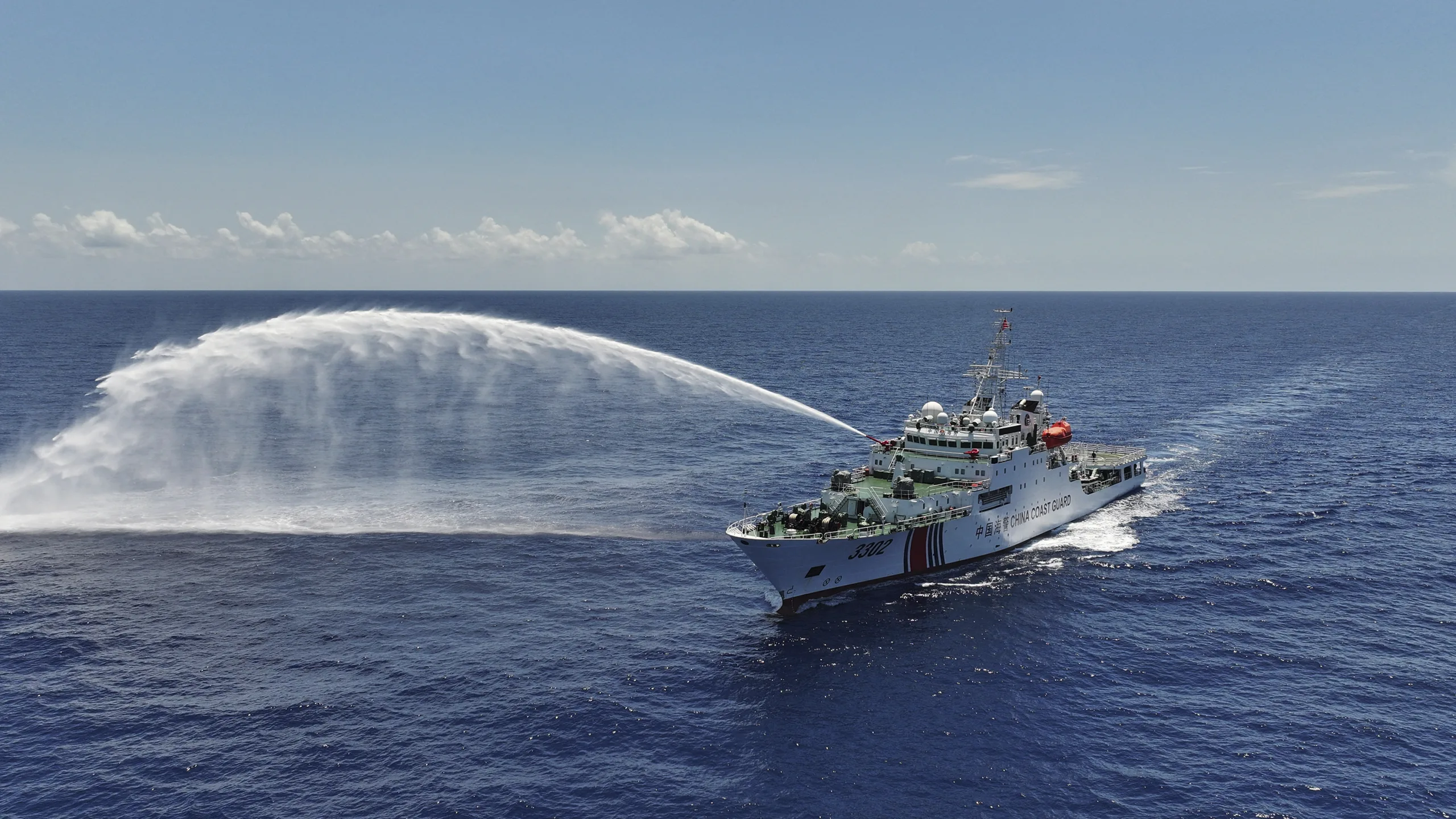
The Chinese Foreign Ministry summoned the heads of the embassies of European countries in Beijing and the European Union delegation to lodge a formal protest against the statements made on Sunday (12) for the ten years of the South China Sea arbitration. The measure was announced by the ministry’s spokesperson, Lin Jian, at a press conference this Tuesday (14).
The joint declaration, articulated by the United States and the Philippines, was signed by European countries, including the United Kingdom, Estonia, Germany, Latvia, Lithuania and Romania. The European Union released a separate text. The documents marked ten years since the ruling of an arbitration court that operated in The Hague, in the Netherlands, and rejected Chinese claims in the region. Lin Jian claimed that they “distorted the facts and maliciously defamed China.”
“China’s sovereignty over the islands in the South China Sea and its related rights and interests have been established over an extensive historical process and have a broad historical and legal basis,” the spokesperson said. For him, the court that handed down the sentence “was convened in a hurry for political purposes and does not have any authority or impartiality”, and the process was “a farce staged by some Western countries with the political objective of containing China”.
Lin Jian stated that Europe is not a party to the dispute and “has no right to interfere with China’s legitimate territorial sovereignty and maritime rights”. According to him, the “blatant hypocrisy” of European countries in matters of international law “further undermines their international credibility and does not contribute to strengthening mutual trust between China and the EU”. The spokesperson called on the bloc to stop endorsing the ruling, “so as not to affect relations and cooperation between China and the EU.”
The Chinese embassy in the United Kingdom had already spoken out on Sunday, stating that the country “is not a party to the South China Sea issue and is not in a position to make irresponsible comments” about Chinese territorial sovereignty. The embassy called on London to stop participating in the “anti-China spectacle staged by a handful of countries” and stop “stoking tensions and creating problems in the region”.
The arbitration case
The Philippines initiated the process unilaterally in 2013, invoking the United Nations Convention on the Law of the Sea, before a court formed especially for the case. On July 12, 2016, the court ruled in favor of Manila and concluded that Chinese claims to historic rights in the region had no basis in the Convention.
China did not participate in the process and does not recognize the sentence. In a position paper published in 2014, the government argued that the essence of the case is territorial sovereignty over islands and reefs, a matter outside the scope of the Convention. The country also maintains that a declaration made in 2006, provided for by the treaty itself, excluded maritime delimitation disputes from compulsory arbitration procedures.
The dispute covers four archipelagos that China claims in the region: Dongsha, Xisha, Zhongsha and Nansha, in addition to adjacent waters. The case opened by the Philippines focused on the Nansha Islands (called the Spratly in the West), the southernmost group of the sea, and the island of Huangyan (Scarborough).
In a white paper published in 2016, the Chinese government defended the resolution of disputes through negotiation and consultation with the countries directly involved, a position repeated by Lin Jian this Tuesday. According to the spokesperson, over the past decade, “the practices of many countries and international judicial institutions in handling related cases differ from the ruling.” China, he said, will continue to work with countries in the region “to maintain peace and security in the South China Sea and promote regional prosperity and development.”
Source: www.brasildefato.com.br