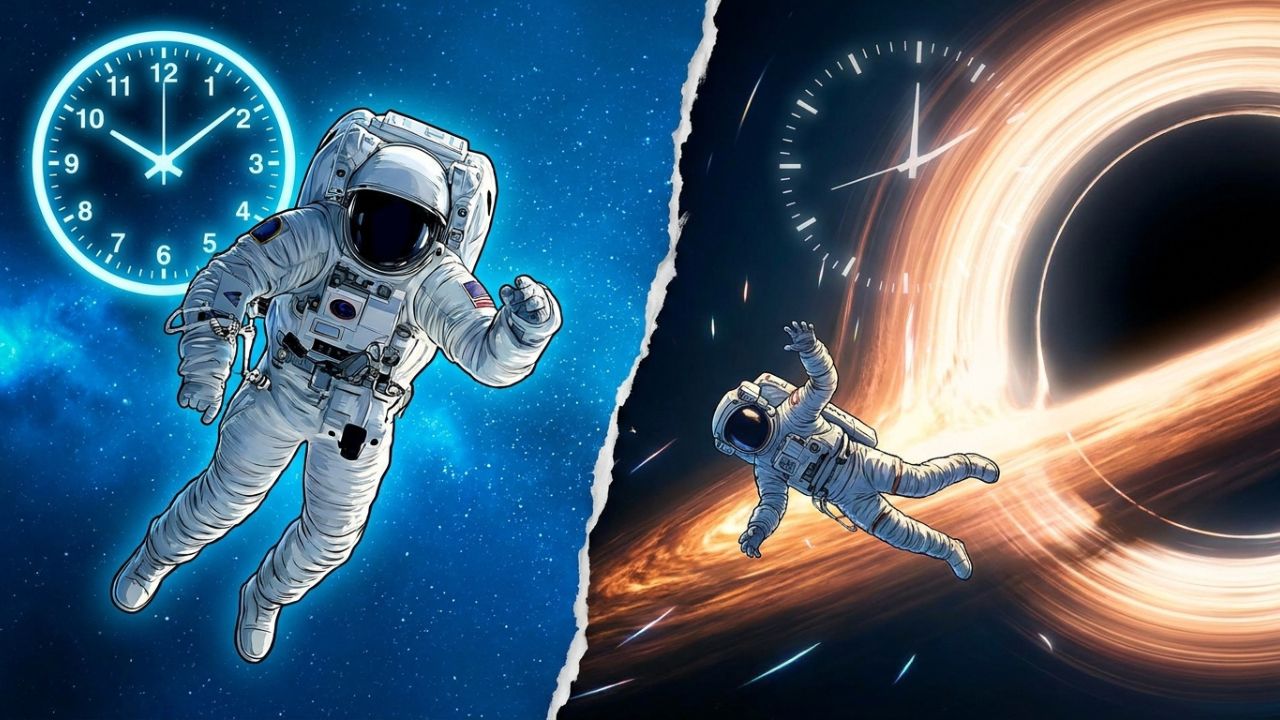
Time is not as universal as it seems. Near a black hole, the extreme curvature of spacetime causes clocks to tick at different rates depending on where they are.
Imagine watching a clock fall toward a black hole. From far away, something strange would appear to happen. As the clock approaches the black hole’s event horizon, its ticking would seem to slow down. The closer it gets, the more dramatically the effect appears.
This is not science fiction. It is a consequence of Einstein’s general theory of relativity, which transformed our understanding of gravity more than a century ago.
Gravity Can Change the Passage of Time
In everyday life, time feels constant. A second on Earth seems to be the same as a second anywhere else. But according to general relativity, time is intertwined with space, forming what physicists call spacetime.
Massive objects bend spacetime around them. Earth does this, as does the Sun. A black hole, however, takes this effect to an extreme.
A black hole can pack an enormous amount of mass into a remarkably small region. Its gravitational field becomes so intense that spacetime is profoundly distorted. One consequence is gravitational time dilation: clocks deeper in a gravitational field run more slowly relative to clocks farther away.
The Closer You Get, the Greater the Effect
Consider two observers. One remains far from a black hole while the other travels toward it.
Each observer carries a clock and experiences their own passage of time normally. The person falling toward the black hole would not suddenly feel their heartbeat slowing or their thoughts becoming sluggish. Their local clock would appear perfectly normal to them.
The difference becomes apparent when the two observers compare their clocks.
From the perspective of the distant observer, the clock closer to the black hole appears to run increasingly slowly. Near the event horizon, the difference becomes enormous.
This is an important distinction: time does not simply “stop” for the person falling into the black hole. Instead, the distant observer receives signals from the falling object that become increasingly delayed and stretched as the object approaches the event horizon.
What Happens at the Event Horizon?
The event horizon marks the boundary beyond which nothing can escape the black hole’s gravitational pull, not even light.
To a distant observer, an object approaching this boundary can appear to slow dramatically and become increasingly difficult to see. Its light is shifted toward longer wavelengths, a phenomenon known as gravitational redshift.
But for the falling observer, crossing the event horizon of a sufficiently large black hole can happen without a special local sensation at that exact boundary.
This apparent contradiction is one of the most fascinating consequences of relativity. Both descriptions can be correct because they refer to different observers and different measurements of time.
Why Does Gravity Affect Time?
The key idea is that gravity is not merely a force pulling objects downward. In general relativity, gravity is understood as the curvature of spacetime caused by mass and energy.
A clock follows a path through this curved spacetime. Different paths can accumulate different amounts of elapsed time.
The effect is measurable even in much weaker gravitational fields. Atomic clocks at different altitudes, for example, can tick at slightly different rates. Modern technologies such as GPS must account for relativistic effects to maintain accurate positioning.
Black holes simply provide the most dramatic natural environment in which gravitational time dilation can occur.
Time Is Local
Perhaps the most important lesson is that there is no single universal clock governing the entire universe.
Time depends on the observer’s motion and gravitational environment. A person near a black hole can experience a different amount of elapsed time than someone far away, even if both started their journeys together.
This does not mean that time becomes an illusion. It means that time is part of the physical structure of the universe, and that structure can be warped.
Black holes therefore offer more than a window into extreme gravity. They reveal something deeper about reality itself: the passage of time is not fixed and absolute. It is connected to the shape of spacetime.
And near the edge of a black hole, that connection becomes impossible to ignore.