Published 02/04/2026 14:56 | Edited 02/04/2026 15:49
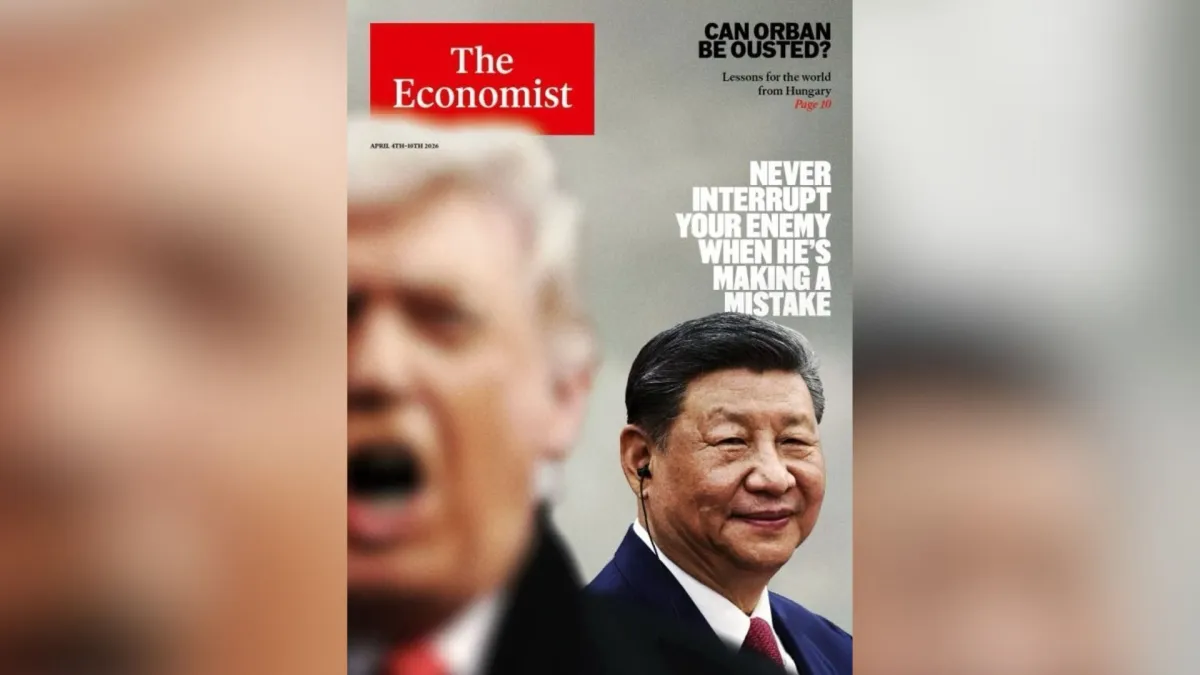
The new cover of The Economistwhich will be published this Friday (3), summarizes a geopolitical diagnosis in visual language: Chinese President Xi Jinping smiling behind Donald Trump, accompanied by the strategic quote “Never interrupt your enemy when he is making a mistake”. The main story already released reveals how China is positioning itself in the face of the American military offensive against Iran.
The choice refers to a maxim attributed to Napoleon Bonaparte and indicates the central axis of the analysis: China does not need to directly beat the United States — it is enough to manage time while Washington wears itself out.
The main article explains that he spoke with diplomats, advisors, academics, experts and current authorities and others who have already left their positions in China, who consider the war in Iran a serious American mistake. “Many Chinese say the war will accelerate the decline of the United States. They see American aggression as validation of President Xi Jinping’s focus on security over economic growth,” the text says.
Iran War as Catalyst of American Decline
“War against Iran promised to change the Middle East, weakening a vicious regime and thwarting its nuclear ambitions. For its most ardent supporters, the war would also change the world, intimidating a rising China. It would show how American control over the flow of oil makes China vulnerable. And it would bolster deterrence by contrasting American military supremacy with China’s reluctance or inability to defend its allies,” says the first paragraph, anticipating broad failure on all fronts.
According to the publication’s analysis, China assesses that the war against Iran promised to change the Middle East, but ended up becoming a strategic error for the US. The magazine notes that “China is taking advantage of Trump’s mistakes in the war with Iran”, literally applying the principle of not interrupting the adversary in his mistakes.
Trump criticized Democrats heavily during the election campaign for the conflicts Americans were involved in in the Middle East. “All of this would divert America’s attention from East Asia, where, if China gets its way, the 21st century will be shaped,” wrote the Economist.
The publication highlights that the war in Iran is weakening Trump – and making him angrier. Although Trump claims to have “destroyed 100% of Iran’s military capabilities,” the remnants continue to cause chaos, breaking campaign promises to avoid wars and reduce prices.
Beijing’s patient strategy
In contrast, Xi Jinping is portrayed as adhering to a long-term approach, based on gradual economic expansion, strengthening own production chains, expanding influence in the Global South and avoiding unnecessary direct confrontations.
China, according to the analysis, is betting on the progressive erosion of American hegemony, rather than an abrupt rupture. And the side effect is the increase in Chinese prestige among allies and adversaries.
The magazine argues that the current scenario is not one of open war, but of systemic competition. In this context, impulsive decisions — especially in the commercial and diplomatic field — tend to favor the more disciplined rival.
The cover phrase therefore works as a warning: by acting reactively, Donald Trump may be creating strategic advantages for Beijing.
US self-inflicted mistakes
The report argues that China’s main advantage today does not come only from its economic or technological strength, but from the succession of erratic decisions by the US.
Among the points highlighted are the strategic oscillations in foreign policy, the excessive use of sanctions and tariffs, with side effects on allies, the difficulties in building stable coalitions and the internal polarization that weakens American predictability.
The reading is that these moves reduce the US’s ability to lead the international order that it itself has structured.
Global impacts and repositioning of allies
Another central point of the report is the effect of these dynamics on the rest of the world: countries allied with the USA seek greater autonomy, emerging economies expand relations with China and multilateral institutions face increasing fragmentation
“This war will also worry countries that depend on the United States. Not only has their ally become less trustworthy, they are paying for their impulsiveness with expensive energy and raw materials. Will Asian countries therefore become more cautious about offending China?”
The result is a more fluid international system in which American influence is no longer automatic.
Chinese strategic blindness
The analysis of the The Economist points out that, despite all the careful analysis, China has a “strategic blind spot”. Chinese experts and officials are unanimous in stating that the US is attacking Iran because it feels weak, not strong, and that Trump’s lack of strategy condemns the initiative to failure.
At the same time, the sources consulted by the magazine consider that, if the war prolongs, the damage to exports and the Chinese economy will increase. Furthermore, “an unstable planet would be uncomfortable for China.”
The publication suggests that China may be underestimating how the war also affects its own strategic vulnerabilities, particularly with regard to access to oil and trade routes in the Middle East. Despite this magazine’s point of view, around the world, analysts believe that US adversaries such as China and Russia have only reaped the benefits of this war so far. As allies, such as Europe, Gulf countries or Japan, they only record losses, often permanent ones.
Xi Jinping’s effort to “protect China from closing choke points” by creating a strategic reserve of 1.3 billion barrels of crude oil would be enough for several months. Furthermore, the Chinese government would have diversified energy generation to nuclear, solar and wind sources, while maintaining the use of domestically mined coal. Its industry based on renewable energy has been extraordinarily accessed by countries interested in reducing their dependence on oil.
Opportunity without direct intervention
The core of the Chinese strategy, according to the magazine, is to allow the US to wear itself out militarily, economically and politically in the Iranian conflict without China having to take a direct position that puts it in confrontation with Washington. It is the practical application of strategic patience: letting the opponent make mistakes on their own.
China argues that its unwavering focus on economic development makes it a reliable partner, while the US engages in questionable military adventures. The magazine suggests that China should reap economic advantages even in the USA, including in relation to diplomacy for Taiwan.
A strategic warning disguised as a cover
The matter occurs at a tense moment in bilateral relations. Trump wanted to postpone his upcoming summit with Xi Jinping, citing the demands of the Iran war. Still, analysts predict that U.S.-China relations will remain largely stable through much of 2026 despite underlying tensions.
The coverage of The Economist it reflects an understanding that China sees the Iran war not just as a challenge but as a geopolitical opportunity – as long as it maintains the strategic discipline of not intervening prematurely. The magazine also points out that the war will create opportunities for China, as countries impacted by the conflict will need to rebuild their attacked infrastructure, including Trump’s allies in the Gulf.
More than a specific criticism, the analysis of The Economist works as a warning to Western elites: the dispute with China can be decided less by direct force and more by the ability to avoid strategic errors.
When reading the magazine, while Washington stumbles, Beijing watches — and advances.
Source: vermelho.org.br