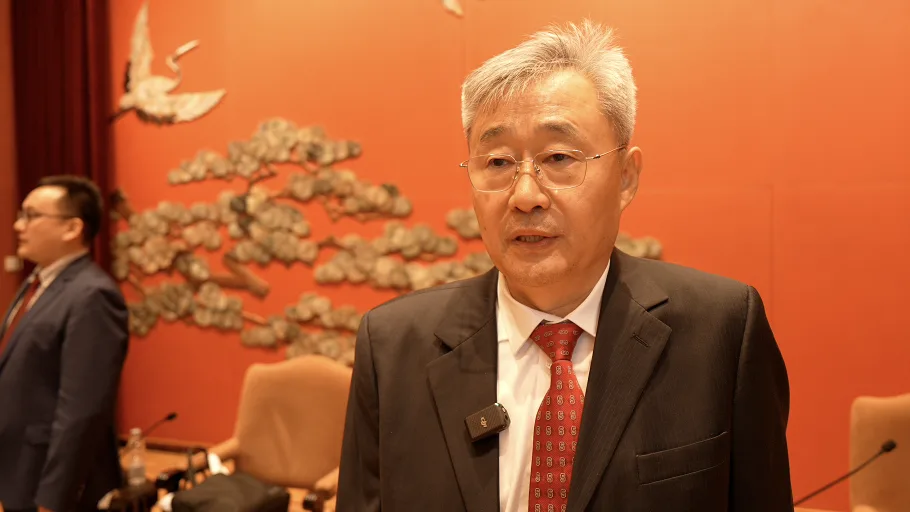
“Marx conceived socialism as an ideal, but the Soviet Union failed to make it work, while China revitalized it,” said Zhang Shiyi, former director of the 6th Research Department of the Party History and Literature Institute of the Central Committee of the Communist Party of China (CPC). The speech took place to celebrate the 105th anniversary of the CCP, the longest-lasting party in continuous power in history.
For the historian, “The central difference lies in the fact that the Soviet Union abandoned Marxism, while China remained faithful to it. This illustrates the lasting theoretical value of Marxism.”
The debate this Thursday morning (23) covered everything from the discipline of the Red Army in the Long March to the approval of the 15th Five-Year Plan, passing through the mass line as a central instrument of governance. The Chinese Public Diplomacy Association (CPDA) organized the press event in Beijing under the title “The 105th Anniversary of the Founding of the Communist Party of China: History, Experience and Global Contributions”.
In addition to Zhang Shiyi, Wang Yi, deputy director of the Party History Research Department, Party School of the CPC Central Committee (National Academy of Governance); Zheng Huan, professor at the Party Building Research Department, Party School of the CPC Central Committee (National Academy of Governance).
Marxism as a living theory
Zheng detailed the “Two Integrations” approved at the 20th National Congress of the CPC, in 2022: from Marxism to the concrete reality of China and traditional Chinese culture. “We do not treat Marxism as a static textbook or immutable dogma,” he said. “We continue to explore and promote theoretical innovations in light of the characteristics of each era.”
Zhang reiterated the idea: the basic principles of Marxism should be applied “to real-world practice, rather than interpreted dogmatically.” For the historian, this unfolds into three aspects.
The historian unfolded the argument into three dimensions. The first is to “defend the position of the people”: “Marxism is a doctrine for the liberation of all humanity, based on the central conviction that the people are the driving force of history”. The second is to “adopt dialectical thinking to coordinate the national and international dimensions”: “managing one’s own affairs well is the basis for facing any challenge”, responding rationally to external pressures such as competition between great powers and technological blockades. The third is to “appropriately address the relationship between universality and particularity”: Chinese-style modernization “perfectly balances the traits common to all modernization paths and China’s specificities.”
“Guided by Marxism, we advocate win-win cooperation and strive to create more development opportunities for all countries, especially developing ones,” he said.
Discipline and pasta line
Wang Yi detailed what he called the fundamental logic of the CCP’s roots among the people: discipline brings cadres closer to the masses; affective and practical bonds integrate Party and people; concrete policies and their implementation guarantee this long-term rooting.
She cited the historic case of the Long March. Alfred Bosshardt, a Swiss missionary who accompanied the Red Army for 18 months and recorded the experience in a book published in 1936, described the discipline he observed: “The troops maintain extremely strict discipline and highly organized order. When the Red Army took shelter in orchards full of ripe oranges to escape aerial bombardment, the entire unit was ordered not to pick a single fruit,” Wang quoted.
In the present, Wang Yi mentioned the two awarded this year’s July 1st Medal. Ma Shanxiang, for more than 30 years, has visited homes and resolved community conflicts in Beijing, developing more than 60 mediation methodologies. Commenting on his own work, he said: “No matter how trivial a mass problem may seem, it is a huge event.”
The other case is that of Huang Wenxiu, who traveled 25,000 kilometers to visit all 195 families in poverty in his rural village in Baise, in the Guangxi Autonomous Region, and created his own map with the causes of poverty for each one. She learned the local dialect to understand the difficulties of the residents. She died at the age of 29, swept away by a flood in June 2019, while organizing flood prevention measures.
Wang Yi defined the mass line as “the CCP’s most successful strategic weapon in its 105-year history.”
Party construction
Zheng highlighted that, according to statistics from the Organization Department of the CPC Central Committee, as of December 31, 2025, the party had more than 100 million members and 5.431 million grassroots organizations across the country.
The researcher also cited “Xi Jinping Thought on Party Building” as a key to understanding the CCP. Systematized in the “Fourteen Commitments” listed in the report “Contemporary Characteristics and Global Significance of Xi Jinping Thought on Party Building“, released on July 2 by the Party School of the CPC Central Committee (National Academy of Governance) and the Xinhua think tank, the Fourteen Commitments constitute the program that translates the principles of this thought into practice, ranging from the Party’s leadership over all sectors of national life to the strict and comprehensive governance of the CCP.
The same report identifies five dimensions of relevance of the Chinese party model for parties in the Global South: alternative to the representation crisis; references for combating corruption; response to organic fragmentation; abandonment of zero-sum logic; and construction of a new type of inter-party relations.
Long-term planning
Zhang traced the historical arc of Chinese planning from the Four Modernizations formulated by Premier Zhou Enlai in 1954. The concept of Chinese-style modernization, developed by General Secretary Xi Jinping, distinguishes the parallel path adopted by the country, in which industrialization, computerization, urbanization and agricultural modernization advance simultaneously, from the Western sequential model, in which each stage preceded the next.
The 15th Five-Year Plan, approved in the Two Sessions of March 2026, establishes 20 central development indicators, 16 strategic tasks and 109 priority projects. “Practice has proven that drafting and implementing Five-Year Plans constitutes the core governance experience of the CCP and a vital institutional force of socialism with Chinese characteristics,” Zhang said.
Source: www.brasildefato.com.br