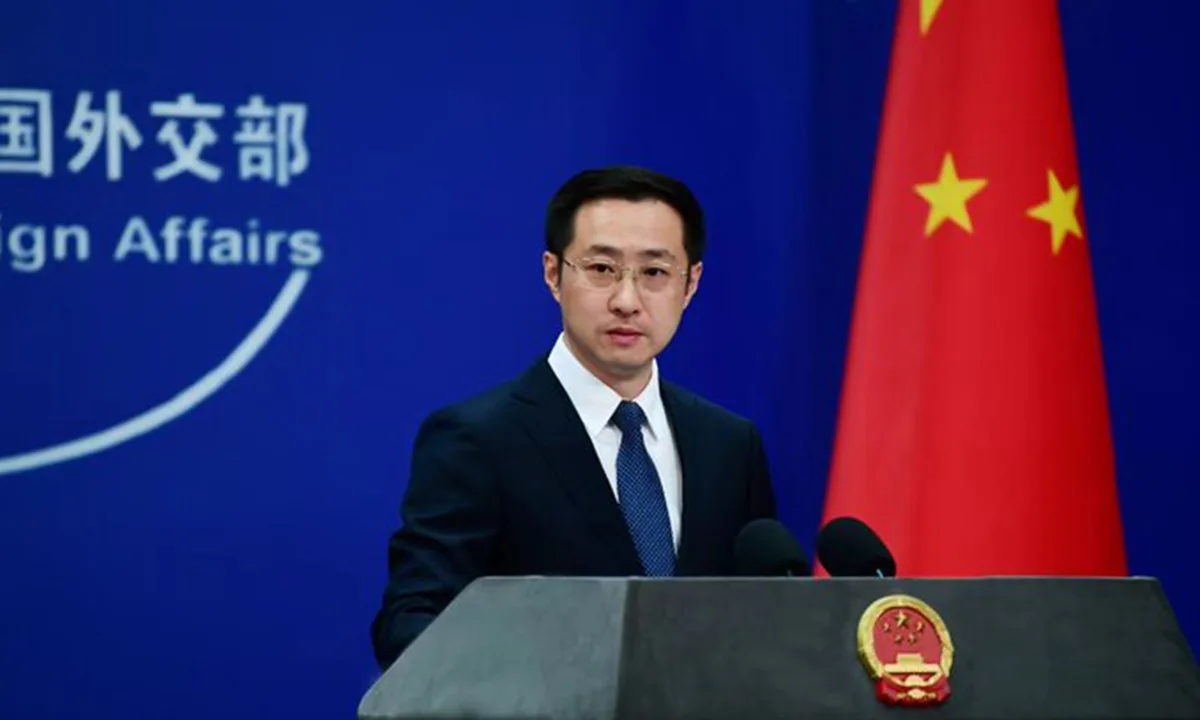
The Chinese government reacted this Tuesday (21) to a new pressure movement from the United States against Cuba and accused Washington of acting like a “thief who shouts catch a thief”. Beijing said the charges against Havana ignore decades of economic sanctions imposed by the United States itself.
The statement was made by Chinese Foreign Ministry spokesperson Lin Jian during a press conference in Beijing. He reaffirmed the country’s support for Cuban sovereignty and the island’s right to establish its own international relations.
The demonstration occurred following a report released by the US State Department on Cuba, a document that expands Washington’s criticism of the Cuban government and questions the island’s relationship with countries such as China, Russia and Iran.
“China’s relationship with Cuba is open and transparent and does not tolerate slander or defamation. We ask the US side to stop repeatedly defaming other countries and stop these ‘screaming thief catches thief’ maneuvers,” the spokesperson said.
Lin also reinforced continued support for Havana. “China will continue to firmly support Cuba in safeguarding its national sovereignty and opposing external interference,” he said.
The expression used by the representative of Chinese diplomacy corresponds to the proverb “zéi hǎn zhuō zéi” (贼喊捉贼), equivalent to the Brazilian saying “a thief who shouts catches a thief”. The term is used to criticize those who accuse others of practices that, according to this interpretation, they also carry out.
The Washington Report
The State Department’s report places Cuba once again at the center of Washington’s pressure policy against governments considered adversaries.
The document presents Havana as an actor of political and strategic influence on the American continent and states that the Cuban government maintains close relations with countries that Washington considers geopolitical rivals.
Among the main points of the report is the accusation that Cuba had developed intelligence and influence structures against the United States. The document also mentions the Chinese presence on the island and states that Beijing has expanded its cooperation in areas considered sensitive by Washington.
The accusations are part of a US government narrative, according to which Cuba, China, Russia and Iran act in a coordinated manner to expand their influence in the Western Hemisphere.
Beijing rejected these interpretations and stated that its relationship with Havana is based on economic cooperation, technological exchange and respect for the countries’ sovereignty.
For the Chinese government, the accusations against Cuba and the bilateral partnership represent an attempt to interfere in the international choices of a sovereign country.
For Havana and its allies, Washington’s accusations cannot be separated from the economic, commercial and financial embargo maintained by the United States for more than six decades. The Cuban government claims that US policy limits access to resources, investments and technologies.
More than six decades of blockade
Between Cuba and the United States, one of the longest diplomatic conflicts in recent history takes place.
The economic, commercial and financial blockade imposed by Washington against Havana has remained in force for more than six decades and is identified by the Cuban government as one of the main obstacles to the country’s development.
The measures restrict Cuba’s access to markets, investments, international credit and certain products, including equipment and technologies that depend on US components.
The US government says the sanctions are a way to pressure political changes in Havana. Cuba denounces the policy as an attempt at economic strangulation and a violation of its sovereignty.
The United Nations General Assembly regularly passes resolutions calling for an end to the embargo. China is among the countries that advocate the lifting of coercive measures against the island.
A historic partnership between China and Cuba
The rapprochement between Beijing and Havana has historical roots. The two countries established diplomatic relations in 1960, making Cuba the first country in Latin America and the Caribbean to officially recognize the People’s Republic of China.
Since then, bilateral cooperation has advanced in strategic areas such as health, agriculture, energy, infrastructure, telecommunications and biotechnology. The partnership has gained special importance in recent years, when Cuba began to face greater economic difficulties worsened by US sanctions and external impacts, such as the Covid-19 pandemic.
In 2018, Cuba joined the Belt and Road Initiative, the main international cooperation program promoted by China, expanding joint projects in different economic sectors. In recent years, Beijing has also increased cooperation with Havana amid the economic crisis faced by the island, marked by difficulties in energy supply, access to financing and imports of essential goods.
China presents this relationship as a partnership based on mutual benefits and cooperation between developing countries.
The new exchange of accusations also reveals a broader struggle for political and economic influence in Latin America and the Caribbean.
For decades, the United States treated the region as a strategic area of its foreign policy. In recent years, however, China has expanded its presence through trade, investment and infrastructure projects.
Beijing has become one of the main trading partners of several Latin American and Caribbean countries, strengthening its presence in sectors such as energy, transport, mining and technology.
The dispute over Cuba reveals a broader dimension of the strategic rivalry between China and the United States, which goes beyond the Caribbean island and involves different views on sovereignty, development and international influence. For Washington, the growth of Chinese influence in the region represents a strategic challenge. For Beijing, this is cooperation based on development and respect for the choices of each country.
In the Cuban case, this difference in views is evident: while the United States maintains a policy of sanctions and pressure, China defends greater economic integration and the end of measures that it considers coercive.
Lin Jian’s statement reinforces a recurring position in Chinese diplomacy: the defense of national sovereignty and non-interference in the internal affairs of other countries.
By accusing Washington of acting like a “screaming thief, catch a thief”, Beijing claims that the United States attributes to other countries practices that are part of its own foreign policy, marked, according to the Chinese government, by unilateral sanctions and pressure.
Source: www.brasildefato.com.br