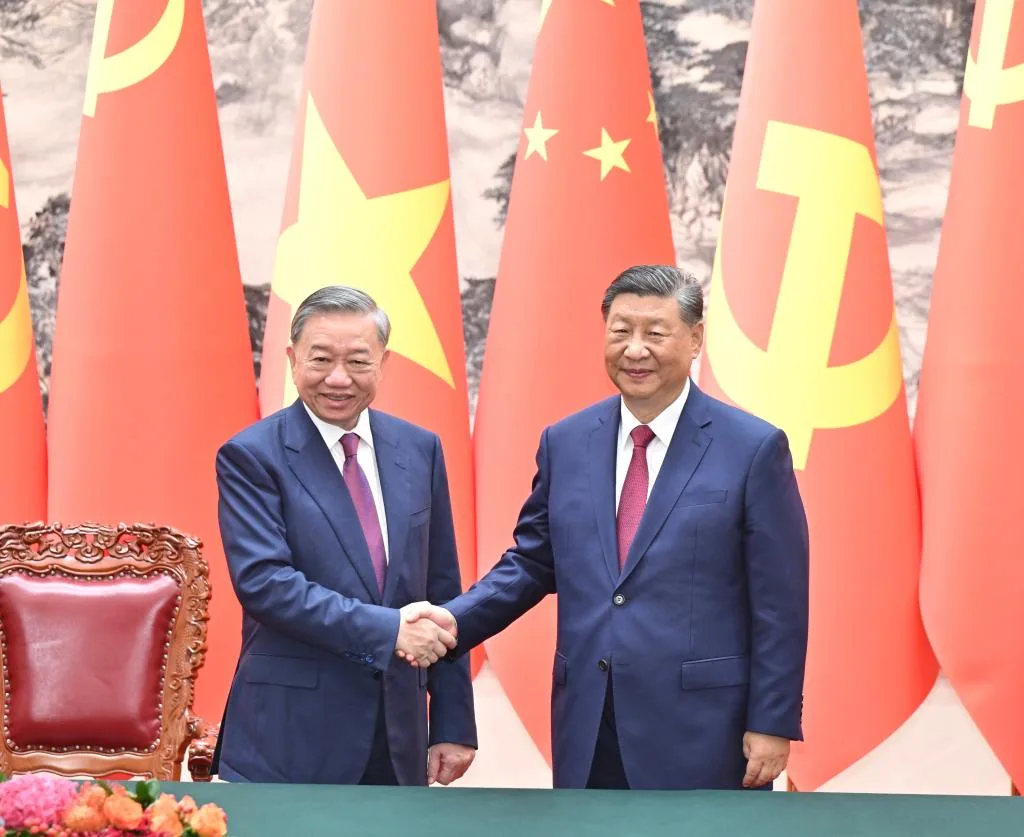
The leadership of the Communist Party of China (CCP) stated this Tuesday (14) that strengthening relations with Vietnam contributes to “the cause of global socialism”, during a meeting in Beijing between leaders of the communist parties of the two countries.
The statement was made by Wang Huning, member of the Standing Committee of the CPC Political Bureau and chairman of the Chinese People’s Political Consultative Conference, upon receiving a delegation from the Communist Party of Vietnam (PCV) led by Lê Minh Trí, member of the Vietnamese party’s Political Bureau.
According to Wang, the understandings reached between the general secretary of the CCP, Xi Jinping, and the general secretary of the Communist Party of Vietnam, Tô Lâm, during the Vietnamese leader’s visit to China in April, represent a guide to deepen bilateral cooperation and advance “the cause of world socialism”. The leader stated that Beijing is willing to implement the consensus reached by the two leaders and advance in the construction of the so-called China-Vietnam Community with a Shared Future, a concept that guides relations between the two countries.
Although it did not result in new agreements, the meeting reinforced the role that both parties attribute to political exchange as an instrument to deepen bilateral cooperation. In addition to diplomatic relations between the governments, the Communist Party of China and the Communist Party of Vietnam maintain permanent mechanisms for dialogue on governance, economic planning, combating corruption, cadre training and socialist development.
Expanding strategic relationship
The rapprochement between Beijing and Hanoi gained new momentum in April, when Tô Lâm made a state visit to China. On the occasion, the two countries signed 32 cooperation documents in areas such as artificial intelligence, railway connectivity, production chains, customs inspection, agricultural trade, culture, sports, human resources development and exchange between the media.
The visit was presented by the two governments as a milestone to accelerate the construction of the China-Vietnam Community with a Shared Future and expand coordination between the two parties.
The partnership is also supported by an increasingly closer economic relationship. China is Vietnam’s largest trading partner. Bilateral trade reached around US$260 billion in 2025, driven by the integration of industrial chains between the two countries. In addition to trade, Chinese companies increased investments in sectors such as manufacturing, energy, logistics and infrastructure, consolidating Vietnam as an important industrial hub in Southeast Asia.
Among the priority projects is the expansion of railway connectivity between southern China and northern Vietnam, considered strategic to reduce logistical costs and strengthen trade flows. The two governments have also been intensifying cooperation in the digital economy, artificial intelligence, agriculture and infrastructure development.
Cooperation between communist parties remains one of the pillars of the bilateral relationship. In addition to frequent contacts between leaders, PCCh and PCV promote exchanges between political training schools, staff training programs and seminars on governance, economic planning and combating corruption.
During Tuesday’s meeting, Wang stated that Xi Jinping and Tô Lâm maintain close strategic communication and defended the implementation of the consensus reached by the two leaders as a way of producing new advances in the bilateral relationship. According to him, the Chinese People’s Political Consultative Conference will continue to contribute to expanding political exchanges between the two countries.
In response, Lê Minh Trí congratulated the Communist Party of China on the 105th anniversary of its founding and stated that Vietnam intends to deepen the implementation of the consensus reached by the leaders of the two countries, in addition to expanding exchanges on the theory of socialism with Chinese characteristics. The leader also praised the global initiatives proposed by Xi Jinping and the results obtained by China in its development process.
Cooperation despite differences
The rapprochement between Beijing and Hanoi occurs despite disputes in the South China Sea. The two countries entered into armed conflict in 1979 and maintained tense relations for part of the following decade. The normalization of diplomatic relations occurred in 1991 and, since then, political and economic cooperation has advanced steadily, even with disagreements over maritime areas claimed by both.
In recent years, the two leaders have sought to prevent these disputes from compromising the rest of the bilateral agenda, preserving permanent channels of dialogue and expanding coordination on economic, political and party issues.
Wang Huning’s reference to the “cause of world socialism” was one of the main points of the meeting. By relating the strengthening of the Sino-Vietnamese partnership to the development of socialism, the leader reinforced the ideological dimension attributed by Beijing to cooperation between two of the few countries in the world governed by communist parties.
Without announcing new concrete measures, the meeting in Beijing reaffirmed the priority given by China and Vietnam to deepening political, economic and party cooperation, in addition to implementing the agreements signed by Xi Jinping and Tô Lâm during their April visit. The meeting also signaled the two countries’ intention to maintain the strengthening of the partnership as one of the pillars of their action on the regional and international scene.
Source: www.brasildefato.com.br