Published 04/28/2026 14:03 | Edited 04/28/2026 14:18
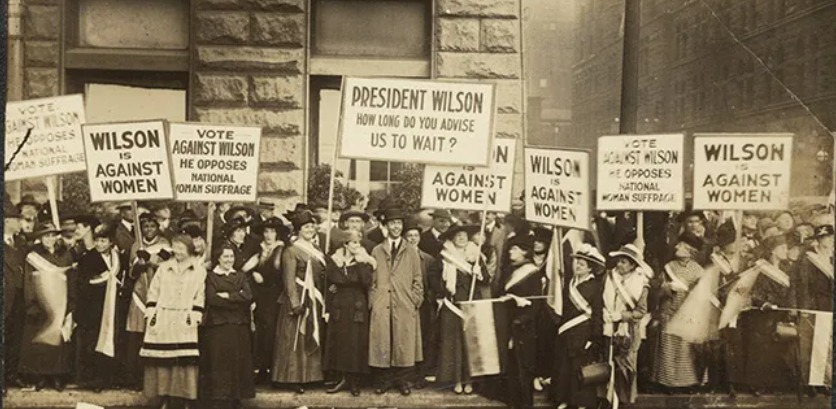
Statements advocating the end of female suffrage have gained visibility in the United States, driven by influencers, religious leaders and sectors of the far right. Although restricted to niches and without direct institutional support, these statements expand their circulation and reintroduce into the public debate questions about women’s rights that have been consolidated for more than a century.
From the digital far right to religious pulpits
Influencer Nick Fuentes is among the names that vocalize this positioning more explicitly. Linked to the new digital far right, he leads the America First movement and gathers a base of followers known as “Groypers”. Fuentes gained prominence with live broadcasts and podcasts in which he combines nationalism, attacks on immigration and speeches against minorities, in addition to having already been banned from traditional platforms for violating policies against hate speech. In his speeches, he defends the return to traditional models of social organization and has already stated that women should not vote.
This type of discourse also finds support in conservative religious sectors. Pastor Doug Wilson is one of the main names in so-called Christian nationalism in the country. For decades, he has defended the reorganization of society based on biblical principles, with an emphasis on patriarchal structures and male authority within the family. From Idaho, he built a network of churches, schools and religious institutions and, in recent years, began to gain space in sectors of the right linked to President Donald Trump. Among his proposals is the “one vote per family” model, in which the political decision would be up to the man. A formulation that, in practice, excludes women from direct participation in political life.
In the same vein, pastor Dale Partridge has disseminated direct criticism of women’s political participation on social media. In a publication made on February 13th on platform
In the same content, he associated the expansion of rights with a supposed “collapse” of Western nations, relating social advances to immigration, multiculturalism and changes in customs. The formulation returns to a recurring logic in these sectors, which attributes responsibility for social transformations to historically excluded groups (such as women and minorities), while at the same time justifying the restriction of rights as a political response.

Conservative offensive targets voting through indirect means
The US 19th Amendment, passed more than a century ago, is not under direct legislative threat. Still, the advancement of this type of discourse occurs in parallel with concrete proposals on electoral rules. A project supported by Donald Trump, approved by the Chamber in April 2026, provides for stricter requirements for proof of citizenship and matching names on documents presented at the time of voting.
In practice, the measure can especially affect married women who adopted their partner’s surname, as well as transgender people and low-income voters. In cases of divergence, the text requires additional documentation, which may create indirect barriers to voting.
This type of position has also been reinforced by members of the government itself. In August 2025, the United States Secretary of Defense, Pete Hegseth, republished on his social networks a video of a pastor linked to Christian nationalism who openly defends the exclusion of women from voting. The episode highlights how this type of discourse also passes into spheres of power, expanding its political reach.
This set of positions emerges in a scenario of strong polarization in the United States, in which disputes around gender, rights and political participation have intensified. In conservative sectors, women have been associated with recent social transformations, such as the advancement of progressive agendas and changes in voting behavior. Data indicates that American voters tend to vote mostly for Democratic Party candidates, which reinforces their weight in political disputes.
More than isolated episodes, the circulation of these ideas reveals a broader political offensive. By casting doubt on the right to vote for women, even without immediate viability, these speeches act to displace the public debate and weaken historical achievements.
In practice, this type of narrative reopens disputes that were already consolidated and creates an environment in which rights are treated as subject to review. It is in this process that conservative and regressive agendas no longer remain restricted to niches and begin to compete for space at the center of political debate, straining, in practice, the limits of democracy itself.
Source: vermelho.org.br