The United States’ additional 25% tariff on part of Brazilian products exported to the country comes into force this Wednesday (22). The measure was announced after an investigation by the Donald Trump administration indicated that Brazil allegedly adopted practices that “encumber or restrict” trade with the United States. The Brazilian government disputes the justifications and considers the decision to be politically motivated.
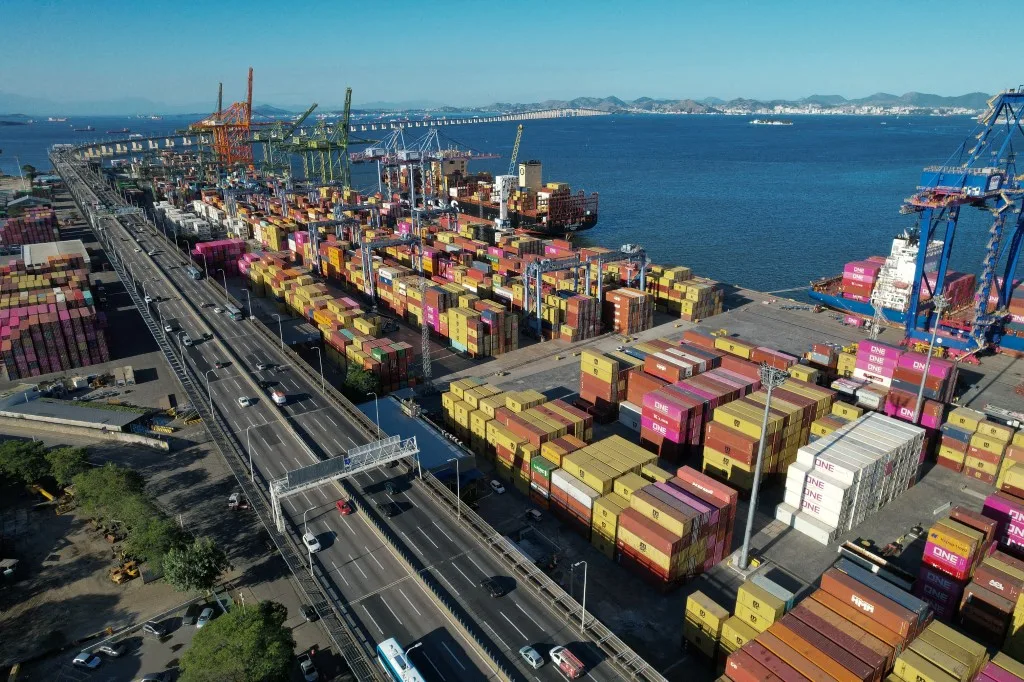
The charge will be applied to approximately three thousand Brazilian products upon entry into the United States. In practice, the tariff increases the cost of imports for American companies and can reduce the purchase of Brazilian products. At the same time, more than two thousand items were excluded from the measure because they were considered strategic for the American economy or because the United States does not produce enough of these products.
Among the main exempt products are crude oil, coffee beans, aircraft, beef, cellulose, orange juice, pig iron and niobium iron. Industrial machinery, agricultural machinery, tires, sugar, ethanol, tobacco, wood, footwear, paper and some aluminum products are now affected by the new tariff.
The investigation
The decision is the result of an investigation conducted by the Office of the United States Trade Representative (USTR) based on Section 301 of the Trade Act of 1974. The mechanism allows the US government to investigate practices in other countries considered harmful to US trade.
In the report, the organization states that Brazilian policies would be “irrational” or “restrictive” and could “encumber or restrict” trade with the United States. Among the points mentioned are the PIX payment system, the regulation of digital platforms, commercial tariffs granted by Brazil to partners such as Mexico and India, the ethanol market, the fight against corruption, the protection of intellectual property, the fight against piracy, the delay in analyzing patents and illegal deforestation.
The charge came into force even after public hearings in which civil society representatives from the United States and Brazil spoke out against the measure.
During the negotiations, representatives of the United States government expressed dissatisfaction with the progress of the talks. On the Brazilian side, negotiators classified the US demands as “very bad and disadvantageous” for Brazilian industry and agriculture and reported difficulties in advancing negotiations given the lack of clarity about the US demands.
The Brazilian government classified the decision as a “regrettable milestone” in the relationship between the two countries. Vice President Geraldo Alckmin (PSB) stated that the measure is “unfair and unreasonable” and declared that Brazil “has not left the negotiating table”. The Minister of Finance, Dario Durigan, stated that “there is no point in talking about retaliation” and said that Brazil will continue to “protect our geological sovereignty without ‘viralism’” and “our democracy against undue international interference”.
According to the Ministry of Development, Industry, Commerce and Services, the tariff will affect 18% of Brazilian exports to the United States, considering data from 2024. The percentage corresponds to US$7.4 billion. Considering data from 2025, the share drops to 15%, equivalent to US$5.8 billion. The ministry also states that 57% of products exported by Brazil to the United States will remain tariff-free.
In agribusiness, the Brazilian Confederation of Agriculture and Livestock estimates an annual impact of R$4.6 billion, a value corresponding to 36.5% of the sector’s exports to the United States. Dario Durigan stated that, despite the sectors affected, the measure will not have an impact on “the country’s economy as a whole”.
Reciprocity
After confirming the rate, Palácio do Planalto informed that it had started the procedures to activate the Economic Reciprocity Law. The legislation, approved by the National Congress and sanctioned by President Lula (PT) in 2025, allows the government to adopt measures against countries that impose commercial, legal or political barriers to Brazil.
Despite this, the government has not yet announced concrete measures based on the law. The assessment is that an immediate response could provoke a new reaction from the United States and increase tariffs, as occurred in the trade dispute between the United States and China.
According to government members, the strategy is to maintain technical and diplomatic dialogue while preparing measures to reduce the effects of the tariff on the affected sectors.
Among the actions under study are lines of credit for companies affected by tariffs, financing for fertilizer mixing companies, investments through the Sovereign Brazil Plan and support for maintaining jobs. At the same time, ApexBrasil is preparing a market diversification program with an investment of R$130 million to expand destinations for Brazilian exports and take advantage of opportunities in the agreement between Mercosur and the European Union.
The Brazilian government is also following a new investigation conducted by the Office of the United States Trade Representative into alleged failures in the inspection of products produced with forced labor. The measure may result in an additional fee of 12.5%. There is still no definition as to whether the charge will be added to the 25% that comes into force this Wednesday. If the two tariffs are accumulated, some Brazilian products could face a surcharge of 37.5%. The decision may be announced in the coming days.
Source: www.brasildefato.com.br