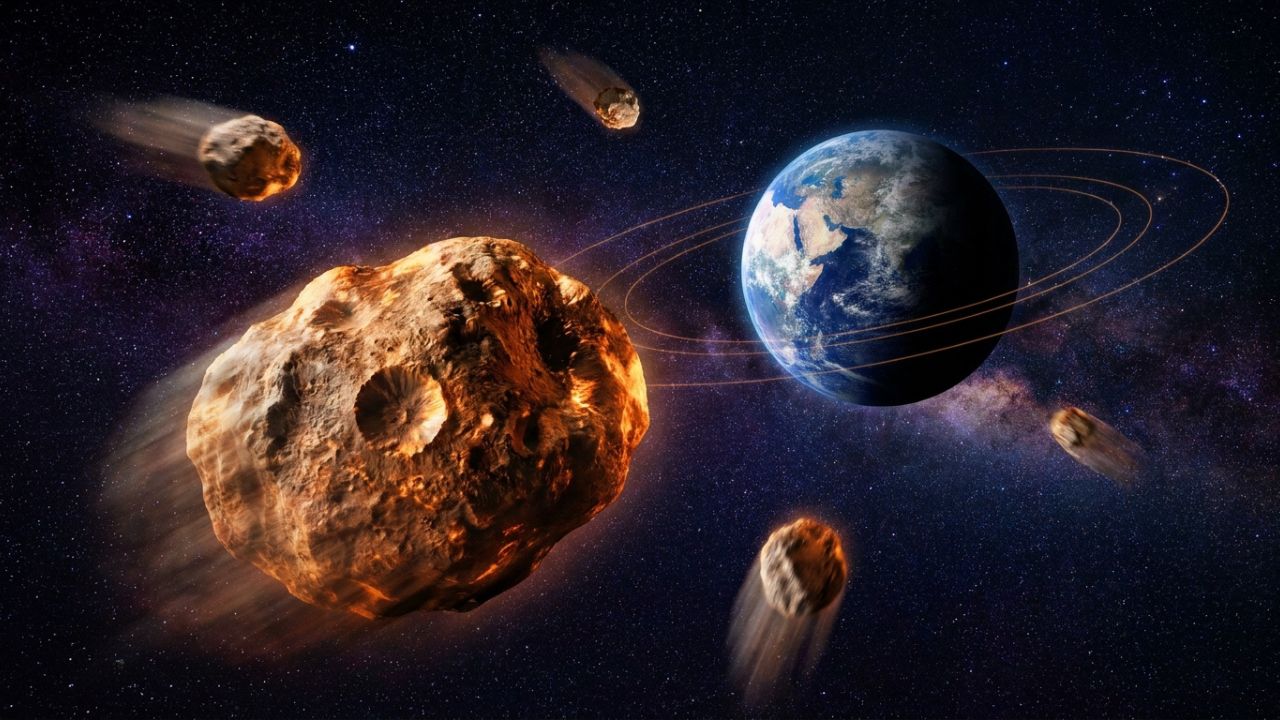
Earth has survived countless cosmic impacts throughout its 4.5-billion-year history, but modern astronomy has revealed that our planet remains vulnerable to asteroid strikes in the coming decades. While the probability of a catastrophic collision remains low, scientists have identified several near-Earth objects (NEOs) that warrant close monitoring as we navigate through the 21st century. These celestial wanderers represent both a scientific opportunity and a potential existential threat, demanding international cooperation and advanced detection systems to ensure humanity’s safety.
The discovery and tracking of potentially hazardous asteroids has become one of the most critical endeavors in contemporary space science. With improved telescope technology and sophisticated orbital prediction models, astronomers can now identify threats years or even decades before any potential impact. This early warning system provides crucial time for developing deflection strategies and emergency response protocols. However, the challenge remains immense: detecting small asteroids that could still cause significant regional damage requires constant vigilance and global coordination.
☄️ Bennu: The Well-Studied Visitor
Bennu, a carbonaceous asteroid approximately 490 meters in diameter, stands out as one of the most thoroughly studied near-Earth objects in human history. NASA’s OSIRIS-REx mission successfully collected samples from Bennu’s surface in 2020, providing unprecedented insights into the composition and structure of these ancient space rocks. The spacecraft returned to Earth in September 2023, delivering precious material that continues to reveal secrets about the early solar system and the origins of life.
Despite being extensively mapped and analyzed, Bennu poses a genuine threat to our planet. Current orbital calculations indicate a cumulative impact probability of approximately 1 in 1,750 through the year 2300, with the highest risk occurring between 2175 and 2199. While these odds may seem reassuringly low, they represent a significantly higher probability than most other known asteroids. The 2182 close approach has particular significance, as gravitational interactions during previous flybys could alter Bennu’s trajectory in unpredictable ways.
What makes Bennu particularly concerning is not just its size, but its composition and structure. The asteroid appears to be a loosely bound rubble pile, held together primarily by gravity rather than solid rock. This characteristic means that if Bennu were to enter Earth’s atmosphere, it might fragment into multiple pieces, creating a wider devastation zone. An impact would release energy equivalent to thousands of nuclear weapons, causing widespread destruction across hundreds of kilometers. Regional devastation would include massive fires, tsunamis if impacting ocean areas, and long-term climate effects from atmospheric dust injection.
🎯 Apophis: The Former “God of Chaos”
Apophis, named after the ancient Egyptian deity of chaos and destruction, captured global attention when it was first discovered in 2004. Initial observations suggested a disturbing 2.7% chance of impact in 2029, sparking widespread media coverage and public concern. However, subsequent observations and refined orbital calculations eliminated this possibility, demonstrating the importance of continued monitoring and data refinement in asteroid tracking.
The 990-foot-wide asteroid will make an exceptionally close approach to Earth on April 13, 2029, passing within 31,600 kilometers of our planet’s surface—closer than many communications satellites. This unprecedented proximity will provide scientists with a unique opportunity to study a large asteroid up close using ground-based telescopes and radar systems. The event will be visible to the naked eye in some regions, appearing as a bright moving star crossing the night sky.
While the 2029 encounter poses no impact risk, the gravitational interaction during this close flyby could subtly alter Apophis’s orbit, potentially affecting future trajectories. Scientists are particularly interested in understanding how Earth’s gravity might influence the asteroid’s rotation state and internal structure. Some models suggest that tidal forces during the 2029 approach could cause surface landslides or structural changes within Apophis itself.
Looking beyond 2029, Apophis maintains a small but non-zero probability of impact in 2068 and subsequent decades. The current estimated probability stands at approximately 1 in 150,000 for the remainder of this century. While this represents an extremely low risk, the sheer size of Apophis means that even a remote possibility demands serious attention. An impact would release energy exceeding 1,000 megatons of TNT, capable of devastating an entire country or causing severe global climate disruption.
🌟 2023 DW: The Recent Discovery
In February 2023, astronomers discovered asteroid 2023 DW, initially triggering alerts due to preliminary calculations suggesting a potential impact in 2046. The asteroid, estimated to be between 40 and 90 meters in diameter, briefly appeared on risk lists maintained by both NASA and the European Space Agency. This incident highlighted both the effectiveness of modern detection systems and the challenges inherent in predicting orbits based on limited observational data.
As additional observations accumulated over subsequent weeks, astronomers refined their understanding of 2023 DW’s trajectory, ultimately ruling out any significant impact probability. The episode served as a valuable test case for international asteroid monitoring networks, demonstrating how quickly initial alarm can transition to reassurance through systematic observation and analysis. Nevertheless, 2023 DW remains classified as a potentially hazardous object due to its size and orbital characteristics.
Asteroids in the 40-90 meter range represent a particularly dangerous category of near-Earth objects. While too small to cause global catastrophe, they are large enough to produce devastating regional effects. The 2013 Chelyabinsk meteor, which exploded over Russia with energy equivalent to 30 Hiroshima bombs, was only about 20 meters in diameter. A 2023 DW-sized impact could level entire cities, generate powerful shockwaves, and cause casualties numbering in the tens or hundreds of thousands depending on impact location.
The brief attention given to 2023 DW also underscored the existence of countless undiscovered asteroids in similar size ranges. Current surveys estimate that we have detected only about 40% of near-Earth asteroids larger than 140 meters, and an even smaller fraction of those in the 40-100 meter range. This detection gap represents a significant vulnerability in our planetary defense capabilities.
💫 1950 DA: The Long-Term Concern
Asteroid 1950 DA, discovered in 1950 and subsequently lost until its rediscovery in 2000, presents one of the highest known impact probabilities for any large asteroid, though the threat lies far in the future. This 1.3-kilometer-wide object has a cumulative impact probability of approximately 1 in 8,300 through the year 2800, with the most likely encounter occurring in March 2880.
While the 2880 date falls well beyond our current century, 1950 DA deserves mention because it exemplifies the long-term nature of asteroid threat assessment. Orbital predictions become increasingly uncertain over centuries due to gravitational perturbations from planets, the Yarkovsky effect (thermal radiation pressure), and other subtle forces. What appears to be a distant threat today could evolve into a more immediate concern as our measurement precision improves.
An impact from 1950 DA would constitute a global catastrophe. The asteroid’s enormous size means it would release energy equivalent to millions of nuclear weapons, triggering worldwide firestorms, massive tsunamis, and a “nuclear winter” scenario that could last for years. Agricultural collapse, mass extinction events, and fundamental changes to Earth’s climate system would follow. Survival of modern civilization would be highly questionable.
The extended timeline for 1950 DA actually provides advantages for potential mitigation efforts. If future generations determine that intervention is necessary, they would have nearly three centuries to develop and implement deflection technologies. Concepts currently under study include kinetic impactors, gravity tractors, nuclear explosives, and ion beam shepherds. Each approach offers different advantages depending on the asteroid’s composition, size, and available warning time.
🛡️ Planetary Defense: Our Shield Against Cosmic Threats
The identification of these four asteroids underscores the critical importance of planetary defense initiatives. NASA’s DART mission, which successfully altered the orbit of asteroid Dimorphos in 2022, demonstrated that humanity possesses the technological capability to deflect threatening asteroids if given sufficient warning time. This proof-of-concept mission marked a historic milestone in our ability to protect ourselves from cosmic hazards.
International cooperation remains essential for effective asteroid monitoring and response. The United Nations Office for Outer Space Affairs coordinates global efforts through the International Asteroid Warning Network and the Space Mission Planning Advisory Group. These organizations facilitate information sharing, coordinate observation campaigns, and develop contingency plans for various impact scenarios.
Public awareness and education play crucial roles in planetary defense. Understanding the real risks posed by asteroids—neither dismissing them as science fiction nor exaggerating them into panic-inducing scenarios—enables rational policy decisions and appropriate resource allocation. Investment in detection infrastructure, including space-based infrared telescopes that can identify dark asteroids difficult to spot from Earth, represents wise insurance against future threats.
As we progress through the 21st century, the asteroids discussed here will continue to be monitored with increasing precision. New discoveries will undoubtedly add to the list of potentially hazardous objects, while improved observations may eliminate concerns about others. What remains constant is the need for vigilance, scientific rigor, and international collaboration. The cosmos holds both wonder and danger, and humanity’s survival depends on our ability to distinguish between the two and act accordingly.
The next few decades will prove critical for establishing robust planetary defense capabilities. Every asteroid detected, every orbit calculated, and every deflection technique tested brings us closer to ensuring that Earth remains safe from cosmic impacts. The four asteroids highlighted here serve as reminders that while the universe is vast and mostly empty, the objects that do cross our path demand our respect, our attention, and our preparedness.