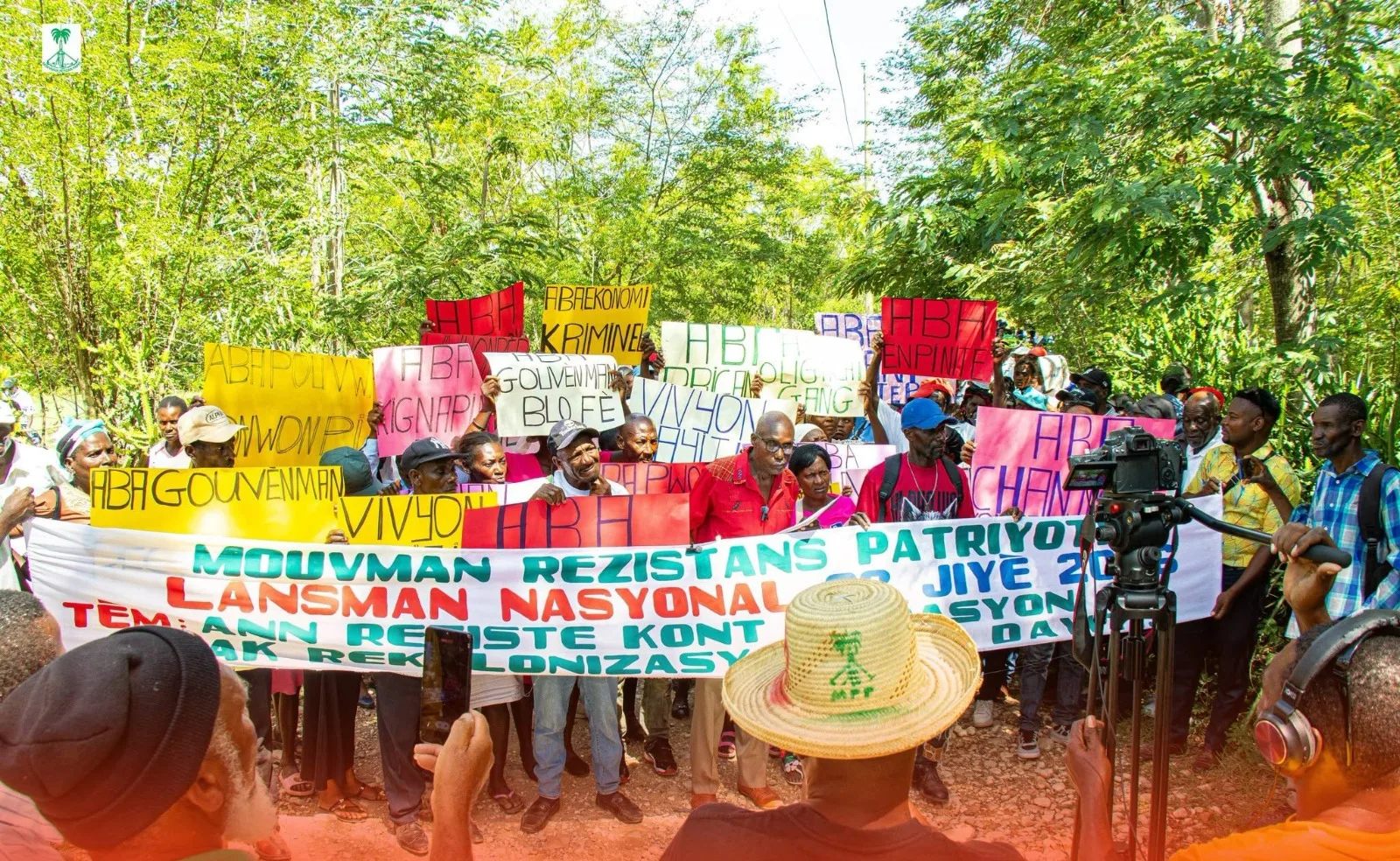
“These elections cannot happen in the current context of the country.” Jean William Jeanty, former senator and member of the left-wing Popular Patriotic Front (FPP) coalition, is categorical when commenting on the calendar published in July by the Provisional Electoral Council of Haiti (CEP), which establishes the date of December 13th for the first round of general elections. The election has been postponed for more than four years, in a context of unprecedented institutional crisis, and remains highly unlikely to be held this year.
There is no shortage of data to point out that the minimum conditions of security, logistics and circulation are not met for the free exercise of democracy. Armed conflicts have occurred weekly in and around the capital, and one and a half million internal refugees, driven from their neighborhoods by violence, remain far from their homes. The country’s main roads are blocked by gangs and the operation of state institutions, as well as hospitals, schools and universities, has been intermittent or suspended.
The Gang Repression Force (FRG) itself, a military operation launched in September last year by the United Nations, under American pressure, with the supposed objective of reestablishing security in the country, has not yet yielded any concrete results, not even a sign of optimism for this year. Its action plan, presented in June to the Security Council, sets a deadline of September 2028 to “create the minimum security conditions” that would allow the return of the rule of law.
In such a context, the electoral calendar defended by the government seems like nothing more than a strategy to gain time and remain in power, in the face of an international community that does not hide its concern. Measures “for the English to see”… and pay the bill! Fulfilling the electoral agenda also depends on external financing to cover its budget, estimated at 120 million dollars. Another reason for indignation on the part of the opposition: how can popular and national sovereignty be guaranteed if the country depends on imperialist “aid” to carry out its democratic processes?
The population on the margins of the process
It would be an understatement to say that the Haitian population is not excited about the prospect of new elections. Institutional politics, constantly besieged by foreign interventions or corruption by the country’s elite, have not aroused much enthusiasm for some time. The last general elections took place in 2016. At the time, only 18% of voters bothered to go to the polls and President Jovenel Moïse was elected with just over 500,000 votes – within a population of 11 million. Five years later, he was assassinated by foreign mercenaries.
This year, as part of the electoral agenda, the CEP announced that all voter registration cards used in the last election had expired and that it would be essential to obtain a new registration card to be able to vote in December. A requirement that, once again, is at odds with the country’s current reality, in which traveling to an electoral center can be life-threatening.
“Haiti has between 6 and 7 million potential voters,” explains Jeanty. “Currently, we have around four thousand people signing up every day [para tirar o título]. The deadline to register is 85 days. This means that, continuing at this pace, only 340 thousand citizens will have a title in hand when the deadline ends! Will they want to hold elections with only 340,000 voters? The truth is that the population is not interested!”
From the point of view of political parties, the situation is more complex. More than 320 parties have already registered to participate in these elections. They are organized into 18 platforms (or federations). Few, however, represent the left, as most parties in the popular camp have refused to join the game in what they denounce as a democratic masquerade.
“There is no point rushing to hold an election in which there is no chance of people deciding something. It is not the priority. We need to find solutions to the problems of security, unemployment, the crisis, justice… Society’s priority today is to reestablish peace, organize a true dialogue, so that the country can stand on its own two feet”, insists Jeanty.
The questions led, at the beginning of August, to the construction of the Patriotic Resistance Movement, of which Jeanty is part. Alongside progressive political parties, unions, peasant organizations, feminist and social movements, it strives to define a new project for the country, based on grassroots work, and against the neo-colonization project implemented by the government.
The legal framework
In addition to the political and logistical doubts associated with the electoral calendar, the legal framework of the election itself presents contradictions. Firstly, because the pressure exerted by the government on the Provisional Electoral Council has already exceeded the limits of the latter’s independence, sparking widespread indignation in the political sphere.
“Through control of financial, administrative and security levers, the Executive exerts constant pressure on the members of the CEP”, expressed the Progressive Opposition (Centrist) group in a letter addressed to the Provisional Electoral Council itself. “The attempts at independence by some councilors quickly come up against threats of dismissal or marginalization, enshrining the pre-eminence of an omnipotent Executive over the electoral arbiter.”
Another element of inconsistency is the intention to hold, alongside the general elections, a constitutional referendum that would alter the country’s institutions. The content of these changes is not yet known, but the result of the referendum itself could annul the results of the elections. It would be possible to elect deputies and senators and, on the same day, vote on a constitutional project that would change the composition and responsibilities of the Chamber and the Senate.
Finally, it is essential to look at the diaspora, which is completely separated from this electoral process. It is estimated that between two and four million Haitians live abroad, contributing around 25% of GDP through remittances. However, CEP planning does not provide for any provision for voting in embassies, consulates or remotely to guarantee the rights of these citizens.
In a press release, the Nou Bouke collective, which brings together Haitians living in different countries, considers the idea of holding elections in the current context and without the participation of the diaspora to be “scandalous”. “Excluding from the electoral process millions of Haitians who contribute each year to the country’s economic survival represents an immense injustice and a true assault on democracy. Such exclusion leads to questioning the representativeness of the scrutiny and the legitimacy of future elected officials.”
Source: www.brasildefato.com.br