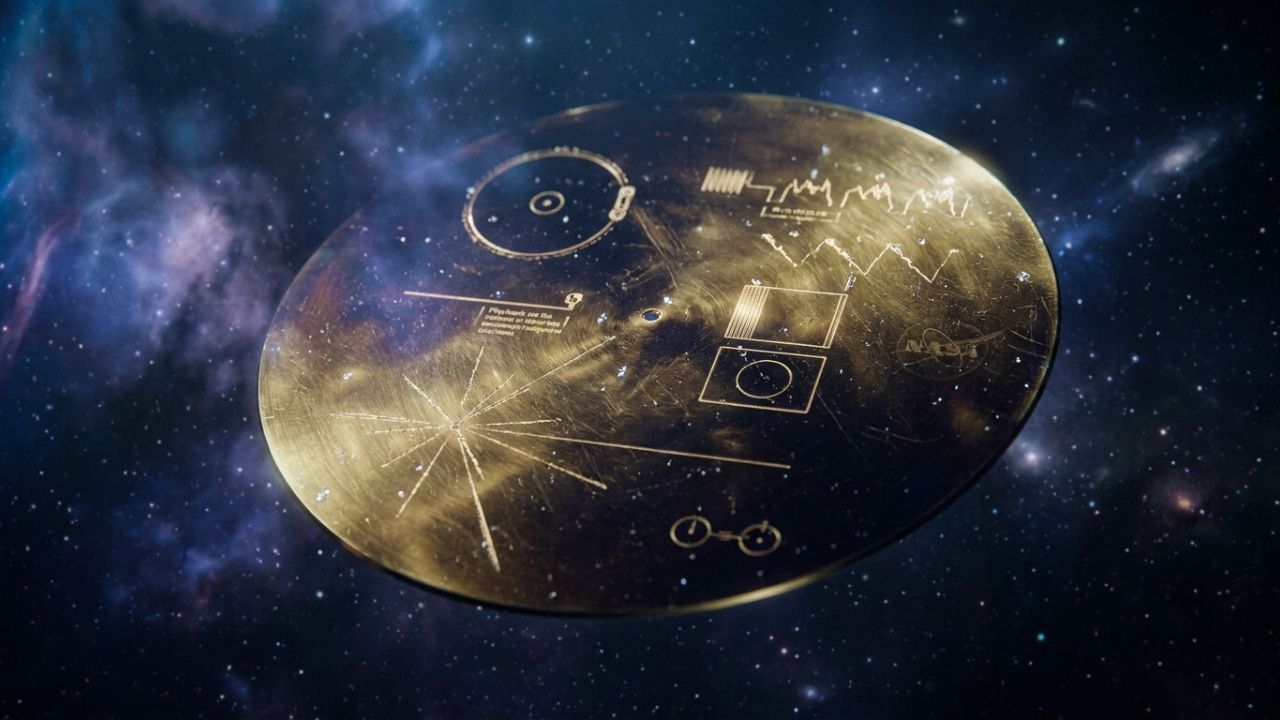
In the vast, silent expanse of interstellar space, two tiny emissaries from Earth continue their eternal journey. Launched in 1977, Voyager 1 and Voyager 2 have long since surpassed the boundaries of our solar system, entering the mysterious realm of interstellar space. Bolted to the side of each spacecraft is an object that has captured the imagination of scientists, artists, and dreamers for nearly five decades: the Voyager Golden Record. This 12-inch gold-plated copper phonograph record is far more than a simple time capsule or a collection of sounds and images. It is a complex, layered artifact containing a secret message, a hidden grammar of communication designed to bridge the unimaginable gap between human civilization and any extraterrestrial intelligence that might one day intercept it. While popular culture often focuses on the Chuck Berry tracks or the greetings in fifty-five languages, the true genius of the Golden Record lies not in its content alone but in the sophisticated, mathematical key required to unlock it. The secret message is not a sentence written in English; it is the universal language of physics itself, encoded in the very structure of the artifact.
🔢 The Universal Key: Hydrogen as the Rosetta Stone
The most profound secret hidden within the Voyager Golden Record is the method of its own decoding. The designers of the record, led by the visionary astronomer Carl Sagan and his team at Cornell University, faced an insurmountable problem. How does one communicate with a being that shares no biological, cultural, or linguistic history with humanity? Any attempt to use human symbols, alphabets, or even pictographs would be hopelessly anthropocentric and likely unintelligible. The solution was to anchor the entire message in the only thing we can be reasonably certain any advanced technological civilization would understand: the fundamental laws of nature.
The cover of the Golden Record bears a series of cryptic diagrams that serve as the instruction manual. The cornerstone of this manual is a depiction of the hyperfine transition of neutral hydrogen. Hydrogen is the most abundant element in the universe, and its ground state electron spin flip emits radiation at a precise frequency of 1,420 megahertz, corresponding to a wavelength of 21 centimeters. This physical constant serves as the universal unit of measurement for the entire record. By defining this specific transition as the base unit of time and length, the creators established a Rosetta Stone grounded in astrophysics rather than human convention. Every other measurement on the cover, from the size of the record to the duration of the audio tracks, is expressed as a multiple or fraction of this hydrogen standard. The secret message here is clear: intelligence is recognized through the shared comprehension of natural law. If a finder can understand the hydrogen diagram, they possess the cognitive framework necessary to decode everything else. Without this key, the Golden Record is nothing more than a shiny, grooved disc. With it, the disc transforms into a portal.
💿 The Architecture of Analog Intelligence
Another layer of the hidden message resides in the deliberate choice of analog technology over digital encoding. In the late 1970s, digital media was in its infancy, but the Voyager team consciously rejected it in favor of a traditional phonograph format. This decision was not born of nostalgia but of strategic communication theory. Digital formats are arbitrary constructs; they require specific hardware architectures, software protocols, and binary logic conventions that are entirely dependent on human engineering choices. An alien civilization might have developed computing systems based on ternary logic, quantum states, or biological substrates that bear no resemblance to silicon-based binary processing. A CD or a USB drive would likely be indecipherable.
Analog sound waves, however, are a direct physical representation of acoustic energy. The groove in the record is a topographical map of air pressure variations. Even if the finders have never encountered a phonograph, the relationship between the physical undulation of the groove and the concept of vibration is a mechanical truth that transcends specific technological paradigms. The secret message embedded in this format choice is one of accessibility and patience. It invites the finder to engage with the artifact physically, to trace the contours of human experience through tactile exploration before achieving auditory comprehension. Furthermore, the record’s rotation speed is specified on the cover using the hydrogen time unit, ensuring that the playback rate can be reconstructed precisely. If played too fast or too slow, the audio would be distorted beyond recognition. The correct speed restores the voices, music, and natural sounds to their intended form, rewarding the decoder’s understanding of the universal constants with the revelation of earthly culture.
🌌 The Pulsar Map: A Cosmic Address in Time
Perhaps the most famous yet frequently misunderstood secret on the Golden Record cover is the pulsar map. This radial diagram displays fourteen lines emanating from a central point, each marked with a unique binary code. To the untrained eye, it appears to be abstract art or a stylized sunburst. In reality, it is a precise galactic positioning system and a timestamp rolled into one. The central point represents our Sun, and each line points toward a known pulsar, a rapidly rotating neutron star that emits beams of electromagnetic radiation with extraordinary regularity.
Pulsars are the lighthouses of the cosmos. Their rotation periods are so stable that they rival atomic clocks in precision. The binary numbers along each line indicate the period of that specific pulsar, again expressed in units of the hydrogen transition. Because pulsars gradually slow down over millions of years, their current rotation rates serve as a temporal fingerprint. An advanced civilization discovering the record could measure the current periods of these same pulsars, compare them to the values etched on the cover, and calculate exactly when the spacecraft was launched. Simultaneously, by triangulating the relative positions and distances of the fourteen pulsars, they could determine the origin point of the probe within the Milky Way galaxy with remarkable accuracy.
The secret message of the pulsar map is twofold. First, it says, “We know where we are, and we know what time it is.” It demonstrates that humanity had achieved a level of astronomical sophistication sufficient to map our neighborhood using the most extreme objects in the universe. Second, and more poignantly, it acknowledges the passage of time. The creators understood that the record might drift for billions of years. Stars will move, constellations will distort, and Earth itself may become uninhabitable or unrecognizable. The pulsar map ensures that even if our planet is gone, our location in spacetime remains legible. It is a declaration of existence that outlasts the existence of the declarer.
🎨 Visual Grammar and the Binary Image Secret
The Golden Record contains 115 images encoded as analog waveforms, another deliberate choice that hides a message about the nature of perception. These images are not stored as discrete pixels in a digital file but as continuous signals that must be reconstructed line by line. The instructions for this reconstruction are provided on the cover, showing how to convert the audio signal back into a visual raster. The first image encoded on the record is actually a calibration circle, followed by scientific diagrams, photographs of human anatomy, landscapes, animals, and scenes of daily life.
The secret within this visual encoding scheme is the assumption of shared sensory processing. Vision, as we understand it, is the detection of electromagnetic radiation in a specific spectrum. By encoding images as waveforms that can be converted into spatial patterns, the creators bet on the likelihood that any species capable of building interstellar probes would also possess some form of spatial sensing analogous to sight. The images themselves follow a careful pedagogical sequence, moving from abstract scientific concepts to concrete biological forms to complex social behaviors. This progression mirrors the development of human knowledge and subtly communicates our intellectual priorities. We chose to show mathematics and physics before art and emotion, signaling that reason is the foundation upon which our culture is built. Yet the inclusion of diverse human faces, meals, childbirth, and musical performance reveals that we are not merely calculators but beings who feel, create, and connect. The hidden message is that science and humanity are not separate domains but intertwined expressions of the same cosmic curiosity.
💰 The Economic Impossibility and the Value of Legacy
When discussing the Voyager Golden Record, it is essential to address the economic context of its creation, translating the historical costs into modern terms to appreciate the scale of the endeavor. The total cost of the Voyager program was approximately $865 million at the time of launch. Adjusted for inflation and converted to current dollars, this represents an investment exceeding $4 billion today. The Golden Record itself, while a small fraction of the total budget, required specialized manufacturing, gold plating, and rigorous testing to survive the rigors of space travel. The electroplating process alone, performed by a specialized contractor, cost roughly $15,000 in 1977, which equates to approximately $75,000 in today’s currency. The custom aluminum protective case with its beryllium coating added another $20,000 then, or about $100,000 now.
These figures, while substantial, pale in comparison to the symbolic value of the artifact. No amount of money can purchase immortality, yet for less than $200,000 in today’s dollars, humanity created an object that may outlast our species by eons. The economic secret hidden in these numbers is the prioritization of legacy over utility. In an era of Cold War tensions and terrestrial crises, the United States government allocated resources to send a love letter to the unknown. This allocation was itself a message: that despite our flaws, conflicts, and limitations, we deemed it worthwhile to reach out. The conversion from historical reais or dollars to present-day currency underscores that the true cost was never financial but existential. We spent not just money but hope, projecting our best selves into the void with no expectation of return.
🕊️ The Silence Between the Notes: What We Chose Not to Say
Every act of communication involves selection, and every selection implies exclusion. One of the most haunting secrets of the Voyager Golden Record is what it omits. There are no images of war, poverty, disease, or environmental degradation. There is no mention of nuclear weapons, colonialism, or systemic inequality. Critics have argued that this presents a sanitized, dishonest portrait of humanity. However, this curation is itself a deliberate and meaningful message. The record was never intended to be a comprehensive encyclopedia or a journalistic documentary. It is a greeting, a gesture of goodwill extended across the abyss.
Just as a person introducing themselves to a stranger does not immediately recount their traumas and failures, humanity chose to lead with its aspirations rather than its atrocities. The secret message of the omissions is not deception but diplomacy. It reflects a conscious decision to represent what we wish to be rather than solely what we have been. In the cold vacuum of space, where survival is uncertain and connection is miraculous, the choice to emphasize beauty, harmony, and creativity is an act of defiance against despair. It suggests that even if we fail to sustain ourselves on Earth, the ideals we reached for deserve to endure. The silence between the notes speaks of regret, yes, but also of redemption. It acknowledges that we are imperfect messengers carrying a perfect intention.
⏳ The Eternal Present: A Message That Outlives Its Senders
As Voyager 1 travels farther from the Sun at a speed of over 38,000 miles per hour, the Golden Record continues its silent vigil. It will take approximately 40,000 years to pass within 1.6 light-years of the star Gliese 445, and hundreds of thousands of years more to encounter another stellar system. By then, the English language will have evolved beyond recognition or vanished entirely. The nations that funded the mission may have dissolved. The very concept of “humanity” may have transformed into something unrecognizable. Yet the hydrogen transition will remain constant. The pulsars will still tick, albeit slower. The grooves will still hold the shape of a mother’s lullaby and a thunderstorm.
The ultimate secret message of the Voyager Golden Record is that meaning can transcend mortality. It is a testament to the belief that consciousness, once awakened, leaves an indelible mark on the fabric of reality. Whether anyone ever finds it, decodes it, or understands it is almost secondary to the fact that it exists. The act of sending the message was the message. In crafting this golden whisper, we declared that we were here, that we mattered, and that we believed the universe was a place where such declarations could, against all odds, be heard. The record is not merely a bottle thrown into the cosmic ocean; it is proof that we learned to swim, to build, to sing, and to hope. And in the endless dark, that proof shines brighter than any star.