For nearly a century, the Big Bang has stood as the leading scientific explanation for the origin of our observable universe. According to modern cosmology, everything we see today, from galaxies and stars to planets and people, emerged from an unimaginably hot and dense state approximately 13.8 billion years ago.
Yet one question continues to fascinate scientists, philosophers, and the public alike:
What came before the Big Bang?
At first glance, the question seems straightforward. Every event in our daily lives has a cause. Every story has a beginning. Every effect follows something that came before it. However, the universe may not follow the same rules as everyday experience.
Some physicists argue that time itself began with the Big Bang, making the idea of “before” meaningless. Others believe our cosmic history stretches much further into the past, hidden behind a veil that current observations cannot yet penetrate.
Over the decades, researchers have proposed a variety of theories that attempt to explain what, if anything, existed before the universe burst into existence. Some are grounded in advanced mathematics and physics. Others remain highly speculative. None have yet been confirmed.
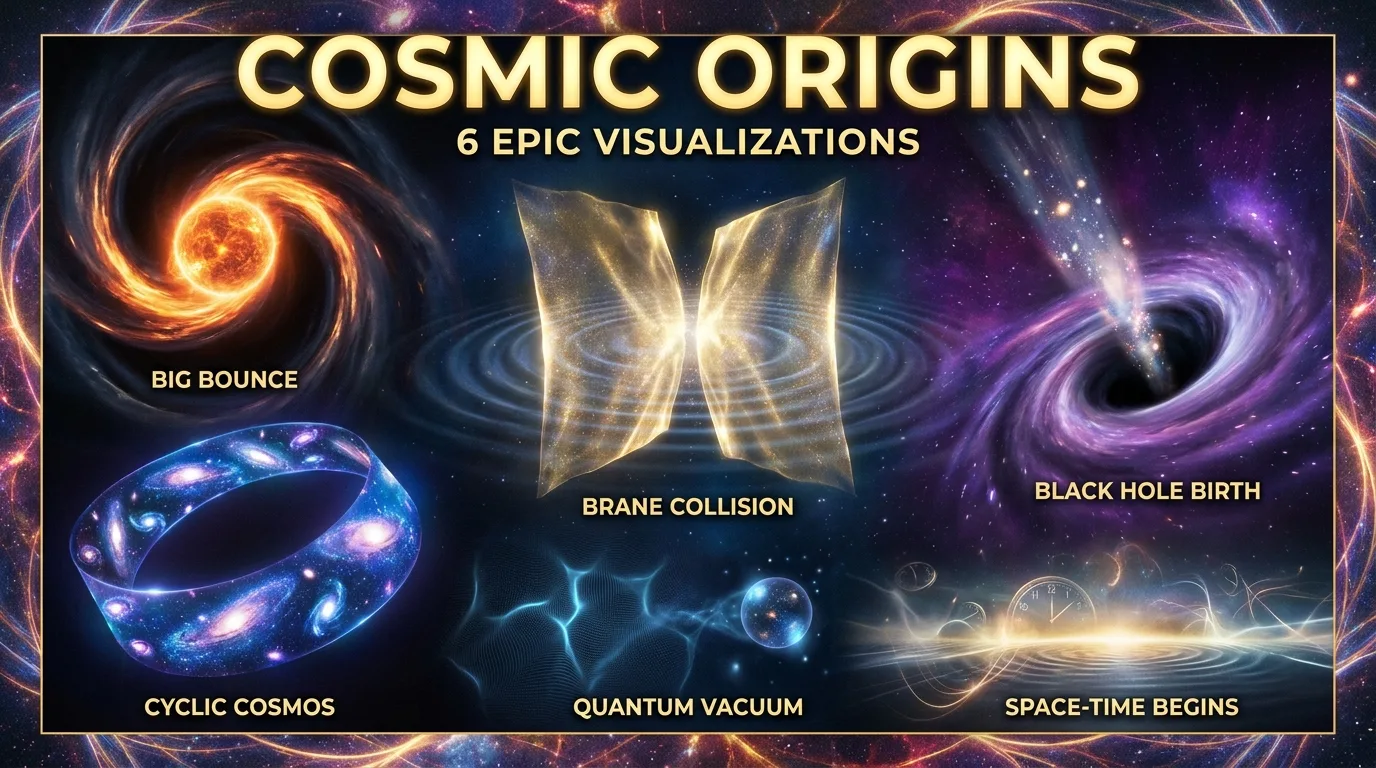
Here are six of the most intriguing theories about what may have come before the Big Bang.
🔄 1. The Big Bounce: A Universe Reborn
One of the most widely discussed alternatives to a cosmic beginning is known as the Big Bounce theory.
Instead of the universe emerging from absolute nothingness, this idea suggests that our cosmos is the result of a previous universe that collapsed in on itself.
According to traditional Big Bang models, tracing cosmic expansion backward leads to a singularity, a point of infinite density where the laws of physics break down. Many physicists view singularities as signs that current theories are incomplete.
The Big Bounce attempts to solve this problem.
In this model, the universe undergoes cycles of contraction and expansion. A previous cosmos slowly shrank over billions or even trillions of years. As matter became increasingly compressed, quantum effects prevented a true singularity from forming. Rather than collapsing into an infinitely small point, the universe “bounced,” triggering a new phase of expansion.
The result would be the universe we inhabit today.
Supporters of the theory point to developments in quantum gravity, an area of physics that seeks to reconcile Einstein’s theory of relativity with quantum mechanics. Some versions of quantum gravity naturally produce bouncing universes instead of singularities.
If the Big Bounce is correct, our universe may be only the latest chapter in an endless cosmic cycle. Every Big Bang could represent the rebirth of a previous universe.
The challenge is that evidence remains elusive. Scientists continue searching for subtle patterns in cosmic background radiation that might reveal traces of a pre-existing universe.
For now, the Big Bounce remains a compelling possibility that replaces a cosmic beginning with a cosmic renewal.
♾️ 2. The Cyclic Universe: Endless Cosmic History
Closely related to the Big Bounce is the concept of a cyclic universe.
In this scenario, the cosmos does not experience a single bounce but an infinite series of expansions and contractions. The universe repeatedly grows, evolves, collapses, and starts over.
The idea is surprisingly old. Ancient cultures often imagined reality as a recurring cycle rather than a linear progression. Modern physics has given this ancient intuition a mathematical framework.
Some cyclic models propose that after expansion slows, gravity eventually pulls everything back together. The universe contracts into an extremely dense state before triggering another Big Bang.
Other versions suggest more complex mechanisms involving extra dimensions or exotic forms of energy.
One of the attractions of cyclic cosmology is that it eliminates the need for a true beginning. If the cycle has been occurring forever, then there may never have been a first universe.
This approach also addresses philosophical questions that arise when discussing creation. Instead of asking how the universe emerged from nothing, cyclic models imply that existence itself is eternal.
However, significant obstacles remain.
Observations indicate that the expansion of the universe is accelerating because of a mysterious phenomenon known as dark energy. If dark energy continues to dominate cosmic evolution, the universe may never reverse into a contraction phase.
Researchers continue to refine cyclic theories to account for these observations. Although not currently the mainstream view, cyclic cosmology remains one of the most fascinating attempts to extend cosmic history beyond the Big Bang.
🧵 3. The Multiverse Collision Theory
What if our universe is only one among countless others?
The multiverse concept has become one of the most influential ideas in theoretical physics. While different versions exist, some suggest that our Big Bang was triggered by a collision between larger cosmic structures.
One prominent variation emerges from string theory.
String theory proposes that the fundamental building blocks of nature are tiny vibrating strings rather than point-like particles. The mathematics often requires additional spatial dimensions beyond the familiar three.
In certain models, entire universes exist on vast multidimensional surfaces called branes. These branes can move through higher-dimensional space.
According to the theory, our universe began when two such branes collided.
The collision released enormous amounts of energy, creating conditions similar to those associated with the Big Bang. Matter, radiation, and the structure of our cosmos emerged from this cosmic impact.
If true, the Big Bang would not represent the birth of everything. Instead, it would be one event within a much larger and older reality.
The multiverse framework offers intriguing explanations for several puzzles in cosmology. It could potentially account for why the laws of physics appear finely tuned for the existence of galaxies, stars, and life.
Yet the theory faces a major challenge.
Other universes may be fundamentally inaccessible. If they cannot be observed directly, testing the theory becomes extraordinarily difficult.
Despite this limitation, multiverse scenarios remain among the most actively discussed possibilities in modern theoretical physics.
⚛️ 4. Quantum Creation from Nothing
Among the most controversial ideas is the proposal that the universe emerged from “nothing.”
At first, this seems to violate common sense. How can something arise from absolutely nothing?
Physicists who advocate this view emphasize that the scientific meaning of “nothing” differs from the everyday definition.
In quantum physics, empty space is not truly empty. Even the vacuum contains fluctuating fields and temporary particles that appear and disappear constantly. These quantum fluctuations are an established feature of nature.
Some researchers suggest that the universe itself could have originated from a quantum fluctuation.
Under certain conditions, a tiny quantum state might spontaneously emerge. Inflation, a period of extraordinarily rapid expansion thought to have occurred shortly after the Big Bang, could then magnify that microscopic seed into an entire universe.
Theoretical physicists such as Alexander Vilenkin and others have explored mathematical models in which a universe can tunnel into existence through quantum processes.
In these frameworks, no previous universe is required.
Critics argue that the theory may simply shift the question elsewhere. If quantum laws enabled the universe to emerge, where did those laws come from?
Supporters counter that physical laws may be fundamental features of reality, requiring no external explanation.
The debate highlights one of the deepest tensions in cosmology. Even when physics offers a mechanism, philosophical questions often remain.
Nevertheless, quantum creation models continue to occupy an important place in scientific discussions about cosmic origins.
🕳️ 5. A Black Hole Birth Scenario
One of the most imaginative proposals suggests that our universe may have formed inside a black hole.
Black holes are regions of space where gravity becomes so intense that nothing, not even light, can escape. At their centers, according to classical physics, lie singularities.
Some researchers have wondered whether these singularities might not represent endings but beginnings.
In certain theoretical models, the interior of a black hole could create a new expanding region of space-time. To observers inside that region, the event might appear as a Big Bang.
This means our universe could potentially exist within a black hole located in a larger “parent” universe.
The idea gains additional intrigue because black holes are common throughout the cosmos. If every black hole can generate a new universe, reality could consist of a vast cosmic family tree.
Each universe would give birth to others through black hole formation.
Some physicists have even proposed a form of cosmic evolution. Universes that produce many black holes would create more offspring universes, making their physical laws increasingly common over time.
Although highly speculative, the theory connects two of the most profound mysteries in physics: black holes and cosmic origins.
At present, no observational evidence confirms that black holes generate new universes. However, the concept continues to inspire research into the nature of gravity, singularities, and space-time.
The possibility that our entire cosmos exists inside a black hole remains one of the most astonishing ideas ever proposed.
⏳ 6. There Was No “Before”
Perhaps the most radical possibility is also the simplest.
What if there was no “before” at all?
According to Einstein’s theory of relativity, space and time are intertwined into a single structure known as space-time. Many cosmologists argue that time itself began with the Big Bang.
If this is correct, asking what happened before the Big Bang may be like asking what lies north of the North Pole.
The question assumes the existence of something that does not exist.
In this view, the Big Bang was not an explosion occurring within time. It was the origin of time itself.
Without time, concepts such as earlier, later, cause, and effect lose their meaning.
This perspective has been defended by numerous physicists, including Stephen Hawking in some of his work on cosmology.
One analogy compares the universe to the surface of Earth. Just as the North Pole marks the northernmost point without requiring anything farther north, the beginning of cosmic time may represent a boundary rather than an event preceded by another event.
For many people, this idea is deeply counterintuitive.
Human beings naturally think in terms of sequences and causes. We expect every event to have a prior explanation. The notion that time itself emerged at the Big Bang challenges those assumptions.
Yet modern physics repeatedly demonstrates that reality can behave in ways that defy intuition.
If time truly began with the Big Bang, then the search for a pre-Big Bang universe may ultimately be searching for something that never existed.
🔭 Why Scientists Still Don’t Know
Despite remarkable advances in astronomy and physics, scientists face a fundamental obstacle.
The early universe was extraordinarily dense and hot. Conditions near the Big Bang exceed the limits of current theories. General relativity describes gravity on large scales, while quantum mechanics governs the microscopic world. Researchers still lack a complete theory that unifies the two.
Without such a framework, understanding the universe’s earliest moments remains difficult.
Observations can only take us so far. The cosmic microwave background, often described as the afterglow of the Big Bang, provides a snapshot of the universe roughly 380,000 years after its beginning. Earlier epochs are much harder to study directly.
Future observatories, gravitational-wave detectors, and advances in theoretical physics may reveal clues hidden in the fabric of space-time itself.
Researchers hope these discoveries will help determine which, if any, of the proposed scenarios is correct.
🌠 The Search Continues
The question of what came before the Big Bang sits at the frontier of human knowledge.
Some theories envision an eternal cycle of cosmic rebirth. Others propose collisions between universes, quantum creation events, or black hole origins. Still others argue that the concept of “before” has no meaning because time itself began with the universe.
At present, none of these ideas has been conclusively proven.
What makes the mystery so compelling is that it touches on some of humanity’s oldest questions: Why does the universe exist? Has it always existed? Is our cosmos unique, or one among countless others?
As new technologies probe deeper into the cosmos and theoretical breakthroughs reshape our understanding of reality, answers may eventually emerge.
Until then, the moments preceding the Big Bang remain one of science’s greatest unsolved mysteries, a reminder that even after centuries of discovery, the universe still holds secrets beyond our imagination.