Published 05/05/2026 10:54 | Edited 05/06/2026 08:35
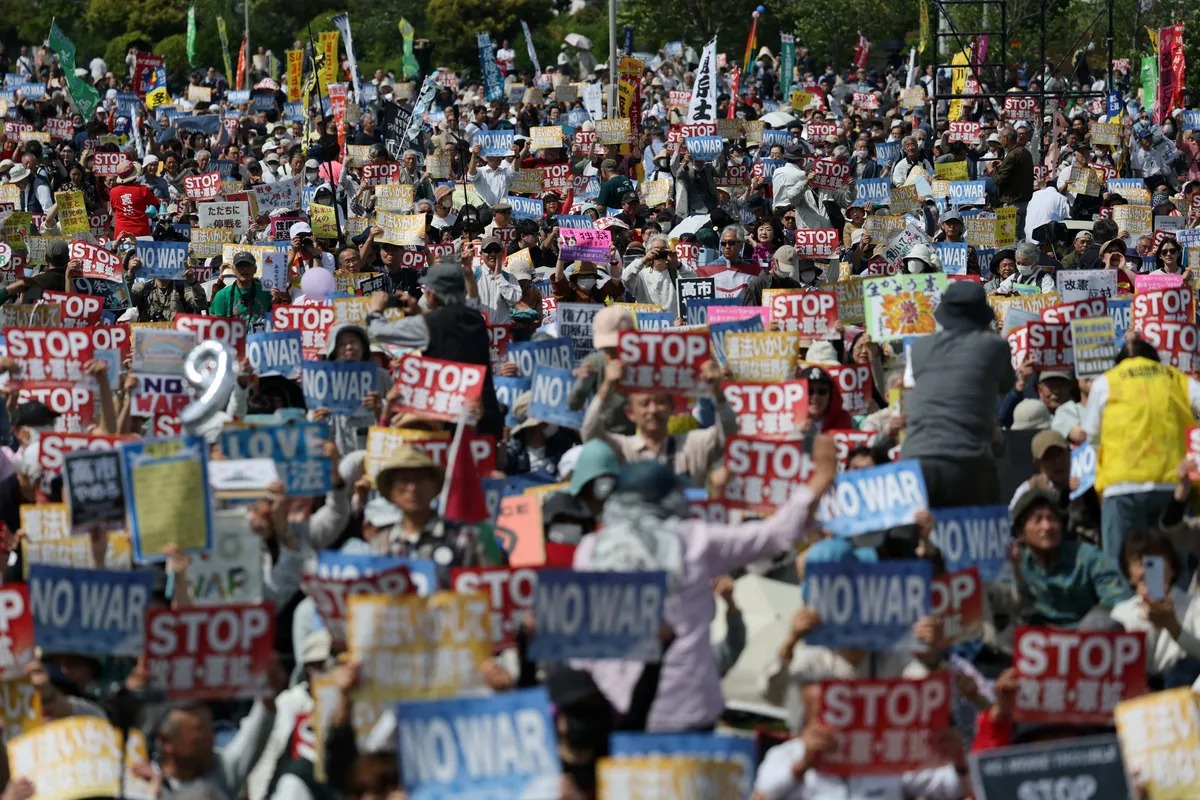
Around 50,000 people gathered in Tokyo on Sunday (3) to protest against the Japanese government’s intention to modify the current Constitution with the argument of facing international threats.
The proposal, defended by Prime Minister Sanae Takaichi, includes changes to Article 9 — which establishes the country’s pacifist character — to incorporate the Self-Defense Forces into the constitutional text.
The demonstrations, which have been multiplying since February in several cities, express rejection of the measure and what participants see as a change in Japan’s historical commitment to not using war.
“Under Takaichi, Japan is following the United States like a dog following its owner,” said Hiroko Maekawa, a Tokyo ward councilor. “The PLD wants to transform the Self-Defense Forces into a traditional army, because it knows that the Constitution, as it stands, prevents this.”
Another local councilor, Megumi Koike, described the Japanese Constitution as “a national treasure and a treasure for the world.”
“Takaichi believes that the majority of Japanese people want to change the Constitution because of a supposed threat from China and North Korea, but that is not true,” he said. “We should invest in health, education and jobs, not more weapons.”
Demonstrations also took place in dozens of other cities, bringing together people who experienced the post-war period and associate the Constitution with stability and peace.
“I want to preserve the Constitution as if it were my own child and pass it on to the next generations,” said Haruka Watanabe, 87, during a protest in Osaka, according to Kyodo News agency.
The protesters’ reading is that the constitutional revision proposal also responds to external pressure, especially from the United States.
Criticism appears on the streets associated with the Sanae Takaichi government’s alignment with Washington’s military strategy in the region, amid increased tensions in the Indo-Pacific.
Despite the rejection expressed in the demonstrations, recent research indicates a society divided on the issue.
A survey by the Yomiuri Shimbun shows that 57% of those interviewed support some type of revision of the Constitution, while a survey by the Asahi Shimbun records 47% in favor of the reform.
In force since May 3, 1947, the Japanese Constitution has remained unchanged since its promulgation.
Its core is Article 9, which establishes the pacifist character of the State and determines the renunciation of war as a sovereign right. The device was instituted during the North American occupation led by General Douglas MacArthur, in the context of the country’s reorganization after the Second World War.
Japan was defeated in the conflict and underwent reorganization under United States occupation, after having joined the axis led by Nazi Germany and Fascist Italy.
During this period, the country had expanded its dominance over parts of Asia, including Chinese territories, a context that directly influenced the adoption of a Constitution with restrictions on the use of military force.
China protests against Takaichi’s militarism
The eventual revision of this article is accompanied by concern and protests by countries in the region, especially China.
Beijing has warned of what it considers a resumption of Japanese militarism, associating the changes with expanded military cooperation with the United States and allies in the Indo-Pacific.
Chinese authorities say that initiatives such as the relaxation of arms export rules and the debate over the role of the Self-Defense Forces pose risks to regional stability.
In recent episodes, the Chinese government classified Takaichi’s statements about Taiwan as “interference in China’s internal affairs” and reiterated the one-China principle as the basis of bilateral relations.
For Beijing, any advance by Japan towards a more active military role, especially in sensitive issues such as the Taiwan Strait, breaks historical commitments made in the post-war period and increases the risk of escalation in the region.
Source: vermelho.org.br