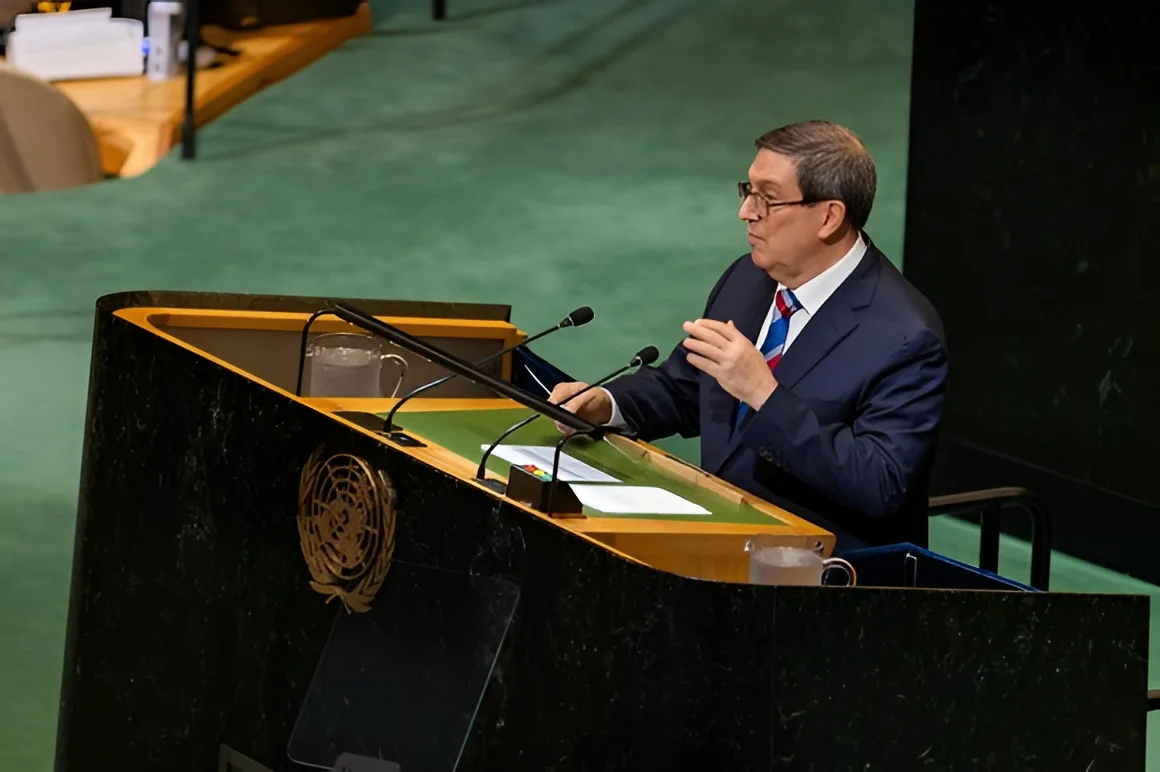
The United States failed this Tuesday (7) in an attempt to prevent the UN General Assembly from debating the escalation of aggression that, according to Cuba, Washington has been promoting against the island.
The debate in the UN’s main deliberative body was requested by Havana, which presented a formal request to include this specific topic on the agenda, with the aim of denouncing the blockade policy imposed by the White House.
At the beginning of the session, the United States representative at the UN, Jeff Bartos, expressly asked that the inclusion of the debate on the agenda be rejected and questioned the relevance of dedicating a new session of the General Assembly to the topic of the blockade against Cuba.
However, the United States’ position was defeated by a large majority. The initiative presented by Cuba to include the debate on the blockade received the support of 136 countries, while nine voted against — including the traditional votes of the United States and Israel, as well as Argentina, Costa Rica and Paraguay — and 30 states abstained.
During his speech to the Assembly, Cuban Foreign Minister Bruno Rodríguez Parrilla stated that the United States and, in particular, the State Department, “spread the lie that the blockade is not directed against the Cuban people, but only against the government.”
Furthermore, he maintained that Washington forces other States to break or reduce their relations with Cuba “not out of self-interest or commercial disadvantages, but because of the imposition of a foreign regime.” At the same time, he rejected any attempt to impose, from abroad, the country’s political system, economic model or international relations.
Rodríguez classified the blockade as “an unconventional multidimensional war, which has lasted almost seven decades”, and stated that “it has become more cruel and merciless in the last seven months”. In this context, he highlighted that the energy siege faced by Cuba worsened the humanitarian impacts on the population, causing a deterioration in the quality of life, the reduction of sources of subsistence and the limitation of possibilities for personal, family and social development.
The chancellor also denounced that Washington has been adopting “unprecedented measures of an extreme extraterritorial nature”, such as the expansion of so-called “secondary sanctions”, which threaten to punish any foreign entity that maintains commercial relations with Cuba.
Havana states that the current energy siege constitutes, in practice, a “naval blockade against Cuba” and, therefore, should be considered an “act of war”. At the same time, it denounces that obstructing the entry of humanitarian supplies violates the norms of international humanitarian law.
The United States blockade against Cuba is the longest in modern history. In force for more than six decades, it has undergone successive tightenings over the years. It is an instrument of economic warfare and political coercion that deliberately seeks to limit the island’s economic capacity with the aim of “forcing a change of government”. For more than 60 years, the blockade has been a state policy in Washington, regardless of changes in government, although with variations in its intensity.
Source: www.brasildefato.com.br