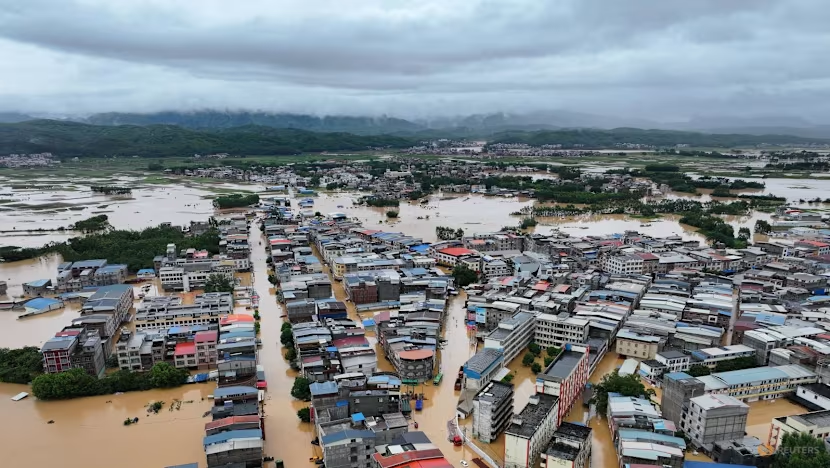
As Typhoon Maysak loses strength over southern China, the work of emergency teams continues to intensify on several fronts. This Monday (6), the Chinese government expanded operations to respond to the floods caused by the persistent rains that have accompanied the system since its arrival in the country. In Guangxi, one of the most affected regions, rivers remain above the safety level, a reservoir broke after days of intense rainfall and thousands of professionals remain mobilized to prevent further damage.
The most critical situation is concentrated in an axis that includes urban and rural areas of Guangxi, where soil saturation has rapidly raised the level of rivers and canals. In Nanning, the capital of the region, the maximum alert for floods was activated due to the advance of waters over residential areas and main roads. In cities like Guigang, entire neighborhoods were partially isolated after prolonged flooding and blockages on secondary roads.
In the city of Hengzhou, the partial rupture of a medium-sized reservoir led to the immediate evacuation of nearby communities and increased monitoring of other hydraulic structures. The authorities’ priority became to avoid cascading effects in drainage areas already overloaded by rain.
According to the state agency Xinhuathe State Flood Control and Drought Relief Headquarters upgraded the national emergency response in Guangxi to Level II. The measure strengthens coordination between the central government and local authorities, accelerating the dispatch of resources and concentrating teams in areas of greatest risk.
The Ministry of Emergency Management said 1,372 firefighters and national rescue team members were sent to Guangxi. Operations include 350 specialists, 270 vehicles, 140 vessels and two Wing Loong drones, used mainly for communication support, reconnaissance of isolated areas and coordinating rescues.
At the same time, the distribution of 150,000 humanitarian aid items began, including tents, folding beds, blankets and emergency kits for displaced families.
The National Development and Reform Commission confirmed the release of 100 million yuan (about R$76 million) for the reconstruction of essential infrastructure, focusing on roads, hospitals, schools and drainage systems damaged by the floods.
Although the winds have lost intensity, the main challenge now is the persistence of rain. Meteorologists from the China Meteorological Administration explain that the system, as it advanced over the continent, started to function as a moisture channel, maintaining intense precipitation in the south of the country. This pattern prolongs the risk of flooding, landslides and overflows, even after the cyclone weakens.
The typhoon reached the coast of Hainan province on Friday (3), causing interruptions to flights, rail and maritime transport, in addition to the preventive evacuation of residents in vulnerable areas. In Guangdong, more than 23 thousand people were evacuated, while in Guangxi the total number of displaced people reached around 48 thousand people.
After crossing Hainan, the system headed towards Guangxi and northern Vietnam, progressively losing strength, but maintaining a strong concentration of moisture. In recent days, this has caused new rapid rises in river levels and required continuous monitoring of dams and reservoirs in different parts of the region.
Images released by CCTV They show completely flooded streets, rescue teams using boats to reach isolated communities and containment work along rivers and unstable slopes. In some areas, residents have gradually begun to return to assess damage, while heavy machinery removes mud and debris.
For Chinese authorities, the scenario remains critical. The forecast is for continued rain in the south of the country, which keeps the risk of new flooding high. The focus is now divided between emergency response and preventing new collapses in infrastructure already under pressure from the accumulated volume of water.
Source: www.brasildefato.com.br