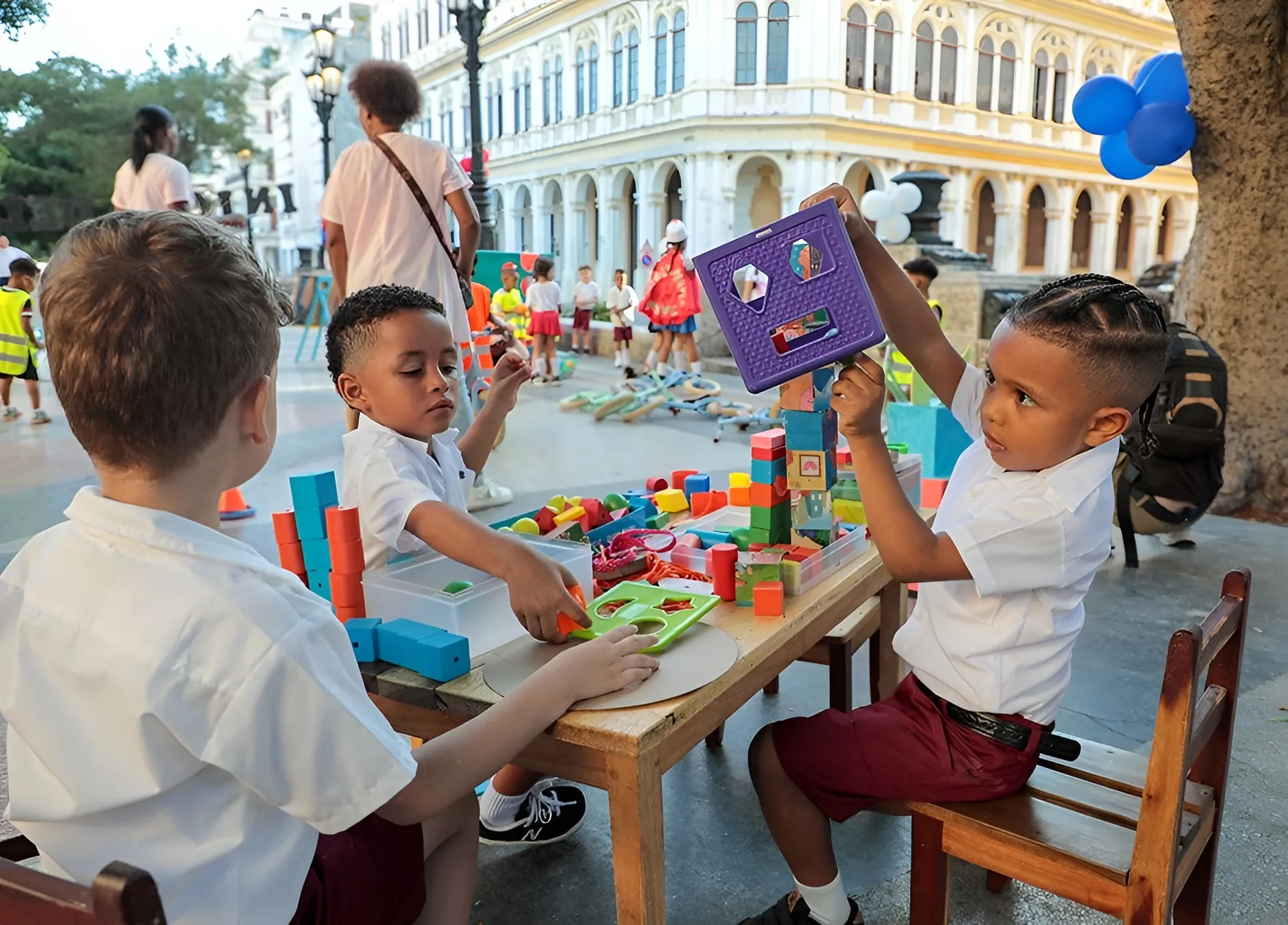
“Starting this school year is a response to the colonizing barbarity that they try to impose on us. It is the will of a people, of a Revolution”, stated Cuban President Miguel Díaz-Canel during the national event for the beginning of classes for the 2026-2027 cycle, held this Tuesday (1st) on Paseo del Prado, in Havana.
Amid the energy suffocation faced by Cuba, more than 1.4 million students returned to schools, countering a context of increasing difficulties, which had already forced the closure of the previous school year to be brought forward.
Díaz-Canel stated that the movement expresses a political, pedagogical and national will. “May knowledge and passion for learning be above any adversity. And I believe that, when this is achieved, when this victory is achieved in the classroom, in the conditions in which this was done, the greatness of a people and a nation is demonstrated.”
The opening of the new school period was presented by the authorities as a challenge that must be “sustained day after day”. The Minister of Education, Nayma Ariatne Trujillo Barreto, stated that the main challenge will be to guarantee the sustainability of the academic year and that the educational system will seek to ensure “as many face-to-face activities as possible”, although each institution organizes the process according to its own conditions.
The start of classes takes place after weeks of work to prepare schools and create the necessary conditions. Speaking to the press, Díaz-Canel highlighted the participation of Education management structures, bodies responsible for training, families, communities and different state institutions in this process.
He also stated that, for months, those responsible for Education, Higher Education and other training bodies have been working on developing alternatives to face the new academic year amid the energy blockade.
“The triumph is in the classrooms” is the slogan with which the Cuban authorities summarize the challenge of maintaining education in these conditions.
Between the difficulties and the commitment to not leave anyone without classes
On Paseo del Prado, among the people arriving to drop off their children, dressed in their traditional school uniforms, a young man draws attention. He arrives on an old, unpainted bicycle, with a girl hugging his back.
“In the morning, I drop my sister off at school by bicycle and, a few days a week, I go to teach at a high school a few kilometers away,” says Rubén Mendieva, a Physics student, to Brazil in fact.
Faced with a lack of teachers, Mendieva, like other university students, began teaching as a volunteer in high schools, in subjects related to her area of training. “I feel that this is the way I can help in this difficult situation. No one should be left without the possibility of studying”, he states.
While he tries, together with his friends, to reconcile volunteer activities with his day-to-day classes at university, he also faces difficulties studying. “We don’t have an internet connection or electricity, so it’s very difficult to keep in touch with teachers and study the bibliography of the subjects.”
The energy suffocation faced by Cuba permeates all areas of daily life and directly affects the functioning of the educational system. The lack of fuel has practically paralyzed public transport and keeps school transport out of operation, making it difficult for teachers and students to travel to educational centers.
This situation is compounded by instability in the electricity supply. Power cuts not only leave schools without lighting, but also affect basic services such as water pumping. Amid the heat of the Caribbean, interruptions in the power supply also make it difficult to refrigerate food intended for students.
Difficulties arising from the energy crisis affected the development of the previous academic year, which had to be ended early, in June. In some educational institutions, blended models were adopted to maintain teaching activities. Furthermore, during this period, universities were unable to hold face-to-face classes due to difficulties in maintaining student scholarships.
“Every day is a battle,” says Irene de León, an elementary school teacher. “Managing to get to school and making sure the children can get there too. Imagine: many times not having been able to sleep well, because of the heat at night or the tremendous difficulties that exist in the houses. And the same happens with us, as teachers. It is very difficult and very unfair what they are doing to our children”, he laments, with a trembling voice and on the verge of crying.
But, despite the difficulties, she guarantees that the teachers are determined to continue. “We have to move forward, carrying out the Revolution, educating as we have always done. This Revolution educated this country and we are not going to let them take away the most sacred thing we have, which is the education of our children”, he states.
Source: www.brasildefato.com.br