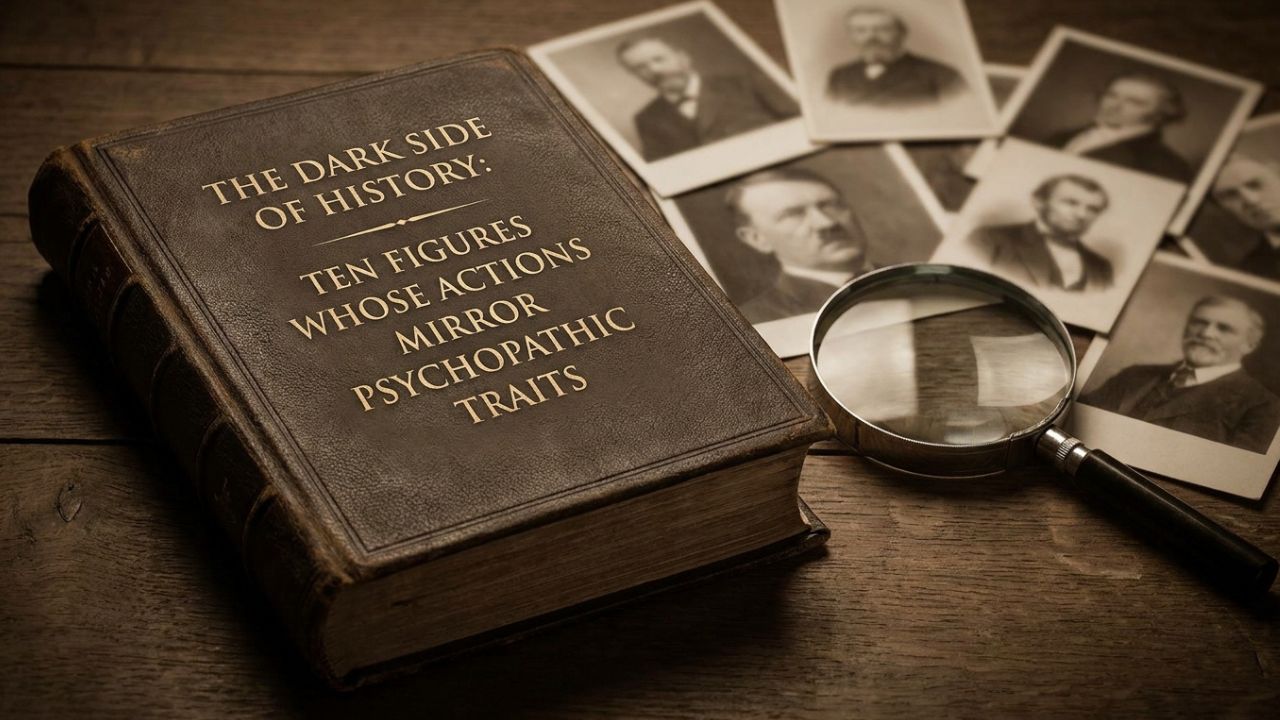
Throughout human history, certain individuals have risen to positions of power, influence, and notoriety. While many are celebrated for their achievements, others leave behind legacies marked by manipulation, cruelty, and a profound lack of empathy. Modern psychology offers tools to understand these behaviors through the lens of psychopathy, a personality disorder characterized by persistent antisocial behavior, impaired empathy and remorse, and bold, disinhibited, and egotistical traits. It is important to note that diagnosing historical figures posthumously is inherently speculative and controversial. However, examining their documented actions, writings, and the accounts of contemporaries can reveal patterns consistent with psychopathic tendencies. This exploration does not seek to demonize but to understand the complex interplay between personality, power, and historical impact.
Understanding Psychopathy in Historical Context
Psychopathy, as defined in contemporary clinical settings, involves a cluster of interpersonal, affective, lifestyle, and antisocial traits. Key features include superficial charm, grandiosity, pathological lying, manipulativeness, lack of remorse or guilt, shallow emotions, callousness, and a failure to accept responsibility for one’s actions. When applied to historical figures, we must exercise caution. Cultural norms, political necessities, and the brutal realities of different eras often demanded actions that might seem psychopathic by modern standards. Nevertheless, some individuals exhibited these traits to such an extreme degree, and with such personal gratification or indifference to suffering, that they stand out even within their own contexts.
The following ten figures, drawn from various periods and regions, displayed behaviors that align closely with core psychopathic characteristics. Their stories serve as cautionary tales about the dangers of unchecked power combined with a deficit of empathy.
1. Caligula (12-41 AD)
Gaius Julius Caesar Augustus Germanicus, better known as Caligula, ruled the Roman Empire from 37 to 41 AD. Initially popular, his reign quickly descended into tyranny and apparent madness. Ancient historians like Suetonius and Cassius Dio describe acts of extreme cruelty and capricious violence. Caligula reportedly ordered executions on whims, forced senators to run alongside his chariot, and allegedly planned to make his horse, Incitatus, a consul. His behavior suggests a profound lack of empathy, grandiosity, and impulsive aggression. He seemed to derive pleasure from humiliating and harming others, viewing people merely as objects for his amusement or obstacles to be removed. While some scholars argue his actions were exaggerated by hostile historians or influenced by illness, the pattern of erratic, cruel, and self-aggrandizing behavior remains striking.
2. Vlad III Dracula (1431-1476/77)
Vlad III, Prince of Wallachia, known as Vlad the Impaler, is the historical figure behind the Dracula legend. His primary method of execution was impalement, a slow and agonizing death. He used this tactic extensively against Ottoman invaders and internal rivals, creating forests of impaled bodies to terrorize enemies. While his actions were partly motivated by political strategy and defense against a powerful empire, the sheer scale and brutality suggest a deep-seated callousness and enjoyment of inflicting pain. Contemporary accounts describe him as ruthless, cunning, and devoid of mercy. His ability to orchestrate mass killings without apparent remorse aligns with psychopathic traits, particularly when viewed alongside reports of his personal cruelty towards individuals who displeased him.
3. Gilles de Rais (1405-1440)
A French nobleman and marshal of France, Gilles de Rais fought alongside Joan of Arc. However, he is infamous for the abduction, torture, and murder of hundreds of children over an eight-year period. His crimes were discovered only after financial difficulties led to investigations into his estates. De Rais confessed under threat of excommunication, detailing horrific acts of sexual abuse and murder. His case represents one of the earliest recorded instances of serial killing. The meticulous planning, the exploitation of his status to lure victims, the complete lack of empathy for the suffering of children, and the apparent satisfaction derived from these acts strongly indicate psychopathic pathology. His charm and high social standing masked a monstrous interior.
4. Leopold II of Belgium (1835-1909)
King Leopold II’s rule over the Congo Free State (1885-1908) stands as one of the most brutal colonial regimes in history. Under his personal control, millions of Congolese died due to murder, starvation, disease, and exhaustion while forced to harvest rubber. His agents employed systematic mutilation, including cutting off hands, to enforce quotas. Leopold presented himself as a humanitarian bringing civilization to Africa, a stark example of superficial charm and manipulative deceit. The immense wealth he extracted came at the cost of unimaginable suffering, which he largely ignored or denied. His ability to maintain this facade while overseeing genocide demonstrates a profound lack of remorse and empathy, driven by greed and a sense of entitlement.
5. Idi Amin (1928-2003)
Idi Amin, dictator of Uganda from 1971 to 1979, presided over a regime characterized by extreme violence, ethnic persecution, and economic mismanagement. Estimates suggest that between 100,000 and 500,000 people were killed under his rule. Amin was known for his unpredictable rages, public boasts about his exploits, and blatant disregard for human life. He expelled Asians from Uganda, seized their property, and targeted political opponents and specific ethnic groups. His grandiose self-image, referring to himself as “His Excellency, President for Life, Field Marshal Al Hadji Doctor Idi Amin Dada, VC, DSO, MC, Lord of All the Beasts of the Earth and Fishes of the Seas and Conqueror of the British Empire in Africa in General and Uganda in Particular,” exemplifies pathological grandiosity. His actions showed a complete absence of guilt or concern for the devastation he caused.
6. Marybeth Tinning (Case Study in Maternal Filicide)
While not a head of state, Marybeth Tinning’s case in the United States during the 1980s offers a chilling example of psychopathic traits in a domestic context. She murdered nine of her ten children, initially claiming they died from Sudden Infant Death Syndrome (SIDS). Her ability to deceive medical professionals, law enforcement, and her community for years highlights manipulativeness and superficial charm. The repeated nature of the crimes, the lack of visible grief, and her eventual confession revealing a desire for attention and control point towards severe personality pathology. This case underscores that psychopathic traits are not confined to political leaders but can manifest in any context where empathy is absent and manipulation thrives.
7. H.H. Holmes (1861-1903)
Herman Webster Mudgett, known as H.H. Holmes, is often cited as America’s first serial killer. He constructed a “Murder Castle” in Chicago during the 1893 World’s Fair, designed with soundproof rooms, gas lines, and chutes to dispose of bodies. Holmes targeted vulnerable individuals, particularly women, for insurance fraud and murder. His elaborate planning, charm in luring victims, and complete lack of remorse demonstrate classic psychopathic behaviors. He viewed people purely as means to financial gain, showing no empathy for their lives or families. His calculated approach and ability to maintain a respectable facade while committing heinous crimes exemplify the manipulative and predatory nature associated with psychopathy.
8. Lavrentiy Beria (1899-1953)
Lavrentiy Beria was a Soviet politician and chief of the NKVD, the secret police under Joseph Stalin. He played a central role in the Great Purge, orchestrating mass arrests, torture, and executions of perceived enemies of the state. Beria was known for his personal involvement in interrogations and his sadistic pleasure in inflicting pain. Survivors and colleagues described him as cold, calculating, and utterly devoid of empathy. He used his position to settle personal scores and indulge in criminal behavior, including abduction and rape. After Stalin’s death, Beria was arrested and executed, but his legacy remains one of terror and brutality. His ability to operate within the bureaucratic machinery of the Soviet state while personally engaging in cruelty highlights how psychopathic traits can thrive in authoritarian systems. Beria’s charm and administrative skill masked a deeply malicious nature, allowing him to rise to power and wield it with devastating effect.
9. Elizabeth Báthory (1560-1614)
Countess Elizabeth Báthory of Hungary is infamous for allegedly torturing and murdering hundreds of young peasant girls. Legends claim she bathed in their blood to preserve her youth, though historians debate the accuracy of this detail. Regardless, extensive testimonies and investigations confirmed her involvement in prolonged torture and murder. Her high social status allowed her to act with impunity for years. The cruelty inflicted, the targeting of vulnerable victims, and the apparent satisfaction derived from their suffering align with psychopathic traits. Her case illustrates how power and privilege can enable and mask extreme sadistic behavior.
10. Josef Mengele (1911-1979)
Known as the “Angel of Death,” Josef Mengele was a Nazi SS officer and physician at Auschwitz concentration camp. He conducted brutal and often lethal medical experiments on prisoners, particularly twins, without consent or regard for their suffering. Mengele approached his work with cold scientific detachment, viewing human subjects as mere data points. His charm and demeanor reportedly fooled some prisoners initially, but his actions revealed profound callousness and a complete lack of empathy. He escaped justice after the war, living freely in South America, showing no remorse for his crimes. His case exemplifies how psychopathic traits can manifest within institutional frameworks, enabling large-scale atrocities under the guise of science or duty.
Reflections on Power and Pathology
Examining these figures through the lens of psychopathy raises important questions about the nature of power, leadership, and human behavior. While not all leaders who commit atrocities are psychopaths, and not all psychopaths become leaders, the combination of psychopathic traits with access to power can have devastating consequences. The lack of empathy allows for decisions that prioritize personal gain, ideology, or whim over human welfare. Manipulativeness enables the maintenance of power through deception and fear. Grandiosity fuels the belief that one is above moral or legal constraints.
Understanding these patterns is crucial for recognizing warning signs in contemporary leaders and institutions. It emphasizes the importance of checks and balances, transparency, and accountability. It also highlights the need for psychological evaluation in positions of significant power, although such measures must be implemented carefully to avoid misuse.
Moreover, this exploration reminds us that evil is not always monstrous in appearance. Many of these individuals were charming, intelligent, and capable of presenting a respectable face to the world. Their darkness lay beneath the surface, revealed only through their actions and their impact on others. Recognizing this duality is essential for vigilance against manipulation and abuse.
History provides numerous examples of individuals whose actions caused immense suffering. By analyzing them through modern psychological frameworks, we gain deeper insights into the mechanisms of cruelty and the importance of empathy in human society. These stories serve not only as historical records but as enduring warnings about the potential for darkness within humanity when empathy is absent and power is unchecked. They challenge us to remain vigilant, to question authority, and to uphold values of compassion and justice in our own time. The legacy of these figures is a testament to the destructive potential of psychopathic traits when amplified by opportunity and authority, reminding us that the safeguarding of human dignity requires constant effort and awareness.