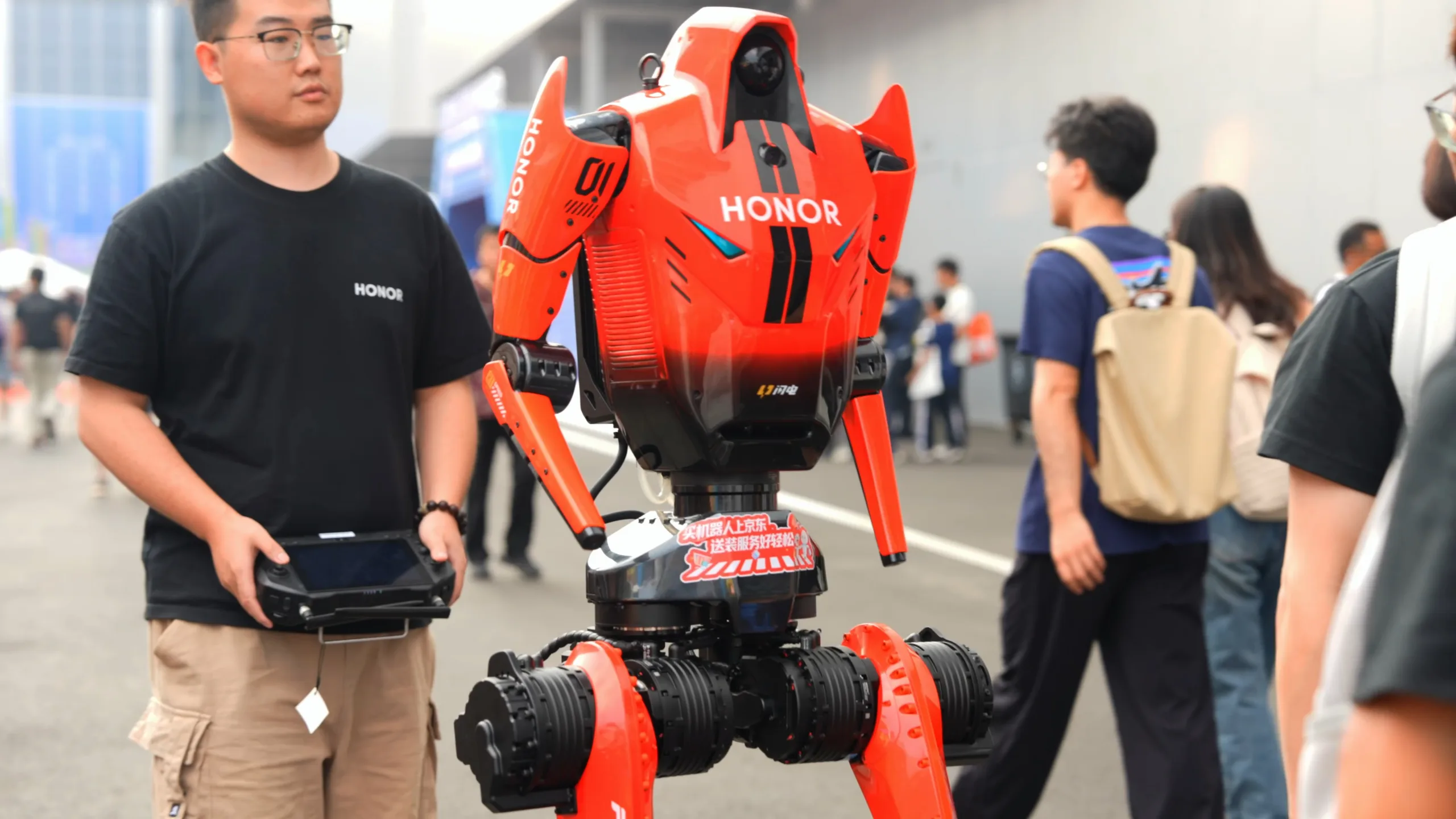
In Beijing, the World Robot Conference (held from August 19 to 23) and the second edition of the World Humanoid Robot Games (from the 22nd to the 26th) represented China’s consolidation in the robotics sector.
In the first half of 2026, Chinese manufacturers accounted for more than 97% of all humanoid robots sold worldwide. The country’s two largest companies, Zhiyuan and Unitree, account for three-quarters of this market.
The robot conference brought together 373 companies from 26 countries and more than 557 thousand visitors. In parallel, the World Humanoid Robot Games featured 666 teams from 16 countries and 2,056 robots in 51 modalities, with the number of participating companies increasing by 36% and the number of new products, by 21%. The machines broke several records.
Replacement in risky jobs
In recent decades, one of the Chinese government’s priorities in the field of robotics has been the development of machines capable of replacing workers in high-risk occupations. In 2025, Beijing’s municipal administration launched a program to accelerate the automation of dangerous, repetitive and physically exhausting functions, prioritizing sectors such as vehicle assembly, mineral extraction and the chemical industry.
During the conference, Intelligent Technology 58 presented the Dasheng D20, a 1.8-meter humanoid robot developed for this purpose. Ling Lei, the company’s product manager, described the scenarios for which the equipment was designed:
“Replacing human workers in risky situations and reducing casualties. Use cases include firefighting, explosives neutralization and security patrolling. It also applies to industrial scenarios such as automotive painting, an activity with serious risks to workers’ health. With the dedicated cockpit, the human operator remains away from the site. Human intelligence compensates for the robot’s cognitive limitations,” said Ling Lei.
The product was launched this year. According to Ling Lei, small-scale commercialization is scheduled for the end of 2026, with orders already confirmed from fire departments, explosives decommissioning agencies and industrial customers.
Robots for disasters
In December 2023, the ministries of Emergency Management and Industry and Information Technology issued a joint standard to accelerate the use of robots in disaster prevention actions, rescue operations and communications in risk areas. Smart Technology 58 presented two models developed for these scenarios.
“This is our emergency recognition robot dog. With onboard sensors, it can identify risks and locate victims in environments affected by disasters. We also have the firefighter robot dog, developed for high-risk fire scenarios. It replaces human firefighters in close combat, equipped with a monitor capable of shooting water up to 60 meters away”, said Zhang Huan, responsible for the company’s emergency products.
Built-in intelligence
China’s 15th Five-Year Plan explicitly included embodied intelligence, i.e. robots controlled by Artificial Intelligence (AI), among the country’s new economic expansion vectors. The central challenge of this field is to develop machines capable of dealing with constantly changing objects and situations.
Liang Zhujin is the co-founder of Octopus Dynamics, a company founded in early 2026 focusing on general-purpose artificial intelligence models. At the conference booth, they showed a known problem in this area of technology.
“Folding clothes is a classic challenge of embodied intelligence, with numerous technical difficulties. A garment is a deformable object: small perturbations completely alter its shape. This variability makes it impossible to solve the problem with modeling alone. Furthermore, folding a garment is a long task, with several steps in sequence. The more steps, the lower the success rate,” explained Liang Zhujin.
The demo was built on the NewWorld V0.5 foundation model, released by the company during the conference.
Open platform
The embedded artificial intelligence sector has received contributions from large conglomerates such as Alibaba, Huawei and BYD, as well as specialized startups. The bet of younger companies is that generalist models, capable of learning in one area and transferring knowledge to another, can serve as a basis for applications in very different markets.
The Octopus Dynamics model was trained with data from industrial, domestic and commercial scenarios. According to Liang Zhujin, the generalization capacity allows it to be applied to contexts as different as assembly lines, homes and elderly care services.
“Our vision is to build a general-purpose productivity platform: any developer who wants to work in a specific scenario can adopt our platform and quickly implement solutions,” said the co-founder.
Records and cooperation
In the World Humanoid Robot Games, the results surpassed human scores in several tests. In the 100 meters, the best time fell from 21 seconds in the first edition to 9.39 seconds in this one, below Usain Bolt’s record. In the 400 meters, the winner completed the race in 38.15 seconds, against the human record of 43.03 seconds. In the 1,500 meters, the mark reached 2 minutes and 21 seconds. In the long jump, the best performance went from 1.25 meters, last year, to 7.97 meters.
Regarding these advances, Ministry of Foreign Affairs spokesperson Lin Jian said that the country is willing to cooperate with the rest of the world and marked differences with the approach of other technologically advanced countries.
“China’s efforts to develop new quality productive forces and promote scientific and technological innovation have always been based on openness, cooperation, mutual benefit and win-win results, rather than artificial barriers or closed and exclusive development,” he said at a press conference.
Source: www.brasildefato.com.br