From difficulties, popular solutions emerge that transform the present and project the future. This is a lesson that the Venezuelan people will not forget. If, on the one hand, the country has faced all sorts of difficulties, such as economic sanctions, military aggression, kidnapping of the president and even a double earthquake, in the socialist communes, the organized people themselves have transformed their realities.
In the heart of Caracas, in the historic 23 de Enero neighborhood, is one of the places where Venezuela is reborn. The Panal 21 Comuna, for almost two decades, has transformed the reality of more than 10 thousand residents of 9 communities in the region. As Santa Rosa Community spokesperson Judith Guerra says:
“I was remembering how difficult it was for us when we couldn’t use our streets and had to live in fear. All of this happened during the Fourth Republic, because our streets were taken over by bad people, people who didn’t believe in organization of any kind, because at that time there were no communal councils or communes”, recalls the commune member.
Far beyond the current difficulties that the country faces, over the decades, the economic war and the strong disinformation campaign against the Bolivarian Revolution have caused resistance territories to sprout across the country.
“We began to mobilize in institutions to look for staff who had the same identity as us, who would support us from this trench of institutional struggle, and we developed our entire community. We replaced 42 shacks with decent housing. We replaced 600 linear meters of drinking water and wastewater pipes. We replaced the roofs. Here almost no one has a damaged roof, only about 2% or 3% remain. When it rains, those cardboard roofs no longer exist in our neighborhood, and we achieved all of this with the revolutionary process. We boosted the family economy and the communal economy”, he reports with pride.
Among the many stories in these almost 20 years of the commune, Judith says that, during the Covid-19 pandemic, faced with the difficulty of getting around and, at the same time, the general lack of work, a solution emerged that to this day has become the hallmark of the Santa Rosa community, known as Panalito.
“When we couldn’t leave the house, we opened a group on a social network and, from there, we started. We saw that Mrs. Maria makes cakes, Mr. Juan is an electrician, Mr. Pedro is a blacksmith. We started to see who we were. Since a lot of people from other communities pass through here, because the path leads directly to the Caracas metro, we started to publicize that a hairdresser, a seamstress, a cook, a carpenter, someone who repairs appliances lives here. This way we can promote the family economy. And, if each family becomes stronger economically, our quality of life improves.
Although there is a lot of work ahead, as the communeros point out, the reality today is different. In addition to productive projects, the territory has a radio, recreation spaces, public library, spaces for sports, dance classes, martial arts and even robotics.
Everyone wants to meet
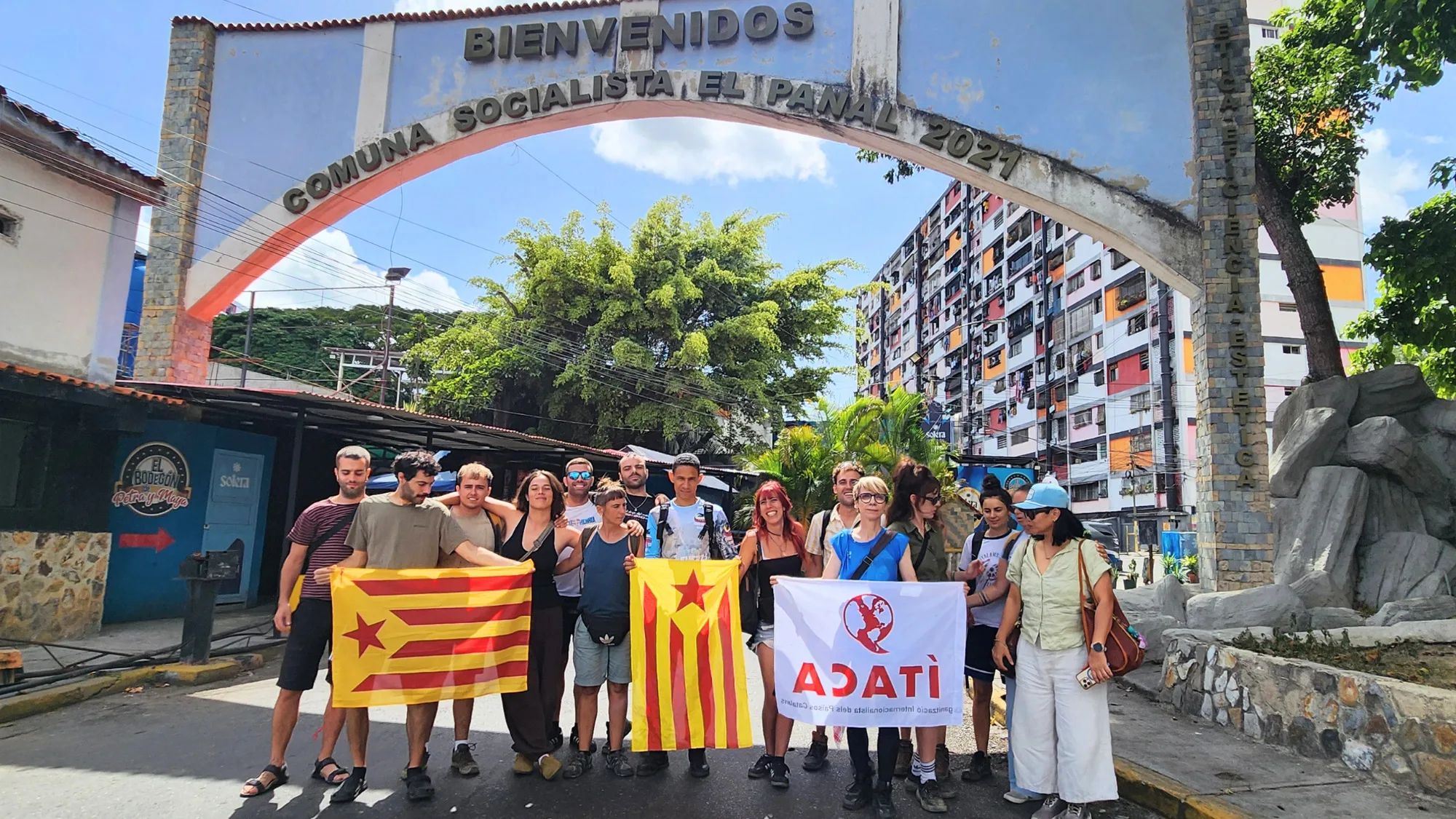
These are experiences like that of the Panal 21 commune that a group of socialist activists from Catalonia came to learn about. Among them, Maura Antoni, who says she is positively surprised.
“I came without many expectations because I didn’t really know what we were going to find, much less now with the earthquake situation. But with the intention of getting to know the communal process in this country, which we heard about before coming, from some trainings we participated in. I didn’t know much and it seemed very interesting to me the way they build politically from scratch, through popular organization”, says the young woman.
“In the end, we, the Catalans, are also a nation oppressed by the Spanish and French State. We learned a lot about assemblyism, decision-making from below, popular power and how people live together as a community”, he continues.
Alex Quintero is another Catalan brigadista who says he was impacted by learning about the experiences of self-management and popular organization in the country.
“Here in Venezuela we found a very fruitful experience of social and community organization that is catalyzed in these communes, where there are collective production systems. This really impacted us because, in European capitalism, this does not exist. We were visiting several communes and they explained to us their participatory processes of citizen participation in terms of elections for communal councils, the topic of spokespeople and so on. Both the productive topic of social production companies and the topic of popular power participation made us learn a lot and we hope to take all this information to our homeland”, points out the internationalist.
“When we came here to Venezuela, we also saw a people fighting, in this case, against the imperialist siege imposed by the United States, and who also have a project for popular transformation based on socialism”, adds Quintero.
Seeds of Bolivarian socialism
But, after all, what makes these communal organization projects a powerful instrument for building socialism?
Cira Pascual Marquina, researcher and popular educator from the Panal 21 commune, explains that communes are not a mere institution, but arise from local experiences of community self-organization.
“There are many red threads that lead us to this point of arrival, which is a rediscovery, from this territory, of this people in struggle, of this revolutionary anti-imperialist people who express themselves in a more forceful way in the commune. Therefore, we say that the commune is the path and the destination. All the communes in Venezuela have their virtues, but all the communes, including the most robust ones, have a long way to go. However, if you come to the El Panal Commune, you will see that sprouts of socialism are already emerging, which must be very well cared for and loved, but the sprouts of socialism are already there”, analyzes the researcher, for whom the commune should be more than a “fourth level of government”.
“Within the Bolivarian Revolution, there are readings that interpret the commune as a space to solve problems that exist in the territory, such as wastewater, lighting, paths and so on. For us, for Força Patriótica Alexis Vive and for the El Panal Commune, the commune goes much further than that. The commune is the epicenter for the construction of new social relations”, he highlights.
“This implies that the commune walks for us on two feet: one is direct, participatory and protagonist democracy without representation, that is, the democracy that surpasses the form of bourgeois liberal democracy. On the other hand, control over the means of production. This set is what builds substantive democracy. In this set, with these two feet, we achieve this collective body that we call the commune”, argues Pascual.
The researcher remembers that it was at a time of greatest difficulty that, between “nothing” and a possibility of a future, people made the decision to transform the present.
“The Venezuelan people forcefully took up the commune’s proposal in a context in which you went to a shelf and got nothing. The Venezuelan people, faced with nothing, remember Commander Chávez’s motto ‘commune or nothing’, and took up with force the communal proposal that was already alive and active, but was not as powerful. In many communes, like in this El Panal Commune, there was a planned food distribution exercise at that time. In other communes of the country, they began to do the same to ensure that the people in the commune had enough food.
“We are focusing on this moment because we need to defend the revolution. As part of this war is ideological and media-related, we have to look for ways to understand what is being built here. (…) The MST says: ‘let us internationalize the struggle, let us internationalize hope’. And we need to internationalize it back and forth. The Communist Manifesto ends with ‘proletarians from all over the world, unite’. We really cannot wage the socialist struggle alone. We have to do it together, as a working class, here, in Brazil, in Venezuela, in Italy, wherever, and also in the Catalan Countries”.
According to the Ministry of Communes, there are 3,924 registered communal territories across the country, 53 of which are indigenous, 1,056 rural, 1,851 suburban or mixed, and 964 urban. Each with its own particularities. In the midst of historical adversities, the organized people carefully and patiently cultivate the seeds of Bolivarian socialism.
Source: www.brasildefato.com.br