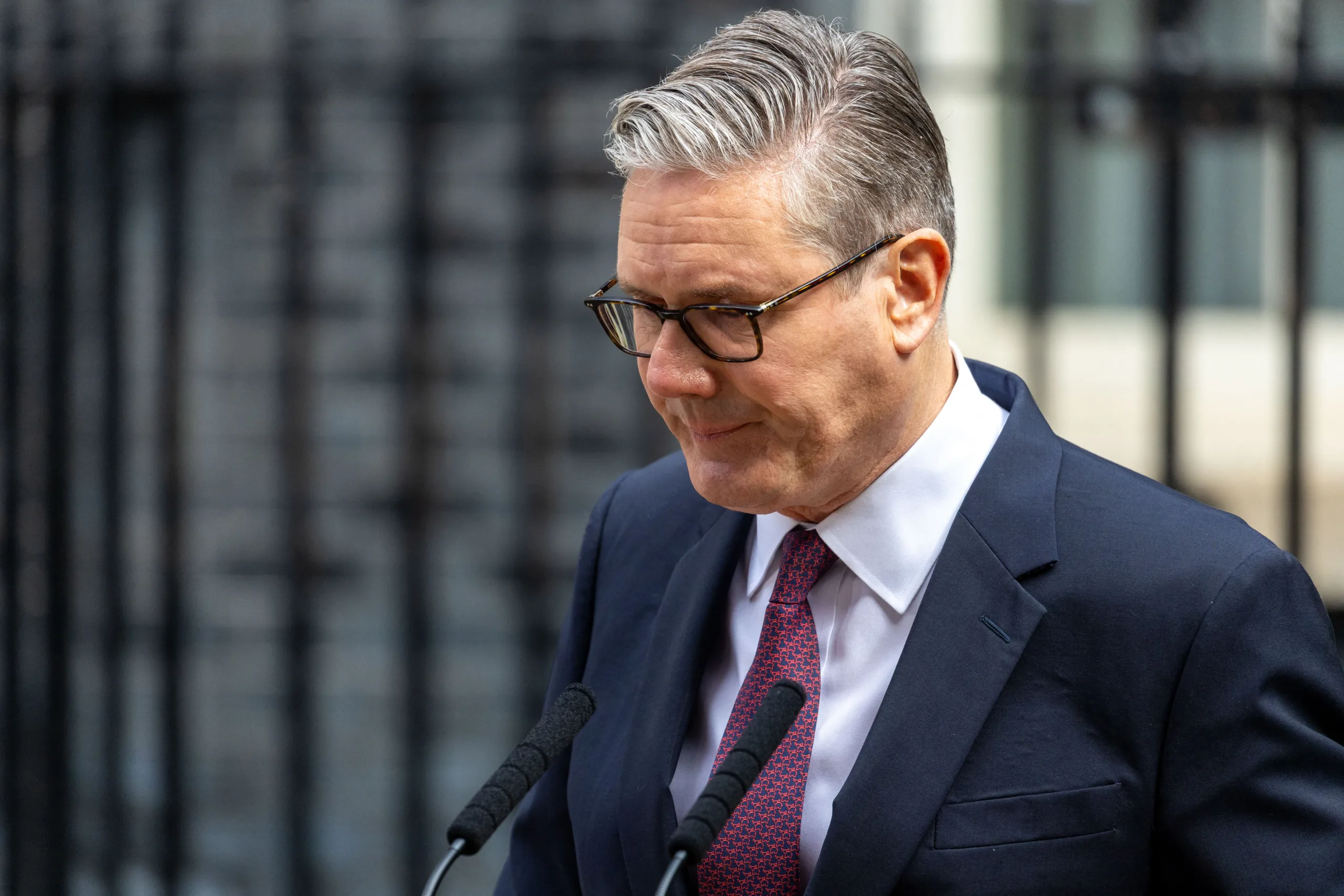
Keir Starmer’s departure from the position of Prime Minister in the British government puts the future of the Labor Party and the strategy adopted by the party in recent years into debate. As it prepares to choose a new leader, the party seeks to respond to the loss of popular support, the economic crisis and the growth of political forces that challenge the United Kingdom’s historic bipartisanship.
Starmer’s arrival in power in July 2024 was a balm for the Labor Party. Just five years earlier, still under the effect of the United Kingdom’s exit from the European Union (EU), the British population caused the party to suffer the biggest defeat since 1935.
But the Conservative Party’s austerity policies, added to the difficulties imposed by Brexit, created the broth with which the British population began to rethink their choices. This is how Starmer became only the fourth Labor leader to win an election, the party’s greatest achievement since Tony Blair’s victory in 1997.
But, two years later, the now former prime minister leaves power with minimal popularity. The economic issue explains part of the process of Starmer’s downfall, but not only. Profound social changes lead to a new balance in the political game in the United Kingdom, causing Labor to rethink its place in the British scene.
In conversation with the Brazil in factHugo Albuquerque, international analyst and editor of Autonomia Literária, points out that the United Kingdom is facing a crisis resulting from the fact that it is expanding the financialization of the economy, “very dependent on American banking, and that it is not that old empire”. It is, for him, a “trash of the US financial system, with many problems”. Far from the European Union, industrial production worsened and the flow of trade with other European countries became even more restricted.
James Schneider, English writer, director of the organization Progressive International and former public relations advisor to the then leader of the Labor Party, Jeremy Corbyn, spoke to Brazil in fact and highlighted that living conditions in the United Kingdom have been worsening to the point of beginning to reshape the social order.
“Wage growth in Britain is stagnant, stuck in real terms at 2005 levels for most workers, while public services have been cut with major austerity imposed on the state,” he said.
Similar to what happens in other countries — even those that are among the world’s leading economies — younger generations in the United Kingdom tend to experience greater difficulties, in financial and economic terms, than previous generations. “While the wealth of the super-rich continues to skyrocket and politics continues to be captured by corporations, full steam ahead,” says Schneider.
Enter and leave the scene
Even so, when announcing that he would resign from his position last Monday (22), Starmer made a point of highlighting his contribution to bringing the Labor Party back to the center of the UK political scene.
He recalled that he “inherited a Labor Party that was politically, financially and morally bankrupt” six years ago, and that the strength to transform the acronym came from him, “extirpating the poison of anti-Semitism, restoring confidence in the economy, defense and national security, and becoming a party that once again stood proudly alongside, and not against” the flag of the United Kingdom.
Recalling how he shaped some bases of the Labor Party, Starmer mentioned that it was during his administration that the then leader of the Labor Party, Jeremy Corbyn, ended up suspended from the party, after the Equality and Human Rights Commission (EHRC) identified problems in the conduct regarding anti-Semitism. Corbyn frequently accuses Starmer of leniency over the genocide in Gaza.
In order to govern in an environment of notable instability — there have been six prime ministers since Brexit in 2016 — Starmer took Labor more to the center, trying to attract (or avoid rejection) conservative voters. Internal dissatisfaction was not long in coming. In his resignation speech, for example, Starmer acknowledged that the party had been questioning his ability to lead the group for the next general elections. The former prime minister would have listened to what he called the “response” from party members and accepted the decision “gladly”.
Reckoning
The future of the Labor Party could be in the hands of Andy Burnham, the former mayor of Greater Manchester who recently won a seat in the British Parliament. In comparison to Starmer, Burnham moves to the left wing of the party.
But the next perspectives will have to align with the recent past of the party founded at the beginning of the 20th century, when it managed unions exhausted by the advanced state of capitalism at the time. After all, the acronym boasts, among its historical figures, the names of Clement Attlee, a key player in the construction of the British Welfare State, and Tony Blair, the reformist leader who adjusted the acronym’s path in the 1990s.
The Labor Party’s biggest challenge is not just beating the Conservatives again. This idea is part of traditional bipartisan logic. The main question is understanding how it will be possible to compete for power in the midst of political fragmentation.
For Schneider, Andy Burnham, Starmer’s possible successor, can hardly “fix much of anything for a long time if the underlying issues are not addressed”. “Burnham would need to cause a much more substantial shake-up in Britain’s political economy and a much more significant redistribution of wealth and power, taking it away from the super-rich and the most privileged sections of capital and transferring it to the majority of the population,” says Schneider. “But this is not done just through speeches”, he highlights.
“The Labor Party is a victim of its own rejection of playing the historic role it ascribes to itself. Instead, the party, under Starmer’s leadership, was captured in favor of corporate interests to serve the dictates of US imperialism. This was Starmer’s undoing, because these shackles prevented him from improving the standard of living for the overwhelming majority of people”, he analyzes.
The future British Prime Minister will be chosen by the Labor Party. The acronym’s executive committee will still publish a schedule for the replacement. The expectation is that the process will be completed by September 1st, the date that ends Parliament’s summer recess.
Historical bipartisanship?
In addition to the internal and general crises, labor has lost space to smaller parties. The Conservatives, whose recent history was marked by Boris Johnson’s time in power, too. The gaps are being filled by the Reform Party, an extreme right-wing group created in 2021 by Nigel Farage. In local elections last May, the party won around 1,500 seats in local councils, which are similar to Brazilian municipal councils. Previously, the Reform Party had just two.
The central axis of the Reform Party’s discourse is the rejection of immigrants. Something expected by Brexit, which provided that the British government would have a greater margin to change migration policies, through a points-based system. In practice, what happened was the opposite.
Since 2016, the United Kingdom has recorded population growth similar to that of the 1960s, which marked the post-war bonanza. In 2023, according to data from the Office for National Statistics (ONS), the net migration balance was 685 thousand migrants.
What changed, however, was the profile of the people who started arriving in the United Kingdom. Before, they were immigrants from European Union countries. Now, individuals from other countries. This condition has changed the work dynamics. According to the organization Changing Europethe number of workers leaving countries outside the EU increased by around 992 thousand, by 2024, compared to the period before Brexit.
Wouldn’t this be the ideal time for the consolidation of Labor in the United Kingdom? Not so much. Until 2019, Labor, alongside the Conservatives, dominated 76% of British voters’ votes. That number fell to 58% in the 2024 election, won by Starmer. The data are from Institute for Governmentwhich also shows that Reform UK has filled spaces on the right in Britain’s political imagination, while the Greens make a similar move to the left.
Source: www.brasildefato.com.br