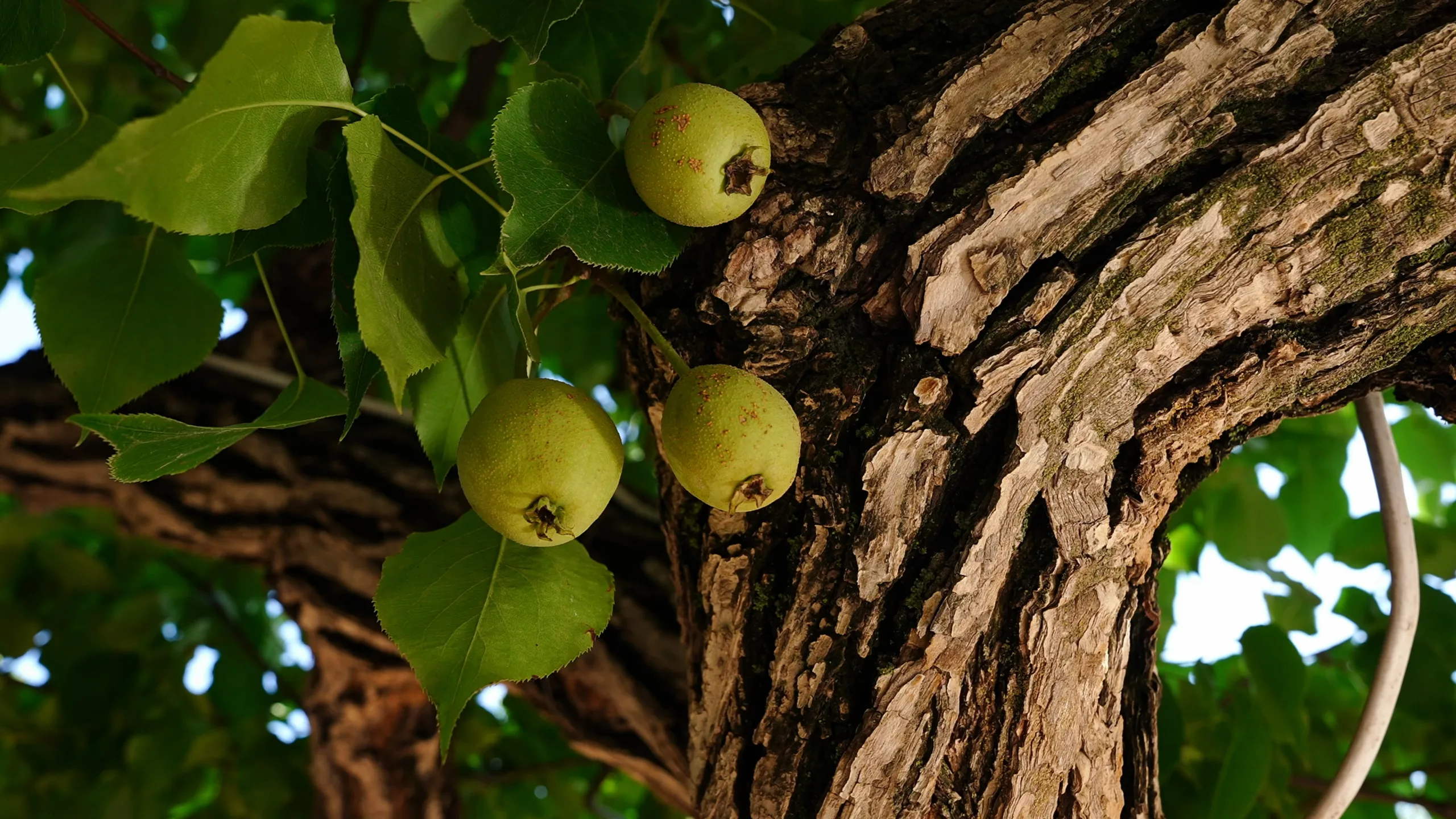
In Lanzhou, capital of Gansu province, around 1,765 peasant families have been dedicated to cultivating and protecting pear trees on the banks of the Yellow River for more than six centuries, in an organic agroforestry system.
The Sichuan Ancient Pear Orchard is in Gaolan County and is home to 9,423 pear trees over a hundred years old, of which more than 2,600 are over 300 years old. The oldest is almost 500 years old and continues to produce thousands of kilos of fruit per year.
In May 2025, the FAO (Food and Agriculture Organization of the United Nations) included the system in its list of Agricultural Heritage of Global Importance, bringing the total number of systems of its kind recognized by the organization in China to 25, of which two are in Gansu.
The pear agroforest has around 12 thousand mu (approximately 800 hectares), and the central area, with centuries-old trees, has around 3,939 mu (262.6 hectares). The recognition not only covers the trees, but also the integrated agricultural techniques passed down from generation to generation, the cultural knowledge associated with the craft and the landscape made up of the orchard, the river and the plateau.
In Sichuan, a cooperative model was implemented under the leadership of party groups: the Chinese Communist Party cell in each village organizes a cooperative that incorporates pear trees and land as collective capital and distributes annual dividends among peasants who hold shares. The villages operate in an integrated manner, which extends the benefits of tourism to the more than 3,000 families living in the orchard area, in addition to the 1,765 that have a direct management contract for the pear trees, according to information from the Lanzhou Daily and the Xinhua agency.
The irrigation system
The documented origin of the orchard dates back to the Jiajing period of the Ming Dynasty, in the 16th century. “The history of pear cultivation in Sichuan begins in the Han Dynasty. Villages emerged during the Northern Song Dynasty, and large-scale planting was achieved during the Ming and Qing Dynasties through waterwheel irrigation from the Yellow River. Our ancestors made it their livelihood, and the practice has continued for hundreds of years,” Han Lei, deputy director of the Gaolan County Ancient Pear Orchard Protection Center, told Chinese newspaper Daily Economical.
To the Brazil in factLiu Kong Bao, deputy director of the Publicity Department of the Gaolan County CCP Committee, said that in the Ming period, without irrigation infrastructure, workers carried water in buckets with poles on their shoulders to water the pear trees. In the Qing Dynasty, waterwheel technology was introduced from Lanzhou to Sichuan, making large-scale planting possible. “Water conservation played a decisive role in the formation and growth of the orchard,” he said. The canals that cross the land today were built more than 200 years ago, forming an interconnected network that, over time, was covered with stone to reduce infiltration and became the irrigation system used today.
Organic production
FAO’s central criteria for recognition were, according to Liu Kong Bao, “the harmonious coexistence between humans and nature and organic agricultural practices”. The ancestors of Sichuan farmers developed traditional pest control techniques such as scraping the bark off trees, creating sand barriers around the trunk, and removing flowers in a controlled manner (known as thinning). “Today, we also work with forestry research institutes to implement biological pest control throughout the orchard,” said Liu Kong Bao. The two main methods are to create natural predators of the harmful insects and to install pheromone ribbons to disorient males and females, preventing them from reproducing. “We only use biological controls. All of this ensures that the fruits produced in the old orchard are green agricultural products without contamination”, he stated.
Wei Zhou Yu, a local farmer whose family has lived in Sichuan for generations, spoke about management at the Brazil in fact: “We combine ancient planting techniques with modern green pest prevention methods. Annual orchard management includes pruning, artificial pollination, fruit thinning, harvesting, irrigation and weeding.”
The management and protection system
On March 1, 2019, the Sichuan Century Pear Tree Protection Regulation of Lanzhou City came into force, establishing an interconnected management mechanism at four levels: city, county, municipality and village. Each of the 9,423 pear trees received its own identification code, through which it is possible to check who is responsible for maintenance. More than 1,760 management contracts are signed annually, according to the China News Service.
There are two management models, according to Liu Kong Bao. In the first, local farmers care for the trees with support from the government, which designates departments for supervision, technical training and biological control. In the second, agritourism operators who lease land from farmers take responsibility for caring for the pear trees on their plots.
Wei Kongtao, a resident of rural Shangche Village, has more than ten century-old pears in his yard. “Each tree receives a subsidy of 100 yuan (about R$77) per year, and we have to take care of them every ten days or so. Taking good care of the trees also increases our income,” he said. In the spring, when the pears bloom, he and his wife sell tea and meals in the yard; in autumn, they set up a stall at the entrance to sell pears. “The orchard environment has been improved and a walking trail has been built. This year, the flow of tourists has been steady,” he said.
The numbers of the ancient orchard
In 2025, the Sichuan Ancient Pear Orchard Scenic Area received more than 1 million visitors. It was the first year in which it surpassed this historic mark. Annual tourist revenue was more than 90 million yuan (about R$70 million).
The municipality’s annual pear production is around 16 thousand tons. In recent years, the development of the orchard has increased the per capita income of local residents by more than 5,000 yuan (about R$3,850), according to the Gansu economic information portal.
Source: www.brasildefato.com.br