Published 04/20/2026 15:34 | Edited 04/20/2026 17:09
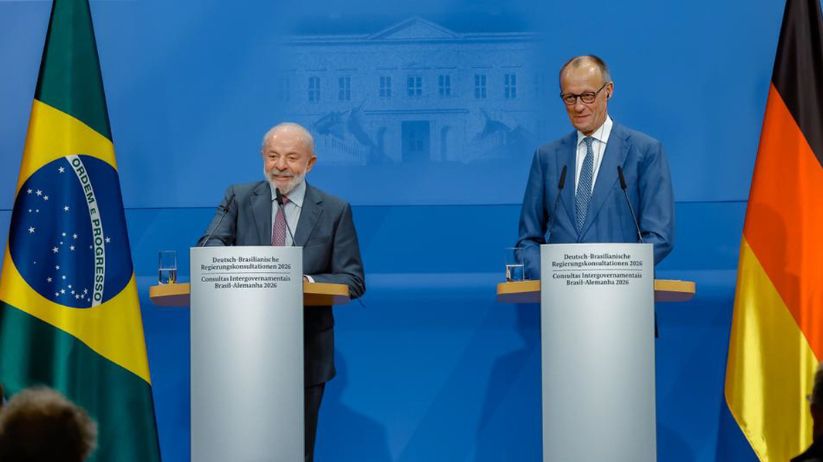
Visiting Germany this Monday (20), President Luiz Inácio Lula da Silva met with Prime Minister Friedrich Merz and signed cooperation agreements. After the meeting, a press conference was held with the two leaders in which relevant topics on the global agenda and between the two countries were discussed.
The government reported that agreements were signed in the areas of defense, artificial intelligence, quantum technologies, infrastructure, circular economy, energy efficiency, bioeconomy and oceanic and climate research.
One of the highlights of the interview was the entry into force, from May 1st, of the Mercosur-European Union agreement. In Lula’s assessment, this is an important step towards the diversification of commercial relations and strengthening economic resilience, but also from the point of view of human rights and the environment.
“After 25 years of negotiations, our regions said yes to integration to create a free trade zone that brings together 720 million people and has a GDP of 22 trillion dollars,” he declared.
Find out more about Lula’s trip to Europe:
Brazil is tired of being treated like a poor and small country, says Lula in Germany
“We have to replace discouragement with dreams, hatred with hope”, says Lula
The risk that the extreme right brings to democracy is not rhetorical, it is real, says Lula
No president has the right to impose rules on other countries, says Lula
Lula added that the agreement “opens space for a comprehensive partnership, which goes far beyond free trade. We are talking about a model of cooperation that values and protects workers, human rights and the environment.”
When talking about the partnership between Brazil and Germany, Friedrich Merz highlighted that this relationship gains even more importance in a context marked by so many transformations on a global level.
“I am very grateful to Brazil because it is one of the few countries with which we have this status. With Brazil, we have a robust and dynamic strategic partnership and we have managed to foster this partnership in recent days. This proximity is more important than ever, in these times of so much change in the world order”, he stated.
Climate and energy
With regard to the climate agenda, the Brazilian president emphasized the country’s commitment to environmental preservation and combating deforestation, with the goal of eliminating the practice by 2030, presenting the results already achieved and highlighting cooperation with Germany in this area.
“So far, we have reduced deforestation rates in the Amazon by 50% and by 32% in the Cerrado. We have reestablished and expanded our environmental cooperation with Germany in the Amazon Fund, an ally since its creation in 2008”, Lula noted.
Regarding the energy issue, Lula defended the diversification of matrices and criticized the resistance that still exists in Europe to the use of biofuels.
“There is no energy security without diversification. The recent rise in oil prices shows that it is high time for Europe to overcome its ideological resistance to biofuels,” he said, pointing to them as a cheap, reliable and efficient option for decarbonizing the transport sector.
Furthermore, Lula emphasized Brazilian experience in the production of ethanol and biodiesel: “With knowledge accumulated over five decades, Brazil is capable of producing ethanol and biodiesel without compromising food production and forest areas.”
When dealing with the exploration of critical minerals, the president declared that “our reserves also make us unavoidable actors in the debate on critical minerals. We want to attract processing chains to Brazilian territory, without making exclusionary options. Collaboration in technology-intensive sectors is a priority for a country, which does not want to limit itself to being a mere exporter of commodities”.
Digital sovereignty
At the press conference, the president also addressed the digital agenda, highlighting the convergence between Brazil and Germany in promoting technological sovereignty, developing digital infrastructure and regulating platforms and artificial intelligence.
“We are committed to the development of digital infrastructures, such as data centers, high-performance computers and semiconductors. We no longer want to remain dependent on foreign companies that enrich themselves at the expense of our citizens’ data, without guarantees of privacy and security,” said Lula.
He defended data protection, digital security and the balance between freedom of expression and human rights. “There are convergences between the guidelines of the Brazilian Artificial Intelligence Plan and German policy on the topic, such as the emphasis on the development of local capabilities. Germany and Brazil are allies in regulating virtual platforms and the use of artificial intelligence”, said Lula.
Wars and multilateralism
The war in the Middle East and the UN’s inaction in the face of various recent conflicts and interventions were also topics discussed during the press conference.
“The prevalence of force over law is the most serious threat to international peace and security. We are deeply concerned about the risks of the resumption of the conflict in Iran and the escalation in Lebanon. The survival of the Palestinian State and its people remains threatened”, said Lula.
Furthermore, the Brazilian president stated that “between the action of those who provoke war and the inaction of those who prefer to remain silent, the UN is once again paralyzed. Brazil and Germany have defended for decades a reform that would restore the legitimacy of the Security Council.”
Lula reaffirmed his position against US sanctions on Cuba, as well as unilateral interventions, a practice that has been routine during Donald Trump’s term. “I am against the lack of respect for the territorial integrity of nations. I am against any country in the world engaging in political interference over how a society should organize itself or not,” he said.
He also criticized the economic blockade imposed by the US on Cuba almost 70 years ago. “If we continue to believe that the law of the strongest should prevail, this has happened other times in the world and it didn’t work,” he added.
Source: vermelho.org.br