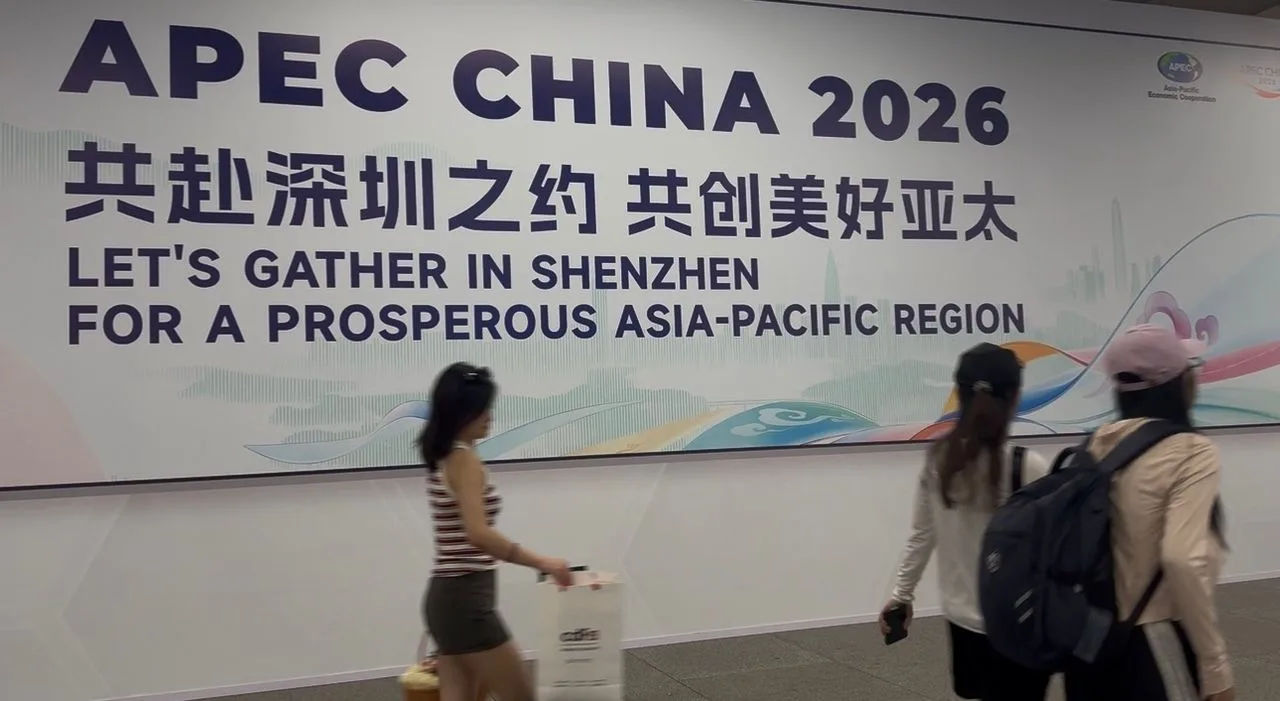
China is preparing to host, on November 18th and 19th, the 33rd Economic Leaders’ Meeting of the Asia-Pacific Economic Cooperation (APEC), in Shenzhen. The meeting will bring together the 21 economies that are part of the mechanism, including Mexico, Chile and Peru, the three members of the forum in Latin America.
Together, the group’s economies have a population of 3 billion and concentrate a GDP of US$57.5 trillion, equivalent to 59.4% of world GDP. In 2025, they accounted for 46.8% of world imports and 46.2% of exports of goods and services.
Created in 1989, Apec brings together economies from Asia, Oceania and the Americas around themes such as trade, investment and economic cooperation. In 2026, China will host the mechanism for the third time, after editions in Shanghai (2001) and Beijing (2014).
This year’s theme is “Building an Asia-Pacific Community to Thrive Together”, with three priorities: openness, innovation and cooperation. The program extends throughout the year, with ministerial meetings, technical meetings, business forums and preparatory activities in different Chinese cities.
One of the preparations was the Asia-Pacific Youth Summit: “Building a Shared Future through Energy”, held in Shenzhen on August 21. More than 60 experts, young representatives and journalists from 13 countries and regions participated in discussions on energy, innovation, regional connectivity and the relationship between electricity and computing capacity.
In addition to the youth meeting, Shenzhen hosted, between July 29 and 31, the meeting of the Apec Expert Group on Energy Efficiency and Conservation. And in September, Beijing will host the APEC Energy Ministerial Meeting.
O Brazil in fact participated in the meeting and spoke exclusively with government representatives, energy sector professionals and foreign participants about their countries’ experiences and the possibilities for cooperation between Pacific economies. See the report below.
Energy and technology at the heart of Shenzhen’s transformation
Shenzhen itself helps explain why it was chosen to host the leaders’ meeting. In just a few decades, the municipality went from a former fishing area to one of China’s main technological and industrial centers.
According to Apec data, the city’s GDP rose from 270 million yuan in 1980 to 3.68 trillion yuan in 2024. In the same period, Shenzhen established itself as an important foreign trade center, with turnover of around 4.5 trillion yuan.
Now, the city is looking to move forward on another front: the transformation of its energy infrastructure. The growth of high-tech industry, digitalization and data centers increases the demand for electricity. At the same time, China has set goals to reduce emissions and expand the share of clean energy sources.
It was at this point that the youth meeting brought together two themes that go hand in hand today: energy and technology. Participants visited the 110-kilovolt Chunhui substation, presented by organizers as a zero-carbon educational smart substation.
For developing countries, the energy transition involves an issue that goes beyond reducing emissions: how to expand access to the technology and investment necessary to sustain development. The issue takes on another dimension with the expansion of artificial intelligence. The greater the computational capacity, the greater the need for electricity and networks capable of distributing this energy efficiently.
For China and other Asian countries, the challenge is to build this infrastructure. For countries in the Global South seeking to expand their industrialization, the issue also involves access to technology, financing and cooperation.
The relationship between China and other countries in the Global South appears, in this context, as a possible alliance. The Chinese experience was presented to participants based on concrete projects developed in Shenzhen.
Chhoeun Raksmey, director of Cambodia’s Drinking Water Policy, highlighted in an exclusive interview with Brazil in fact the progress made: “We have a good policy to achieve carbon neutrality by 2050 and we are also creating opportunities for other development partners to join, especially by promoting the business link between Cambodia and China in terms of green and clean production.”
Fan Siran, customer manager at China Southern Power Grid in Shenzhen, also spoke exclusively with Brazil in fact. She spoke about the progress of the energy transition in the city and the preparation to receive visitors during Apec: “I am not just one of the construction companies, I am also the host, and I am very happy to be able to present the construction process and share our experience with visitors from different cities and countries.”
From Asian integration to Latin America
The energy experience presented in Shenzhen drew attention to a process that is already occurring in other parts of Asia: the integration of electrical networks between countries.
The Association of Southeast Asian Nations (Asean), for example, brings together ten countries. Within the bloc, energy integration is treated as a way to increase security of supply and take advantage of different generation sources.
Anthony Hadi, a young expert from Indonesia, explained to Brazil in fact how this process benefits from the meeting: “Through Apec and cooperation with China, we can deepen this strategy and expand cooperation, not only within Asean, but also for the entire Asia-Pacific region.”
Another example presented at the event was the electrical interconnection between China and Laos. The 500-kilovolt project increased two-way electricity exchange capacity from 50,000 kilowatts to 1.5 million kilowatts and enabled the supply of about 3 billion kilowatt-hours of clean electricity per year.
In the Guangdong-Hong Kong-Macao Greater Bay Area, another front of energy transformation foresees that green sources will account for almost 60% of electricity by 2030. These are projects that show, in practice, how energy, infrastructure and economic integration are increasingly linked.
And this integration does not end in Asia. For the Latin American countries in the group, participation represents a gateway to trade and economic relations.
In the case of Chile, this relationship has a particularly strong dimension. For Magdalena Rojas, Chilean journalist, editor-in-chief of the magazine China Today and resident in China, Chilean participation needs to be understood in a scenario of growing economic interdependence.
Rojas also draws attention to the historical dimension of Chilean commercial relations with the Apec economies: “Between 1994 [ano de ingresso na Apec] and in 2004, in a span of ten years, Chile’s exports to the APEC economies reached almost 75%.”
Today, China is Chile’s main trading partner. Exchange between the two countries mainly involves minerals, such as copper, as well as agricultural products and other goods.
For Peru and Mexico, the relationship with China and other Asian economies also occupies an important part of their commercial strategies. For China, Latin America represents a strategic region to expand trade, investments and cooperation between countries in the Global South.
What’s at stake in Shenzhen
The November leaders’ meeting will be the highlight of the year’s schedule. Meetings of senior officials, ministers and technical groups have been preparing documents and proposals that will be taken to Economic Leaders Week.
In August, Dalian hosted the third meeting of APEC senior officials. Other meetings discuss topics such as digital commerce, supply chains, food security, energy and small and medium-sized companies.
The youth meeting held in Shenzhen fits into this process. The activity brought together representatives from different countries to debate problems that cross the entire region: energy, digitalization, infrastructure and development.
The interviews carried out by Brazil in fact show how these themes are seen from different points of the Global South. Cambodia seeks partners to meet its carbon neutrality goals. China presents the experience of modernizing its electrical networks and integrating energy and technology. Indonesia sees regional cooperation as a possibility to expand energy connectivity. And Chile highlights the importance of maintaining economic integration channels with Asia-Pacific.
Apec brings together economies with very different levels of development and productive structures. At the same time, countries face problems that go beyond their borders and concrete questions: who will have access to new technologies, how the energy transition will be financed and how the economies of the Global South will be able to increase their participation in trade and new production chains.
In November, different perspectives will come together in Shenzhen, and APEC will face the challenge of transforming the economic interdependence of the Pacific into more trade, cooperation and development possibilities for its different members.
Source: www.brasildefato.com.br