India opened, on Monday (22), the 16th BRICS National Security Advisors Meeting in New Delhi, the country’s capital, with delegations of ten members of the group. The meeting, which runs until Tuesday (23), has as its central theme “Non-traditional security challenges confronting the world today” and includes discussions on the role of new technologies in emerging security threats.
The advisors also reviewed the results of the BRICS Joint Working Groups on Counterterrorism and Security in the Use of Information and Communication Technologies, according to the Indian newspaper Lokmat Times. On the margins of the plenary meeting, host Ajit Doval, National Security Advisor of India, held a series of bilateral meetings with delegations from China, Iran, Brazil, South Africa and Ethiopia.
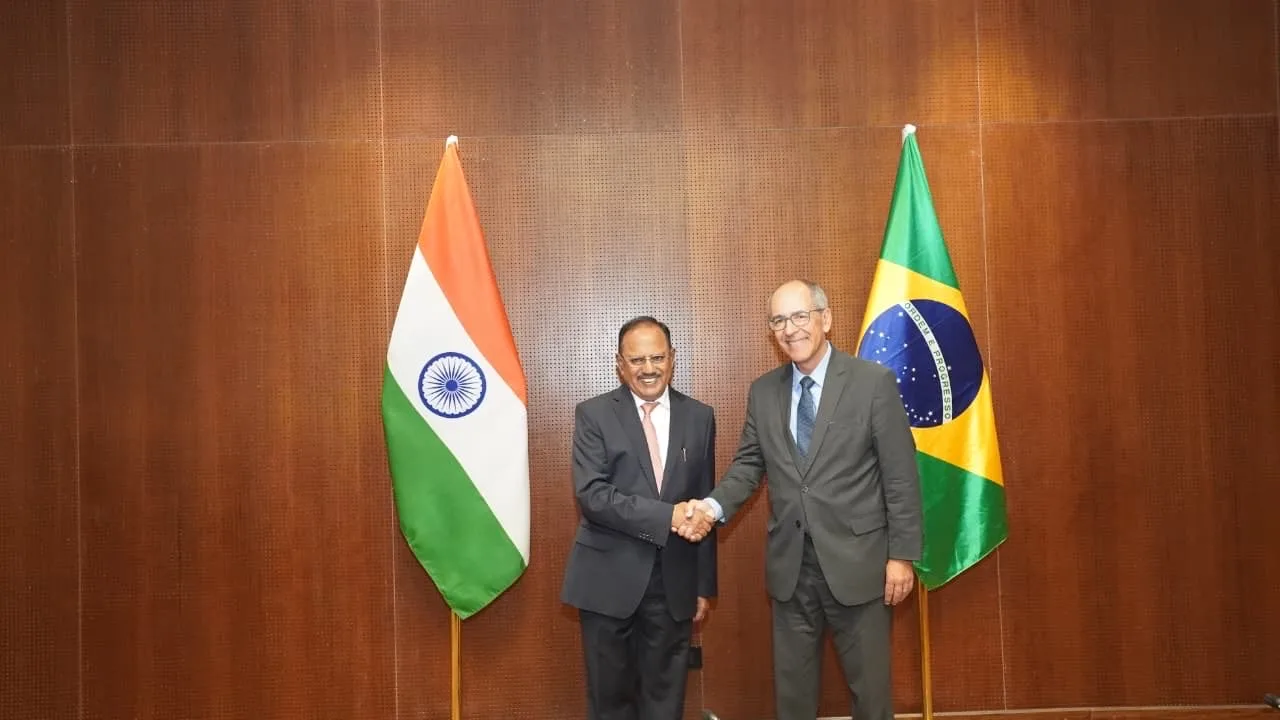
Doval received Carlos Marcio Bicalho Cozendey, Secretary of Multilateral Political Affairs of Brazil, who heads the Brazilian delegation at the meeting. The two sides highlighted the cooperation between India and Brazil within the BRICS framework and reviewed the general state of bilateral relations.
The meeting takes place four months after President Lula’s state visit to India in February, when the two countries signed ten agreements, including a cooperation pact on critical minerals and rare earths, as well as agreements on renewable energy and defense. At the time, Brazil and India set the goal of increasing bilateral trade to US$30 billion (R$171 billion) by 2030, starting from the US$15.2 billion (R$87 billion) registered in 2025, according to the Tribune India.
Brazil transferred the rotating BRICS presidency to India on January 1, 2026, after hosting the leaders’ summit in Rio de Janeiro in 2025.
Sino-Indian dialogue
In the bilateral with Doval, Chinese Foreign Minister Wang Yi highlighted that relations between the two countries “have gradually left their lowest point and resumed a path of recovery and improvement”, according to the agency Xinhua. The relationship between the two countries went through a critical moment in 2020, when a clash between Chinese and Indian soldiers in the Galwan Valley, in the border region between the two countries, resulted in deaths on both sides.
The Chinese minister reiterated the understanding that China and India are partners, not competitors, and that this “constitutes the most important strategic consensus between the two parties, providing impetus and strategic guarantees for the healthy and stable development of Sino-Indian relations.”
The minister added that as the world’s two most populous economies, China and India “should not only view bilateral relations from a long-term perspective, but also promote cooperation from a global perspective.” Wang Yi also framed the relationship between the two countries in the collective rise of the Global South: “The Global South, including China and India, is in collective rise”.
The BRICS countries, “as a leading force in the Global South, must actively defend and promote the multipolarization process, safeguard the legitimate rights and interests of developing countries, and promote the development of the international order in a fair and reasonable direction,” said the minister, according to the Chinese agency.
Wang Yi also said that the Sino-Indian border issue should be placed “in an appropriate position, avoiding affecting the overall situation of bilateral relations” and called on the two countries to speed up the restoration of dialogue mechanisms and promote exchanges in the areas of trade, finance, public security and media.
Doval said, in turn, that the meetings between the leaders of the two countries at the BRICS summits in Kazan and the Shanghai Cooperation Organization in Tianjin set the course for bilateral relations. “India was one of the first countries to recognize the People’s Republic of China and its position on the Taiwan issue remains unchanged,” said the Indian advisor, according to Xinhua. Doval added that New Delhi is willing to “jointly defend multilateralism and safeguard the legitimate rights and interests of developing countries”.
India’s Ministry of External Affairs called the talks “constructive and forward-looking,” according to the Akashvani News.
China and Iran: memorandum of understanding with the USA
Wang Yi also met with Ghadir Nezamipour, deputy secretary of Iran’s Supreme National Security Council. The Chinese minister stated that Beijing welcomed “the start of consultations between Iran and the United States”, with the cooperation of Pakistan and Qatar, based on the Memorandum of Understanding signed between the two countries, according to the CCTV.
Wang Yi said the memorandum’s 14 provisions were “hard-won achievements” and asserted that effective implementation of the document “will help consolidate the ceasefire situation, open up new prospects for Iran-US relations and contribute to peace in the Middle East.”
The minister reaffirmed that China, “as Iran’s comprehensive strategic partner, has always maintained a fair position and supported all efforts leading to peace”, in addition to supporting “Iran in defending its sovereignty, security and national dignity”, according to the CCTV.
Nezamipour stated that the deepening of the comprehensive strategic partnership between Tehran and Beijing “is the consensus of all sectors in Iran”. The Iranian representative expressed the expectation that China “will continue to play an important role in facilitating the effective implementation” of the memorandum with the United States, according to the CCTV.
India, South Africa and Ethiopia
Doval also met with Khumbudzo Ntshavheni, Minister in the Presidency of South Africa. Both discussed bilateral ties, identified areas of cooperation for development and exchanged assessments on the regional and global situation, according to the Indian Ministry of Foreign Affairs.
With Million Lema Tadesse, Executive Director of Analysis at the Ethiopian National Security and Intelligence Service, the Indian advisor explored ways to deepen the India-Ethiopia Strategic Partnership.
It is the fourth time that India has assumed the rotating presidency of the BRICS, after 2012, 2016 and 2021. The theme of the Indian presidency in 2026 is “Building Resilience, Innovation, Cooperation and Sustainability”.
The meeting was attended by representatives of the five founding members of the group (Brazil, Russia, India, China and South Africa) and five of the most recent members: Iran, United Arab Emirates, Egypt, Indonesia and Ethiopia.
In addition to those already mentioned, for Russia, the delegation is headed by Sergey Shoigu, Secretary of the Security Council. For the United Arab Emirates, by Ali Mohammed Hammad Al Shamsi, Secretary-General of the Supreme National Security Council. For Egypt, by Alaa Youssef, head of the State Information Service. For Indonesia, by Yayat Ruyat, deputy of Geoeconomics at the National Resilience Council.
Source: www.brasildefato.com.br