Published 04/21/2026 17:12 | Edited 04/21/2026 17:14
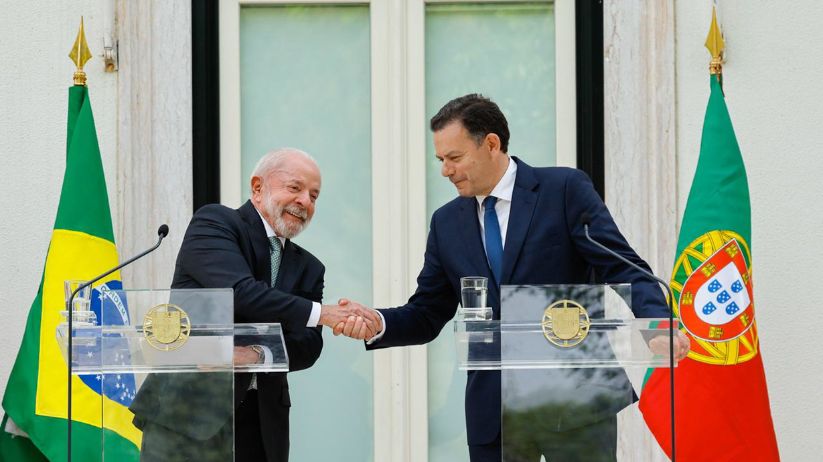
President Luiz Inácio Lula da Silva was in Lisbon this Tuesday (21), where he met with Portuguese Prime Minister Luís Montenegro. On the occasion, Lula reinforced the Brazilian position in defense of multilateralism and against wars, celebrated the Mercosur-European Union agreement and praised the relationship between the two countries, praising the profile of Brazilians, who are often victims of xenophobia in Portuguese territory.
“An important thing in the Brazil-Portugal relationship is that, historically, we have shown that harmony between States is the most effective way to build productive partnerships”, declared Lula.
He then said: “Everyone knows that I am a defender of multilateralism and an enemy of unilateralism and protectionism. Everyone knows that we are on a journey around the world so that we can make changes to the United Nations Security Council and its statutes to give it (the UN) the meaning of existence for which it was created in 1945.”
Lula highlighted that it is not possible “not to have any institution capable of trying to temporize, harmonize and end the number of wars that we have in the world today”.
Harmony to negotiate
When discussing relations between the two countries, Lula highlighted that support for the viability of the Mercosur-European Union agreement reaffirms Portugal as “the great gateway for Brazilian business interests” on the continent.
And he reinforced: “but we don’t want Portugal to be just the gateway; we want Portugal to be the gateway to building a robust partnership between two countries that have known each other since April 1500”.
Find out more about Lula’s trip to Europe:
Brazil is tired of being treated like a poor and small country, says Lula in Germany
“We have to replace discouragement with dreams, hatred with hope”, says Lula
The risk that the extreme right brings to democracy is not rhetorical, it is real, says Lula
No president has the right to impose rules on other countries, says Lula
One of the points of greatest resistance to the agreement was the fear of European farmers, especially from France, of seeing their products lose space to those from South America, mainly Brazil. Regarding this aspect, Lula said that “we have complementarity between our agriculture”.
The president also highlighted that international trade “only works if you don’t want to suffocate your customer” and said he wanted “our relationship with the European Union to be as sophisticated as possible”.
Lula reinforced that Brazil aims to maintain good relations with all countries. “What we want is multilateralism, harmony and a lot of peace so we can negotiate”, he stated.
Xenophobia against Brazilians
In the middle of his speech, President Lula highlighted that “if there is a hard-working people, it is the Brazilian people. If there is a people who like to work and who learn very easily to do things, you can be sure that they are the Brazilian people.” He also said that the Brazilian people are a mixture of races “of which we are very proud”.
The president’s speech comes after several episodes of prejudice by Portuguese against Brazilians that have occurred in recent years, especially amid the wave of xenophobia by Europeans against immigrants from countries in Latin America, Africa and Asia, strengthened and amplified by the action of the extreme right.
Regarding this, Prime Minister Luís Montenegro highlighted the positive nature of the Brazilian presence in the country. “The Brazilians who seek Portugal, of which there are currently more than 500 thousand, have come to work, to develop their life projects, and have had an absolutely impeccable social and economic integration”, he stated.
He added that specific situations do not reflect the entire relationship between communities. “This does not mean that there could not have been, here or ‘there’, a source of disturbance,” he said.
Lula’s visit to Portugal ends the president’s mission to Europe, which included commitments in Spain and Germany. The agenda was marked by the intensification of political dialogue, the promotion of investments and the strengthening of strategic partnerships, in addition to the defense of central themes of Brazilian foreign policy, such as democracy, sustainable development, multilateralism and the reduction of inequalities.
Source: vermelho.org.br