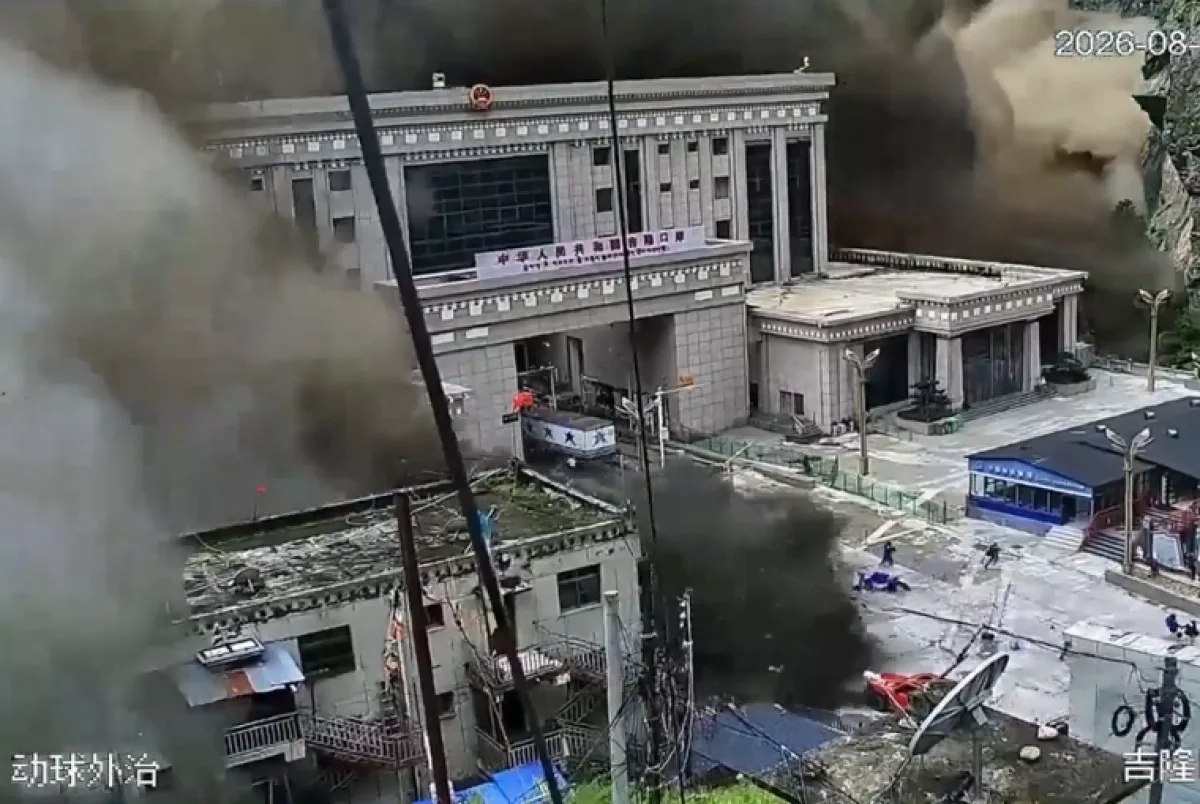
The death toll in the flood that hit Nepal and Tibet, in China, rose to 362, with 1,384 people still missing, according to reports updated this Thursday (27) by the two countries. On the Nepalese side, the police count 359 dead and 826 missing across eight districts. On the Chinese side, in the Tibet Autonomous Region, local authorities confirm three deaths and 558 missing, of which 260 are foreigners.
In Gyirong, Tibet, Chinese Prime Minister Li Qiang followed the rescue operations this Thursday. The central government determined priority for the search for the missing, the care for the injured and the evacuation of residents from threatened areas — a line that follows the determination of President Xi Jinping, who had already ordered a large-scale rescue operation shortly after the disaster, on Wednesday (26).
In the last few hours, China has increased the number of troops deployed in the border region with Nepal. According to the newspaper Global Timesa first group of 141 rescuers had already arrived at the Gyirong post on Thursday morning, and a Mi-171 helicopter adapted for high-altitude operations also reached the area. A chartered flight carried another 111 members of search and rescue teams, with equipment for detection, rescue, demolition and communication.
Also according to the newspaper, another 300 people from the Lhasa and Chengdu engineering rescue bases were transferred to the site, with 120 sets of equipment. A Y-20 military transport plane was also sent, carrying a command group from the Tibet Military Region to reinforce the coordination of operations; at noon, two more helicopters from the Tibet Military Command joined the search, carrying medical and rescue equipment.
The Chinese government allocated 120 million yuan (approximately R$89 million) for emergency operations in Tibet and another 100 million yuan (approximately R$74 million) for the recovery and reconstruction of the affected areas.
Searches continue in Nepal
In Nepal, the flood began on Wednesday morning (26) in the Rasuwa region, in the north of the country, and advanced along the Bhote Koshi and Trishuli rivers until it reached eight districts, destroying houses, roads and bridges. Helicopters continue to be used to evacuate isolated residents and take teams and supplies to locations that cannot be reached by land.
The Nepal Police distribute the 359 deaths across eight districts: 17 in Rasuwa, where the phenomenon began and roads and bridges were destroyed, isolating communities; 28 in Nuwakot; 33 in Dhading; 132 in Chitwan; 30 in Gorkha; 22 in Tanahun; 82 in Nawalparasi East and 15 in Nawalparasi West.
Among those missing in the country are 85 members of the Nepalese security forces. The Nepal Tourism Board had registered 644 tourists and travelers without contact — 517 foreigners, from 32 countries, and 127 Nepalese —, as well as residents and workers, reaching 826 missing. Indians form the largest group among non-localized foreigners, with 178 people; There are also Americans, Ukrainians, Malaysians, Australians, British, Canadians, Japanese, South Koreans and Russians, many of them on trekking and pilgrimage routes that lead to Tibet and Mount Kailash.
The disaster was caused by the collapse of a glacier, which triggered the flow of water, ice, rocks and debris through the region’s valleys. The United States Geological Survey (USGS) even identified a seismic signal associated with the episode, but later ruled out that it was an earthquake. Experts remain alert to the risk of a new flood: a blockage has formed in a river in the border region between Nepal and China, and authorities are also monitoring, on the Tibetan side, an area dammed by the movement of earth and ice.
The port of Gyirong, one of the main land connections between China and Nepal, was also hit by the flood. The pass had previously been affected by another major flood in 2025.
Rasuwa and Gyirong are separated by the border, but they are part of the same river system that runs down from the mountains. The International Center for Integrated Mountain Development (Icimod) advocates sharing data between Nepal, China and other countries in the Hindu Kush-Himalayas and strengthening early warning systems in the region, as information on river levels and slope conditions can be decisive for communities downstream, even when the phenomenon begins in the territory of the neighboring country.
Searches continued this Thursday on both sides of the border. In Nepal, teams roamed riverbanks and areas covered in mud and debris, while helicopters brought rescuers and supplies to isolated locations. In Tibet, work was concentrated in the Gyirong region and close to the border crossing, where teams also monitored the conditions of rivers and slopes.
Source: www.brasildefato.com.br