The announcement of an energy agreement between the governments of Venezuela and the United States, held last Friday (28), marks a turning point in diplomatic and commercial relations between Caracas and Washington.
The negotiation takes place after ten years of a severe economic blockade and unilateral sanctions imposed by the United States, which suffocated the South American country’s economy. Under the impact of these sanctions, Venezuelan oil production plummeted from historic levels of around 3.5 million barrels per day to less than 300,000 barrels per day in 2017.
To try to reverse this crisis and rebuild its main economic sector, Venezuela carried out reforms in its hydrocarbons legislation, seeking to attract international and private capital.
In this fragile scenario, Venezuelan geopolitical analyst Miguel Jaimes emphasizes that substantial and harsh pressure from Washington has stifled the country.
“Venezuela has been suffocated for the last ten years by the issue of the blockade. And the United States has also put pressure in a substantial and harsh way”, points out the analyst. “Venezuela has proven all the scenarios that any country has proven, which has also had much more regrettable situations. In its territory, as it is an oil nation, it will always be threatened, conditioned and persecuted”, he highlights.
In the same sense, Venezuelan political scientist and historian William Serafino points out that, faced with a dysfunctional economy, overheated and deeply damaged by the blockade, the Venezuelan government had clearly reduced options, requiring immediate reconstruction and “escape valves”.
Serafino adds that the geopolitical weakening of the left on the continent and the lack of active interest from partners such as China and Russia in challenging the United States in the region have left Venezuela isolated in the negotiation.
“Trump knows he is winning and has a powerful advantage on the board. The continent is geopolitically fragmented and the left is in retreat. Neither China nor Russia seem interested in challenging the United States’ imperial claim over the region. In this scenario, the options are clearly reduced, in the midst of an overheated, dysfunctional economy harmed by the blockade, which requires escape valves and immediate reconstruction”, he argues.
Geopolitics, power asymmetry and strategic interests
The two analysts present complementary views on the correlation of forces and the real motivations behind the agreement. Jaimes argues that the sanctions applied against Venezuela ended up being counterproductive for the United States itself, which forced Washington to resort to Venezuelan reserves as a regulatory factor for its own market and to provide legal security for its private companies.
On the other hand, Jaimes recognizes that this is not the best time, especially after the United States’ military aggression against Venezuela and the kidnapping of President Nicolás Maduro and the first lady and national deputy Cilia Flores, on January 3 of this year.
“Perhaps, if we had another moment, this agreement would have been different, but unfortunately it was not, because it is not easy for any country in the world, or a country as small as Venezuela, to fight against the United States, against its strategies, its opulence and its weight”, argues the expert.
“They kidnapped and took the President of the Republic – continues Jaimes – there were 130 dead in January. They came and took him, in other words, there is no respect for international law, nor does anyone come to help us in the world”, he recalls.
On the other hand, Serafino analyzes the transaction from the perspective of the profound asymmetry of power and the history of foreign coercion in Latin America. For him, the pact ensures strategic and economic advantages that serve the historic Monroe Doctrine, which aims for exclusive geopolitical control of the region and preferential access to strategic resources.
“The agreement is structured in an asymmetrical way: the United States obtains strategic advantages, both geopolitical and economic, within the doctrinal structure of what Washington called the ‘Monroe Doctrine’, which implies exclusive geopolitical control over the Latin American and Caribbean region and preferential access to the exploitation of its strategic resources”, he assesses.
Risks, uncertainties and the perpetuation of the ‘oil culture’
Analysts warn of the long-term consequences that the agreement carries. Jaimes highlights the existence of non-public terms and counterparts under the current conditions of management of the international geopolitical board.
“And not everything has been said, not all the cards are placed on the table in the new management of the international oil geopolitical board and the role that Venezuela plays”, he ponders.
Serafino warns that, although the pact brings short and medium-term financial relief, it also contributes to the perpetuation of an “oil culture”, which has historically served as a tool of economic occupation and external pressure. According to him, this culture legitimizes exploitation by introducing values and social interactions that support the constant need to export crude oil.
“The United States laid the foundations for the social legitimization of its energy exploration, introducing a system of values and forms of social interaction that would socially support the ‘need’ to continue exporting crude oil. I believe that the agreement reinforces these dynamics, not through an explicit decision or intention of the signatories, but because it constitutes the structure in which the nation’s politics and social aspirations unfold”, he argues.
For the Venezuelan political scientist, the terrain is still uncertain, and it is still too early to assess the material effects of the agreement, especially in improving the quality of life of the Venezuelan people. “It is necessary to wait and see how the contracts will materialize, which principles of the Hydrocarbons Law will end up prevailing and how the political dynamics will unfold once the American company designated by Trump begins operations on Venezuelan soil”, he assesses.
The details of the agreement
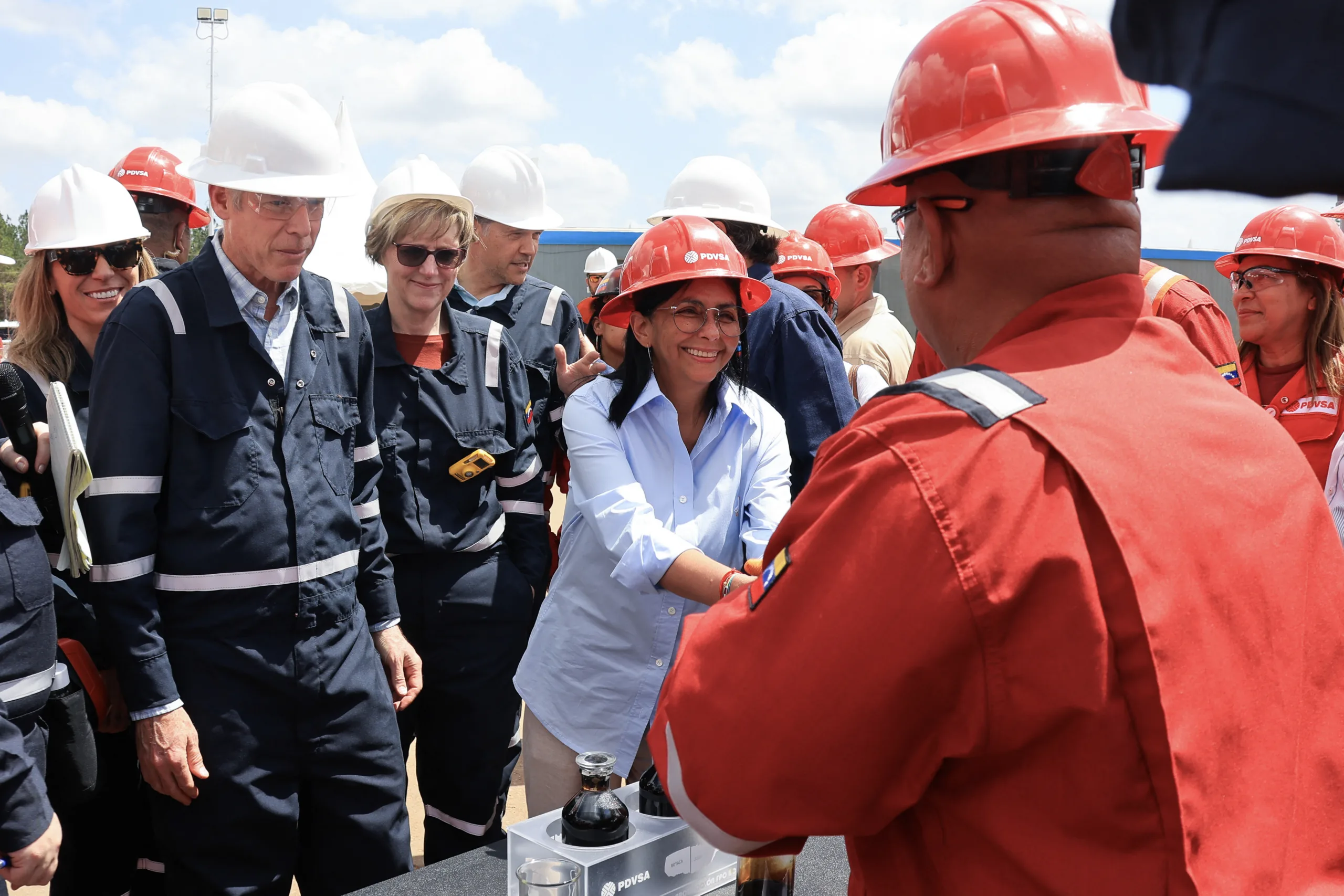
The structured partnership between Venezuela and the United States establishes specific terms for exploration, investments and profit sharing for the next 25 years. The planning includes the development of 17 strategic oil fields and the operation of private oil companies in eight green blocks in the Orinoco Oil Belt.
With this binational operation, the established operational target is to achieve a production of more than one and a half million barrels of oil per day, focusing on a projected reserve of 65 billion barrels, which represents 20% of the South American country’s total proven reserves.
In financial terms, it is estimated that a global investment of more than US$100 billion will be attracted in the national oil industry. For the Venezuelan State, the expectation of total revenue in taxes and duties exceeds US$209.335 billion, a calculation based on an average reference price of US$65 per barrel of crude oil. Of this amount, it is projected that around US$19 for each barrel produced and sold will enter directly into the national economy to be reinvested in public health, education, basic services and road infrastructure.
The tax model stipulates a minimum royalty rate of 16%, that is, higher than the rate charged by Brazil, which varies between 5% and 15%. In addition, there will be a 34% charge in Income Tax which, in the Venezuelan case, is levied on the distribution of profits and dividends.
Despite the rhetoric of the President of the United States, Donald Trump, that there would be total control over Venezuela’s oil reserves, the Venezuelan government ensures that the country maintains 100% ownership and sovereignty over its deposits and national energy resources, as stipulated by the country’s Constitution.
Source: www.brasildefato.com.br