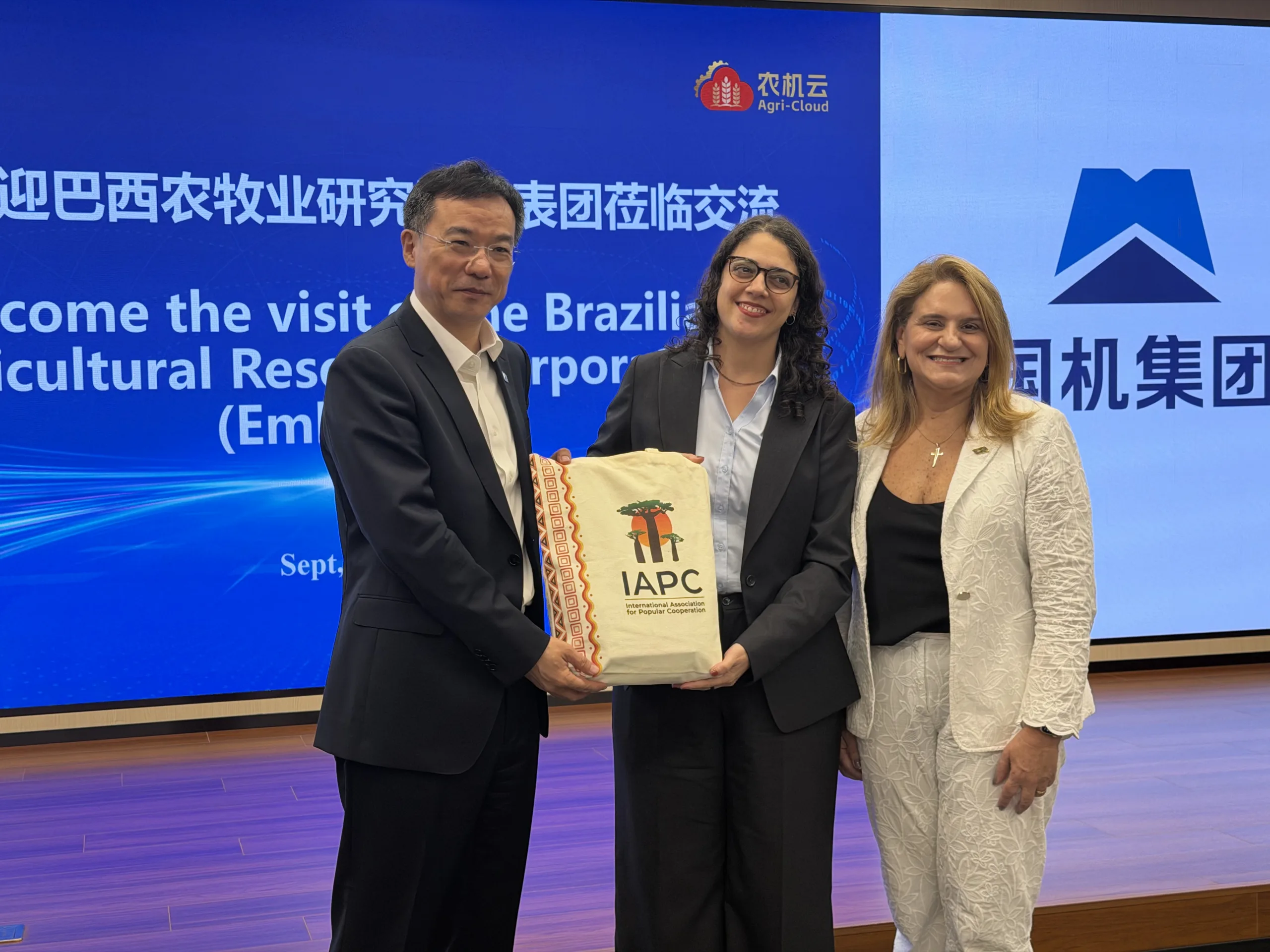
The Brazilian Agricultural Research Corporation (Embrapa) advanced its cooperation with the Chinese state-owned company Sinomach Digital Technology Corporation by signing a Memorandum of Understanding (MoU) to create the Brazil-China Cooperation Center for the Application of Artificial Intelligence in Agriculture, aimed at the digitalization and mechanization of family production.
“This Brazil-China cooperation is very important for adapting technological solutions in the area of digital agriculture, automation, robotics and artificial intelligence, aiming to produce more sustainable, resilient and inclusive food systems,” he told Brazil in fact the president of Embrapa, Sílvia Massruhá, exclusively.
“Family farming occupies a central position in the Brazilian agricultural system. It constitutes a fundamental pillar to ensure national food supply and food sovereignty”, said Chen Yang, who is part of SinomachDT’s Smart Agriculture Business Unit, to BdF. For her, the fact that the MOU prioritizes the family farming sector “reflects the vision shared by the five partner institutions”.
In addition to Embrapa and the Chinese state-owned company, the Nanjing Agricultural University (UAN), the Jiangsu Academy of Agricultural Sciences (Acaj) and the International Association for Popular Cooperation (AICP), also known as Baobab, are part of the agreement. The agreement was signed on Monday (21), in Nanjing, capital of Jiangsu province, where Sinomach Digital is headquartered.
The center will not have a physical headquarters or legal personality, will be a five-year collaborative work program, and will involve short-term staff exchanges, creation of intelligent machinery demonstration centers, joint research and development, and joint applications for funding in both countries.
This memorandum is the continuation of another MOU signed in July last year, also between Embrapa and Sinomach Digital, in Brasília (DF). It was incorporated into the bilateral memorandum signed by the National Development and Reform Commission (CNDR) of China and the Civil House of the Presidency of the Republic within the framework of the BRICS Summit.
In November 2024, Sinomach Digital, the Agricultural University of China (UAC) and the University of Brasília (UnB) had already opened a rural science and technology center focused on family farming in the Brazilian capital.
Non-central family farming
In his speech at the signing ceremony, Massruhá said that the partnership is very important for the digital inclusion of Brazil’s 5 million small farmers.
“I understand this cooperation as an opportunity for co-development, for joint work. This is a win-win partnership for both countries, and a cooperation based on science”, said the president of Embrapa during the ceremony.
In this sense, she explained that “intelligent agricultural machinery service centers will be created in pilot areas in Brazil, small/medium-sized machinery, sensors, internet of things and AI for monitoring and managing production”.
“Collective-based service organizations will be created so that family farmers benefit from the technological dividends of smart agriculture. Training and strengthening family farming cooperatives are also planned”, detailed Chen.
Massruhá stated that local cooperatives will have a leading role in managing the platform, “contributing to the strengthening of technical assistance and rural extension”. The memorandum also plans to evaluate the integration of demonstration units into the National Technical Assistance and Rural Extension Program (Pronater) and “promote its replication in other family farming settlements in Brazilian states”.
According to the text of the agreement, the data generated by the centers “will be stored, processed and managed under the jurisdiction of the country where they were generated, respecting digital sovereignty and the rights of the respective public authorities and data holders”.
Joint research and cooperation model for the Global South
Joint research should focus on intelligent agricultural machinery, digital agricultural platforms, crop models, among other areas, according to Chen. The cooperation provides support for joint applications for Chinese, Brazilian and international financing programs, “to solve concrete challenges in agriculture through digital technologies and artificial intelligence”, said the member of Sinomach Digital.
Among the goals set for the five-year duration of the agreement are: overcoming bottlenecks in family production, increasing productivity and increasing peasants’ income, according to Chen.
“The agreement opens two-way channels for the exchange of talents and technology, facilitating the cross-border flow of experiences and knowledge, contributes to strengthening the human capital of cooperation, raising the quality and effectiveness of China-Brazil agricultural cooperation, and serving as a demonstrative model of cooperation in agricultural science and technology between the BRICS countries,” concluded Chen Yang.
Source: www.brasildefato.com.br