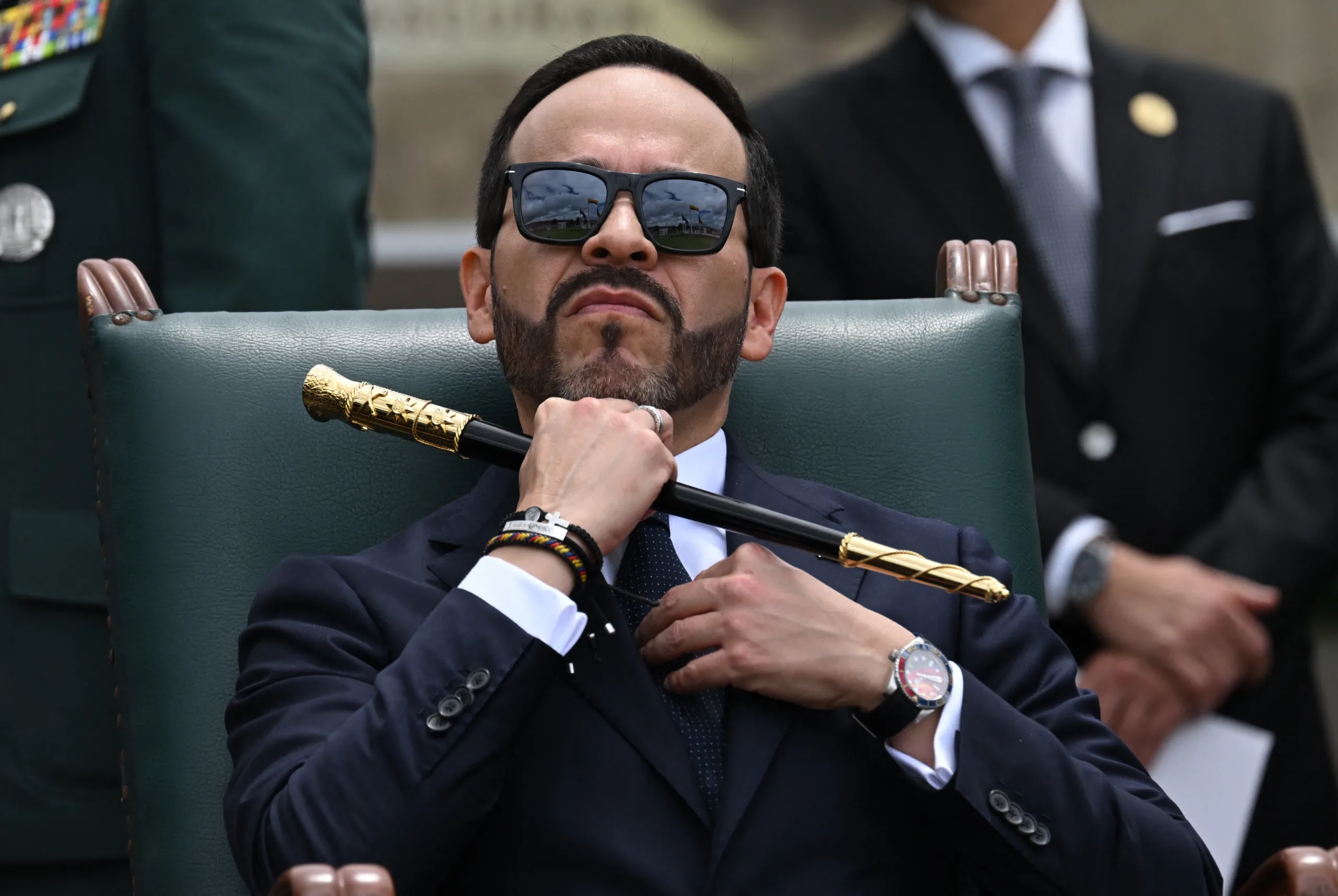
The Colombian government ordered the initiation of police and immigration actions to identify and deport foreigners in an irregular situation in the country. The measure was announced by the far-right president, Abelardo de la Espriella, last Monday (24).
“I will not accept illegal immigrants, wherever they come from, who are committing crimes in Colombia. They will leave or we will deport them,” declared Espriella.
According to the president’s guidance, security agents should initially focus on foreigners who commit crimes and, subsequently, on those who have not regularized their stay in Colombian territory. The plan also includes carrying out police raids and the immediate transfer of prisoners.
Xenophobia
The rhetoric against the migrant population adopted by the recently inaugurated Colombian president, Abelardo de la Espriella, raised alarm bells among human rights defenders and experts, such as the spokesperson and researcher at the Venezuela Observatory at the University of Rosario and professor at the University of La Sabana (Colombia), Ronal Rodríguez. For the expert, the choice of terms used by the recently inaugurated president represents a deliberate alignment with sectors of the continental right.
“Referring to immigrants, both in the campaign and in this first statement as president in office, as illegal, is not a matter of an error, it is a deliberate position of the president, in which he assumes somewhat the discourse of a sector of the Latin American right that has decided to find one of its niches in the anti-migrant narrative. Javier Milei does this in Argentina and, of course, Donald Trump also does this in the United States.”
The researcher considers that, historically, Colombia does not adopt the term illegal, but rather “irregular”, precisely because of the human dynamics and specific needs that characterize this flow in Colombian territory. Which, according to the professor, has the potential to inflame xenophobia in a society in which integration was already complex.
“When a person with a high position needs to address the dynamics and approach to the issue of migration, it ends up generating very strong dynamics of xenophobia”, he assesses.
” of international protection that the Venezuelan population had”, continues Rodríguez.
Venezuelan immigrants in Colombia
Currently, Colombia is home to 2,845,791 immigrants from Venezuela, according to official data from the Colombian government. Of these, according to Rodríguez, 847,894 people are in an irregular situation, of which 527,525 are recognized in this condition and 320,369 are in the process of regularization.
Rodríguez explains that previous regularization measures, such as the Temporal Protection Statute, implemented during Iván Duque’s administration, were not mere acts of charity or Colombian solidarity, but a “pragmatic State security strategy to identify and give name and surname to Venezuelan citizens in the territory”.
“Colombia regularized the Venezuelan population because it was the best strategy, it was the most pragmatic in the face of such a complex and difficult problem. We are neighbors of Venezuela, with a 2,219-kilometer border, and this means that our interdependence makes the issue of human mobility very complex. Colombia has a responsibility. Unfortunately, the government’s speech raises some alarms.”
The researcher’s biggest concern lies with the situation of children and adolescents. Among irregulars, there are 193,213 minors who depend on partnerships with the educational system to obtain regularization. On the other hand, the professor believes that promises to carry out police raids and mass expulsions are unfeasible for the Colombian State.
“There is already concern among some groups of Venezuelans about the dynamics of police raids, which, moreover, are impossible to carry out. If they wanted to remove all irregular Venezuelans, we would be talking about that they would have to carry out operations to at least transfer or expel 215,023 Venezuelans who exist in Bogotá, according to data from Migration Colombia, which would be financially impossible”, assesses Rodríguez.
“A ruler is not elected to do popular things, but rather to do what the State and society demand of him. It seems that the president is more concerned with his image and having a speech and a narrative than actually building a response to one of the biggest challenges facing the Colombian State”, criticizes the researcher.
Ingratitude
On the Venezuelan side, the feeling is one of concern and, above all, of ingratitude, as the country served as home to around 5 million Colombians displaced by the internal armed conflict that lasted more than five decades in the neighboring nation.
The Association for Studies and Defense of Human Rights (Sures) of Venezuela sent a note to the report, in which it expresses strong concern about the recent statements by the president of Colombia and recalls that “although the peoples of Venezuela and Colombia are separated by an extensive geographic border, their deep bonds of fraternity are strengthened daily through sociocultural and economic exchanges rooted in a shared history.”
Sures recalls that, in 2004, the then president of Venezuela, Hugo Chávez, implemented a plan to regularize the situation and grant citizenship to Colombian citizens, free of charge. “These measures allowed thousands of people to formally integrate into Venezuelan society, with full guarantees of their rights”, points out the association.
“Since then, the Venezuelan State has continued to develop migration policies aimed at facilitating mass inclusion and regularization, especially for the Colombian population, despite the geopolitical tensions that have marked relations between the governments of Venezuela and Colombia.”
For Sures, the new Colombian approach focuses on repressive measures and the application of sanctions, which can worsen the vulnerability of migrants. The organization warns that focusing on repression fuels discrimination and xenophobia against the Venezuelan population in the neighboring country.
“Undoubtedly, the Colombian government’s statements generated concern, causing unrest among families with different migratory situations in that country. For this reason, Sures maintains its commitment to promoting quantitative and qualitative studies that help clarify the multiple causes that drive complex social phenomena, such as migration and human mobility”, says the statement.
“We believe that this matter should be dealt with, primarily, within the scope of a binational policy. It is essential to understand the Venezuelan migratory phenomenon in its proper context, in order to avoid situations that fuel discrimination and xenophobia”, concludes the text.
Source: www.brasildefato.com.br