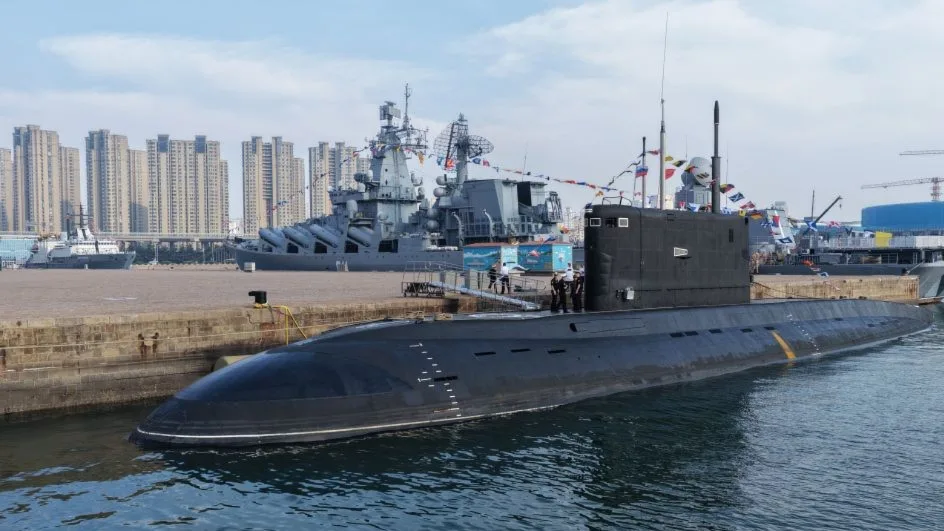
China and Russia have been carrying out the joint naval exercise “Joint Sea-2026” since Monday (6), near the city of Qingdao, home to one of the main bases of the People’s Liberation Army Navy, in the Chinese province of Shandong. The maneuvers will continue until next Monday (13) and will be followed by joint patrols in the Western Pacific, reinforcing military rapprochement between Beijing and Moscow.
The exercise takes place in a context of increased military presence by the United States and its allies in the Indo-Pacific, a region that concentrates part of the strategic dispute between the great powers. Although China and Russia claim that the activities are part of the annual training calendar between their Armed Forces, they take place amid intensifying military competition in the region.
This week, Beijing also announced the successful launch, from a submarine towards the Pacific Ocean, of a ballistic missile capable of carrying nuclear warheads. According to the Chinese government, the test used a simulated warhead to assess the reliability of the weapons system and the level of readiness of strategic forces.
Since the start of the war in Ukraine in 2022, Beijing and Moscow have expanded diplomatic and military coordination, intensifying exercises at sea and in the air, as well as strategic patrols in different areas of the Asia-Pacific.
For China and Russia, these activities are defensive in nature and are not directed against third parties. The strengthening of this partnership, however, occurs at a time of reorganization of military alliances in the region. In recent years, the United States has strengthened cooperation with Japan, South Korea, the Philippines and Australia and promoted initiatives such as the AUKUS alliance, aimed at sharing advanced military technologies, including nuclear-powered submarines.
Beijing considers this move part of a containment strategy led by Washington. The Chinese government accuses the United States of militarizing the Indo-Pacific and encouraging tensions on issues considered central to its national security, such as Taiwan and the South China Sea. Moscow shares a similar assessment and defends a multipolar international order, a position reiterated in successive joint statements between the two governments.
Joint Sea-2026 expands naval and military cooperation between China and Russia
Held since 2012, the Joint Sea has become the main joint naval exercise between China and Russia and one of the most visible symbols of the military rapprochement between the two countries. Over the last decade, maneuvers have passed through the Yellow Sea, Sea of Japan, South China Sea, Mediterranean Sea, Baltic Sea and Arabian Sea, following the expansion of the partnership between Beijing and Moscow.
In the 2026 edition, according to the Chinese Ministry of Defense, training is divided into three phases: concentration of forces, joint planning in port and operations at sea. After the official opening, Chinese and Russian militaries set up a joint command center to coordinate activities.
Russia participates with a naval group led by the missile-launching cruiser Varyag, flagship of the Pacific Fleet, as well as the frigate Rezkiy, the submarine Ufa and the rescue ship Igor Belousov. China mobilized the Type 055 Anshan destroyer, one of the most modern in its fleet, the Type 052D Kaifeng destroyer, the Type 054A Wuhu frigate, as well as submarines, support ships, embarked helicopters and marine units.
Exercises include maritime reconnaissance, air and missile defense, anti-submarine warfare, search and rescue operations, weapons training, communications and tactical coordination. The activities also seek to expand interoperability between the two navies, allowing coordinated operations and greater integration between their command systems.
Once the training is completed, Chinese and Russian vessels will go on joint patrols in the Western Pacific. Unlike exercises, these missions consist of navigation operations in international waters and have become more frequent in recent years. According to Beijing and Moscow, the objective is to increase operational coordination between the two navies and contribute to the security of the region’s maritime routes.
Nuclear-capable ballistic missile test reinforces China’s deterrence strategy
The launch on Monday involved a submarine-launched ballistic missile, known by its acronym in English SLBM (Submarine-Launched Ballistic Missile), one of the main platforms of a military power’s nuclear deterrence strategy. Unlike systems installed on land bases, strategic submarines can remain hidden for long periods, increasing a country’s survivability in a possible nuclear conflict scenario.
China has not officially disclosed the model of the missile used nor the submarine responsible for the launch. Experts, however, follow the development of the JL-2 and JL-3 systems, ballistic missiles designed to be launched by Chinese strategic nuclear submarines. The JL-3 is considered a technological evolution compared to the previous model, with greater range and the ability to carry multiple warheads, although technical details remain confidential.
The test takes place amid the modernization process of Chinese strategic forces. For decades, Beijing maintained a nuclear arsenal significantly smaller than that of the United States and Russia, but in recent years it has started to invest in expanding and diversifying its capabilities, including new ballistic missile-launching submarines, long-range land systems and storage and launch structures.
Strategic nuclear submarines represent a central element of this transformation. China operates the Jin class (Type 094), responsible for transporting submarine-launched ballistic missiles, and is working on developing future, quieter and more advanced platforms. The Yulin naval base, on the island of Hainan, is considered one of the main Chinese facilities for operations of this type of vessel, due to its strategic location close to the South China Sea.
Beijing’s declared objective is to maintain a deterrent capacity and ensure that its strategic forces can survive a possible first attack. China claims to follow a policy of not carrying out the first use of nuclear weapons, but argues that it needs to modernize its military capacity in the face of changes in the international environment.
The launch took place during the same period as Joint Sea-2026, a naval exercise that brings together Chinese and Russian forces off the coast of China. Although Beijing does not officially present the two activities as related operations, both highlight the growing importance of maritime dominance in Chinese security strategy and come at a time of increased military competition in the Indo-Pacific.
The test also generated questions from foreign governments about transparency and prior communication. While China classified the launch as a regular training activity, countries in the region are closely monitoring the expansion of Chinese strategic capabilities and their possible impacts on the military balance in the Asia-Pacific.
Source: www.brasildefato.com.br