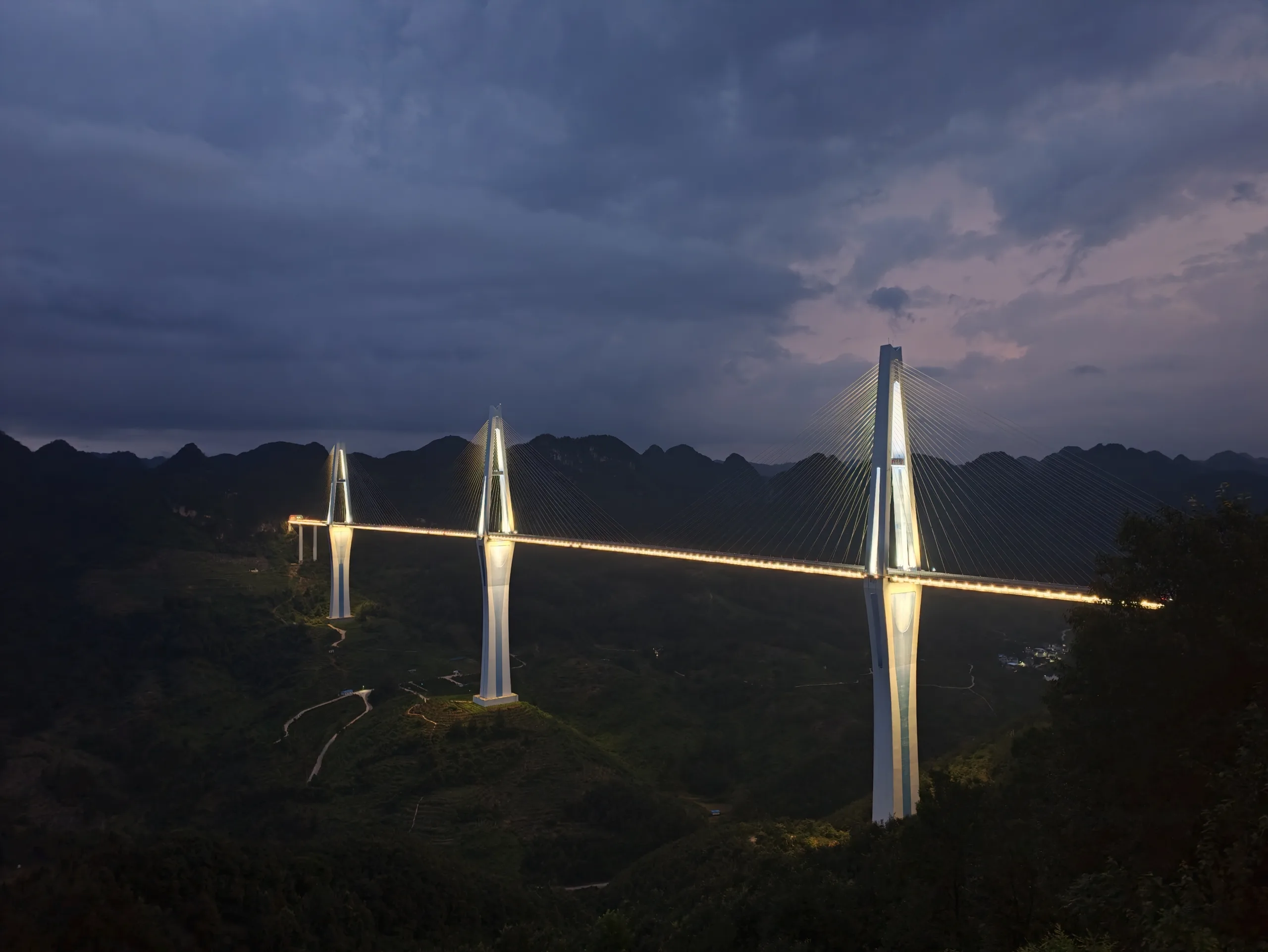
The Pingtang Bridge, located in the interior of Guizhou province and built to connect ethnic communities in the region, holds the world record for the tallest concrete tower and has received four international civil engineering awards. The work was inaugurated on December 31, 2019 and is part of the highway that connects Pingtang and Luodian, in the south of the province. Travel time between these two counties plummeted from two and a half hours to just one hour.
With around 38.5 million inhabitants, Guizhou is the province with the most bridges in China: there are more than 30 thousand, built or still under construction. In terms of number of road tunnels, it ranks third nationally, with almost 3 thousand. The province needs this infrastructure, as 92.5% of its territory is covered by mountains and hills.
The most iconic bridge is in Pingtang County, Qiannan Buyei and Miteao Autonomous Prefecture. It is 2.1 km long and has three pillars. One of them is the record holder, 332 meters high, the equivalent of 110 floors.
The report from the Brazil in fact was in the region and spoke with Shen Mingxuan, professor at Guizhou University and head of the road, bridge and tunnel engineering department. He talks about the importance of the work: “Before the bridge was built, going from one side to the other meant traveling along the winding road at the bottom of the mountain, which took a lot of time”, he says.
“Ethnic minority communities live on both sides of the valley. After the bridge was completed, transportation conditions for these groups improved significantly. What used to take more than an hour can be done in a few minutes,” says Shen.
The international civil engineering awards received by the work were the Gustav Lindenthal Medal, the Design Award from the International Federation of Consulting Engineers, the Outstanding Infrastructure Award from the International Bridge and Structural Engineering Association, and the 2023 Luban Award, the highest honor in Chinese civil engineering.
The project incorporates elements of the local people, mainly the Buyi, one of the 56 ethnic groups in China. The contour of the pillars reproduces the profile of the skirts. “You may have noticed the bridge’s characteristic blue color; this shade is inspired by the traditional costumes of local ethnic minorities, giving the structure striking regional cultural traits,” says Shen.
After the bridge was ready, a complex with a hotel, camping area, engineering museum and an astronomical observatory was installed near it, being the first national project that aims to promote tourism around a bridge.
“In recent years, statistics show that a large number of tourists stop at this post during holidays,” says Shen. “They come to see the bridge and spend money in the region, boosting regional economic growth.”
According to Shen, in recent years all counties have access to express highways and all prefecture-level cities are connected to high-speed rail.
“Improved transportation brings waves of tourists,” says the professor. “Young people who live in the mountains can leave remote areas in search of opportunities. Agricultural products from the region have also started to be transported out of the mountains more efficiently.”
Source: www.brasildefato.com.br