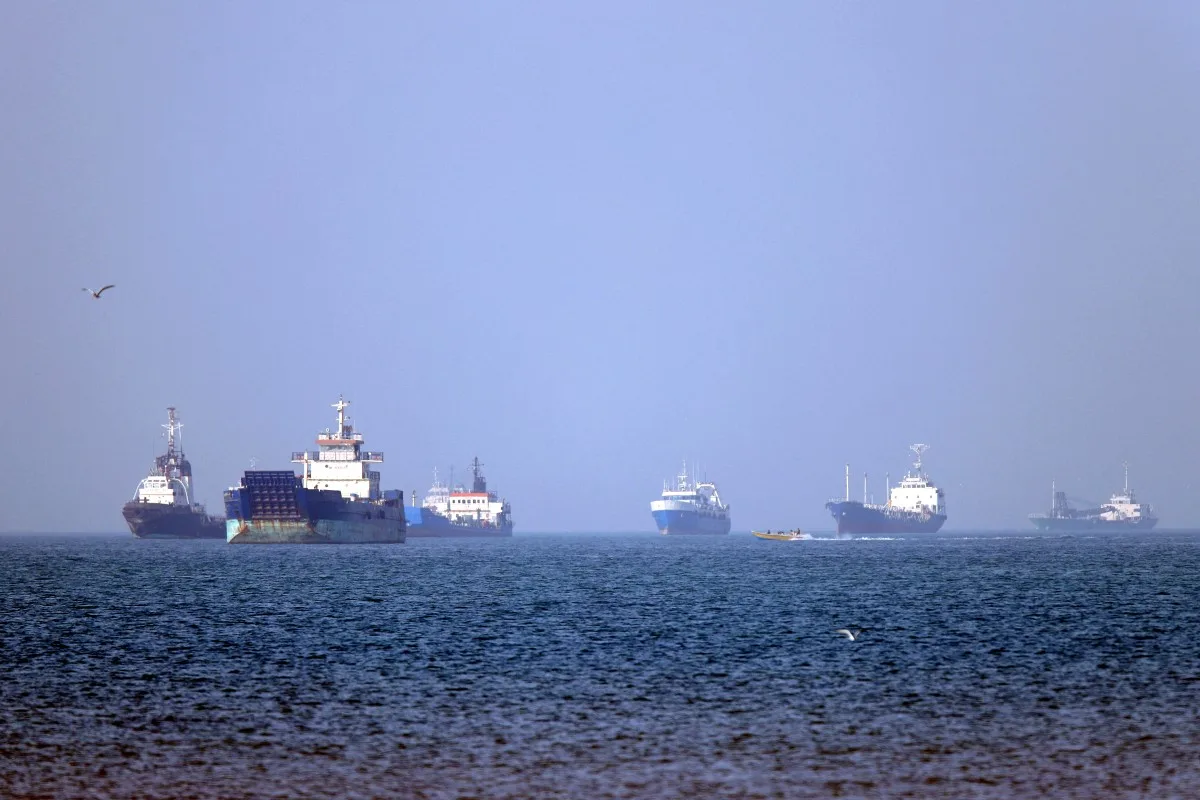
The Strait of Hormuz has been at the center of global concerns in recent months due to attacks by Israel and the United States against Iran. Since the retaliatory measure announced by Tehran, which decided to close the route through which much of the world’s oil passes, practically the entire global energy security ecosystem has been urged to remodel itself. Now, Iran and Oman have agreed to draw up a temporary sea route so that ships can transit Hormuz.
The information was confirmed last Tuesday (25) by Iranian Deputy Foreign Minister, Kazem Gharibabadi. Speaking on Iranian state television, Gharibabadi explained that the two countries agreed that entry into the new route must begin in Iranian territorial waters and that part of the exit route will also be through Iran. In total, the transit corridor will be 11.3 kilometers long.
The agreement is part of a complex agreement between the two countries. According to the Islamic Revolutionary Guard Corps, negotiations began about a month ago. “We reached results that were accepted by both parties. Agreements were reached on the share of each country in the waters of the strait and on the share of Iran and Oman in the revenues arising from it,” the group said, without giving further details.
What is the strategic weight of the agreement
The war between the USA/Israel and Iran turns six months old this week. Long before the conflict began, the possibility that Tehran would block the Strait of Hormuz in the event of an eventual attack always worked as a strong card for the Persian country, and analysts, over time, have always speculated about the real effects of a hypothetical action of this nature. With the shutdown coming to light in the first half of the year, the energy market, notably the oil market, entered a spiral of volatility rarely seen in recent history.
With Hormuz practically paralyzed, around 6,000 sailors have already been blocked. Maritime traffic, whose daily average was 95 crossings per day in February, according to agency data Kplerwas reduced to no more than 10 crossings daily. Furthermore, Iran began using mines installed there, which created, according to the Revolutionary Guard, a “danger area” of around 1,400 square kilometers.
The United States, which failed in its attempt to obliterate Iran’s power structure through military means and is trying to lead Tehran to surrender through economic strangulation, is playing hardball in any management of Hormuz. Due to the rigid situation, Iranian negotiators began to convince Oman, a relatively neutral and proactive country in the diplomatic field, to create an alternative route. This is the background of the sewn arrangement.
In a statement this week, Gharibabadi made a point of emphasizing that the transit route agreed with Oman is temporary, and that the movement does not indicate that the strait will be reopened. For Iran, a definitive reopening is only possible if the US accepts the terms of the peace agreement proposed in June, but which remains stuck.
According to information from the agency Tasnimthe Iran-Oman agreement also provides for a joint demining project. In a joint statement by the foreign ministers of Iran and Oman (Abbas Araqchi and Sayid Badr bin Hamad, respectively), the authorities cited that “technical negotiations between the two parties will continue with the aim of reaching an agreement on the permanent navigation corridor and the future administration of the strait, as well as a mechanism for sharing information, managing traffic and providing relevant navigation and security services.”
What you need to know
The general guidelines of the agreement came to light, but the fine print of the agreement will determine how the provisional route will be operated. Some important details are still unknown, such as what the exact coordinates of the routes will be, when ships will be able to begin crossing the stretch safely and how, effectively, revenues will be distributed. Iran and Oman have yet to explain what the specific operational protocols will be.
Furthermore, Washington’s reaction to the agreement is awaited. At least in the speech, Trump has been saying successively that the US forces are the winners of the conflict, and that the possibility of Iran determining who can and cannot pass through Hormuz is not admissible.
Another important point is the fact that the USA was not part of the construction of the Iran-Oman agreement. This is an especially problematic point for Washington, which has always considered Oman something of an ally.
This week, the Islamic Revolutionary Guard Corps itself mentioned that the United States was obstructing negotiations between Oman and Iran, which would have led to the delay in the agreement. Washington has not yet commented on the announcement of the agreement, but Trump has been showing every sign that he will not accept the measure. Last week, the Republican mentioned, in an interview with the American broadcaster Fox Newsthat if Oman got “in the way” of the United States, US forces would “bomb them until there was nothing left.”
Source: www.brasildefato.com.br