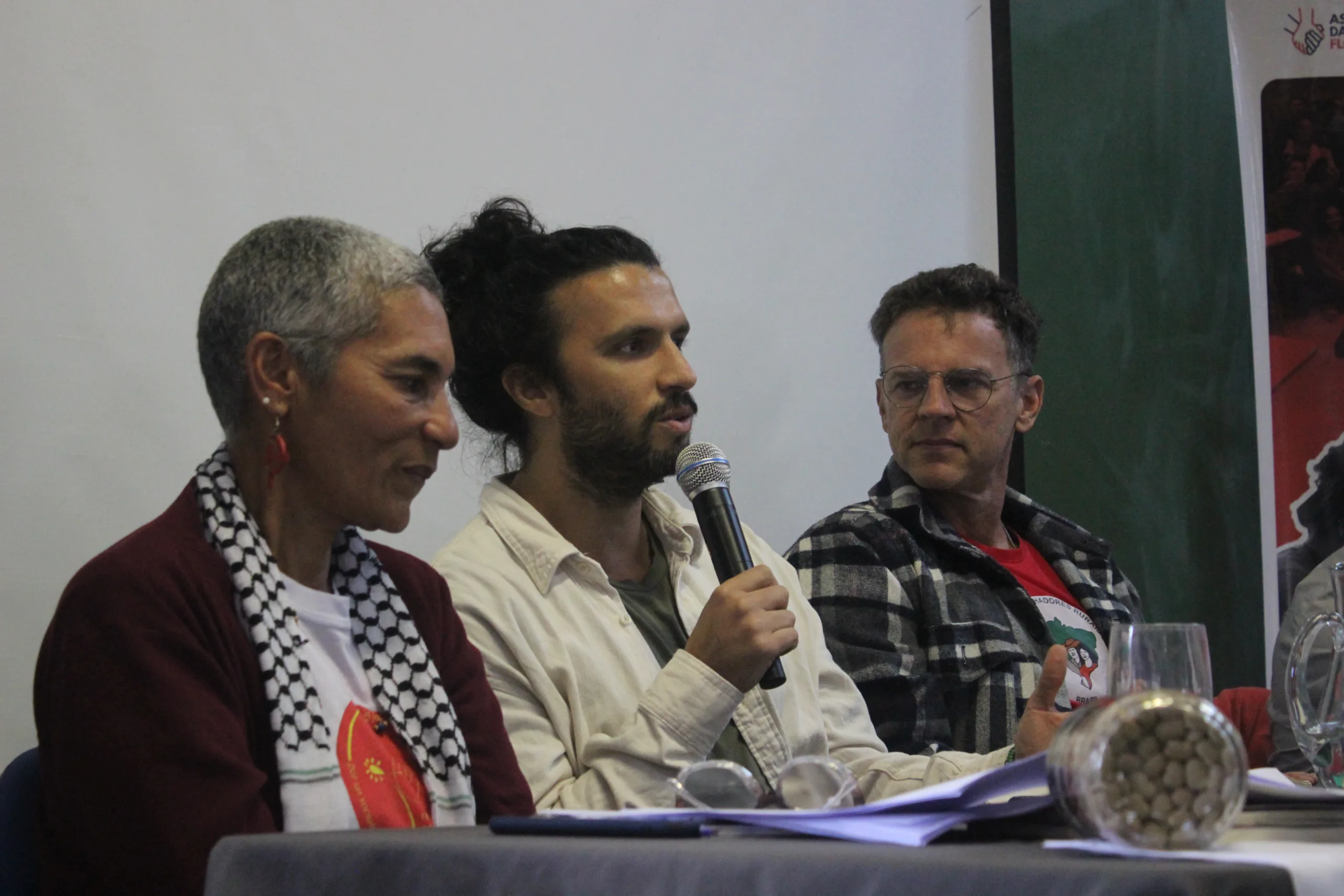
The resistance of the Cuban people to the increasingly intense and inhumane blockade of the United States against the island was the highlight of the panel at the 100 Years of Fidel Castro Debate Cycle, which took place on the 22nd, at Escola Nacional Florestan Fernandes, in Guararema (SP).
The reporter from Brazil in fact and one of the directors of the documentary “Fidel and Socialist Cuba – Burn the Skies”, Rodrigo Chagas, highlighted that resistance against the United States is repeated all the time on the streets of Cuba, especially in the face of the tightening of sanctions that leave the country in an unprecedented economic and energy crisis.
“We hear Cubans repeating all the time: ‘We don’t want to go back to being a colony of the United States’”, says Chagas, who recalled that the US blockade of the island, which is 67 years old, “is an attempt to starve, to make these people suffer, shamelessly”.
Chagas, who was on the island about a month ago, considers that the situation of the Cuban people is “at the level of the imponderable”. “Perhaps at the worst moment from a material point of view, imposed by an inhumane blockade”, putting the Cuban people under “collective stress, to try to overthrow the revolution”.
The journalist points out that the legacy of Fidel Castro, who would have turned 100 this year, is that “we never stop learning” and the importance of the word “revolution”. “The word revolution is very forgotten. We have an audience here that is mostly Brazilians, a very diverse audience. From young people, other people, other young people who are a little older, but this word present in Fidel’s work is something that we have to rescue.”
“I feel that the Cuban people are committed to, in these difficult times, trying to look for examples of struggle in their history to also overcome this new difficult moment”, he added, highlighting the importance of international solidarity at this time.
Unrelenting blockade
The founder of ICL Notícias, Eduardo Moreira, made a historic rescue of the blockade, which began with some restrictions, but was intensifying. “There was no president [dos EUA]whether Democrat or Republican, that had alleviated [o bloqueio]. To be fair, according to some Cuban friends, the only one, who was also terrible, but who did minimally anything, was Obama in relation to tourism, that’s all”, highlighted the presenter, remembering that this change in relation to tourism has already improved and given momentum to the island.
Moreira also recalled that Joe Biden, on the last day of his government, attested: “There is nothing to prove that Cuba financed international terrorism and there has never been any proof of that”, guaranteeing the possibility of ending the sanctions. But the possibility of relief only lasted a day, because Trump came in and greatly extended the blockade.
Moreira also highlighted the discipline of the Cuban people. “There is no greater discipline than in leftist regimes, which managed to resist and managed to make things work, but it is not an imposed and forced discipline, it is a constructed and agreed discipline.”
Solidarity and popular education
Cuban educator and activist of the Martin Luther King Jr. Movement Magda Rodriguez also recalled the solidarity and support of the Landless Rural Workers Movement (MST) and people in general in Brazil for the Cuban people.
In his speech, Rodriguez rescued popular education as “a pedagogical current and ethical, political, cultural movement that has a strong presence in Latin America” and highlighted the influence of Paulo Freire for education for collective and individual well-being, which influenced education in Cuba.
“I always get emotional when I talk about Pablo Freire, because he, above all, highlights that popular education has a very important value, which is humanism.”
The educator also recalled the importance that Fidel Castro gave to education, first with basic issues such as the eradication of illiteracy in Cuba, but also with the reforms that took place in the 1980s, promoted by Fidel, with renewal, when young people demanded an education that “teach how to think”. For Rodriguez, this movement has helped the resistance of the Cuban people at the moment.
Source: www.brasildefato.com.br