Published 06/15/2026 17:11 | Edited 06/15/2026 18:33
President Luiz Inácio Lula da Silva arrived this Monday (15) in Évian-les-Bains, France, for the G7 Summit. Invited by host Emmanuel Macron, Lula is part of a select group of emerging economies — alongside India, South Korea, Egypt and Kenya — called to debate “new partnerships and international solidarity”.
However, behind multilateral diplomacy, the Brazilian mission in French territory is driven by a sense of geopolitical urgency: to circumvent the commercial siege imposed by Washington and Brussels.
Commercial chess and the shield against protectionism
Lula’s participation in the G7 occurs at one of the most hostile moments for Brazilian foreign trade in recent decades. In the United States, Donald Trump’s government not only maintained the USTR investigation that resulted in a 25% tax on Brazilian products — under the allegation that Pix harms American card operators — but also took an unprecedented step by designating the PCC and Comando Vermelho as Foreign Terrorist Organizations (FTO). In Europe, the European Union officially banned the import of meat, fish and honey from Brazil, with effect from September.
Analysis of the scenario indicates that Planalto adopted a “lateral movement” strategy. Instead of directly confronting Trump or the EU in summit speeches, Lula seeks to diversify his alliances to create a geopolitical shield. It is in this context that the meeting with the Prime Minister of Japan, Sanae Takaichi, gains central importance. Brazil intends to lay the foundations for a free trade agreement between Mercosur and the Japanese, taking advantage of the window of opportunity opened by the American trade war. In the same vein, the meeting with the president of Switzerland, Guy Parmelin, aims to unlock and strengthen the South American bloc’s agreement with EFTA (European Free Trade Association).
Strategic bilaterals and Trump’s shadow
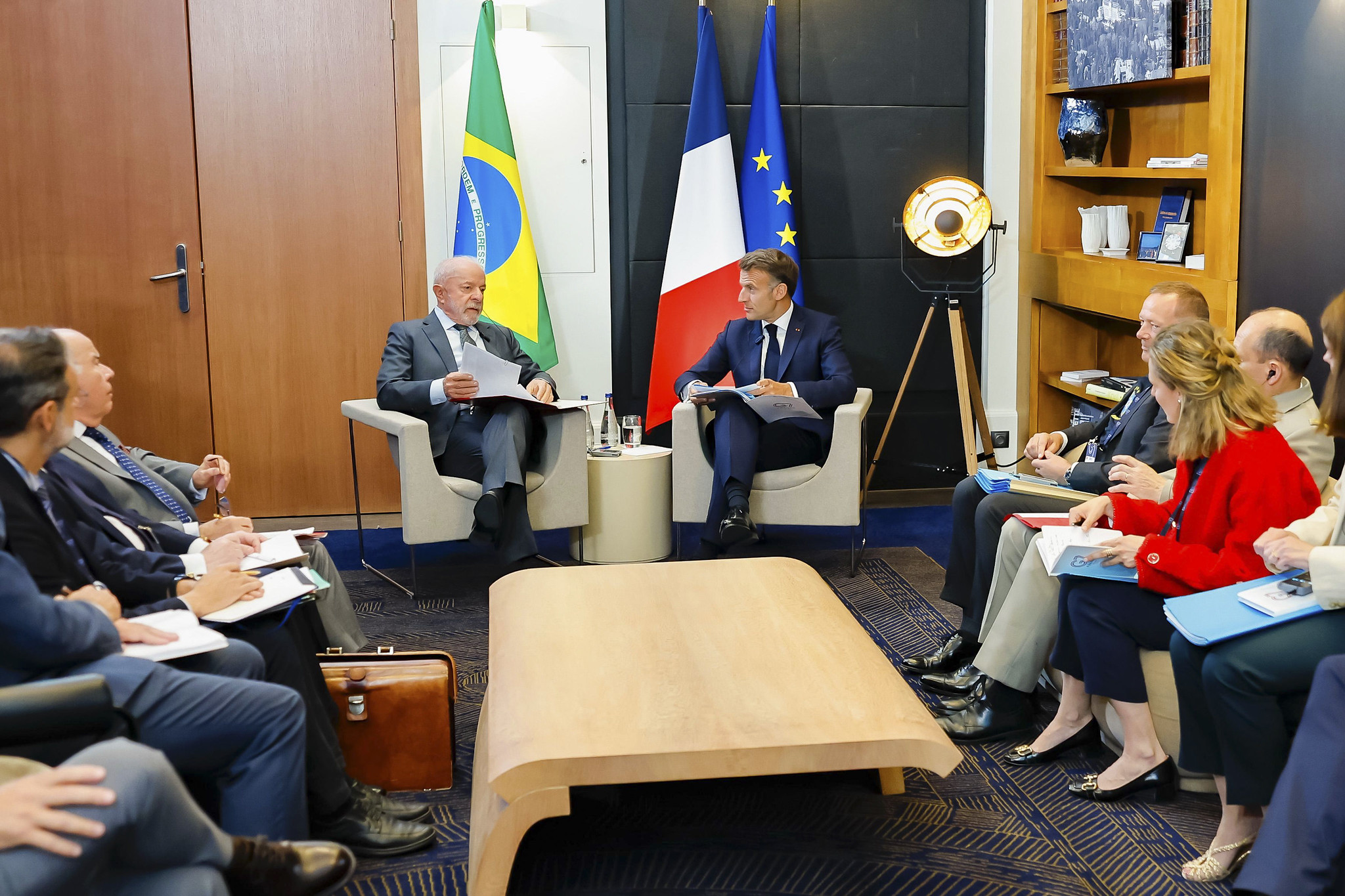
Lula’s bilateral agenda already started intensely even before the official opening of the work. On the border between France and Switzerland, the president met with Parmelin, aligning positions on energy transition, critical minerals and biotechnology. With Emmanuel Macron, the tone was one of cooperation in areas of defense (such as the submarine program) and digital sovereignty (supercomputers), but without hiding the frictions. Macron, who has historically blocked the Mercosur-EU agreement to protect French farmers, saw the European bloc impose sanitary barriers on Brazilian products, a contradiction that Itamaraty classifies as “surprise and concern”.
Behind the scenes, Donald Trump’s presence at the G7 hangs over the event. The Planalto Palace ruled out asking for a new bilateral, arguing that the technical teams have not yet presented the promised proposals to resolve the tariff impasse since the May meeting at the White House.
The global scenario is also dictated by the recent announcement of an agreement between the USA and Iran, whose developments on the Iranian nuclear program and the reopening of the Strait of Hormuz will be thermometers for global energy security, an issue that directly affects the Brazilian industrial matrix.
Global governance, AI and the battle for critical minerals
In the deliberative panels, Lula will assume the role of voice of the Global South. On Tuesday (16), when debating international partnerships, he should demand the expansion of Official Development Assistance (ODA) and the reform of institutions such as the UN and the WTO, criticizing unilateralism without mentioning the USA by name.
The topic of critical minerals, however, promises to be the most tense battlefield. While the USA and China dispute the hegemony of these vital inputs for the energy transition, Brazil will arrive at Évian with a firm thesis: adding value at the extraction site. The Planalto rejects the logic of simply providing cheap raw materials to Western and Asian powers.
Finally, at the lunch on Artificial Intelligence, the Brazilian delegation should echo the global demand for regulation and accountability of big techsaligning with the desires of nations seeking digital sovereignty. Between diplomatic coffees and work sessions, Lula’s 10th participation in the G7 reflects a Brazil that, cornered by the protectionism of the global North, seeks outlets for its development in the South and Asia.
Source: vermelho.org.br