Published 03/09/2026 07:16 | Edited 03/09/2026 15:00
China reaffirmed this Saturday (8) the central lines of its foreign policy by defending multipolarity, strengthening the Global South and respect for international law, at the same time as it called for a ceasefire in the Middle East and criticized unilateralism in the international system.
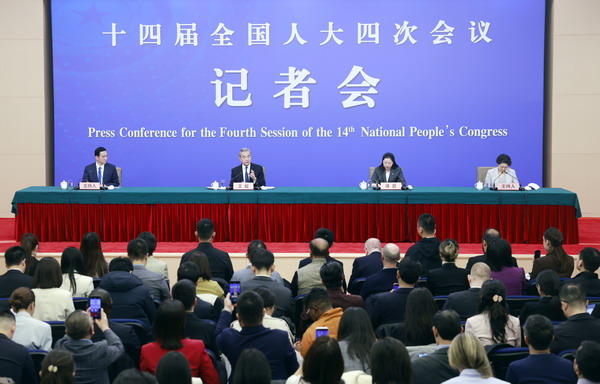
The statements were made by Chinese Foreign Minister Wang Yi during a press conference held on the sidelines of the annual session of the National People’s Congress in Beijing. At the meeting, the chancellor answered questions from media outlets from different countries on the main topics of international politics.
When presenting the general orientation of Chinese diplomacy, Wang stated that the country will continue to defend national sovereignty, international justice and cooperation between States, positioning itself against what he called a policy of force.
According to him, Chinese diplomacy will continue to “firmly safeguard the country’s sovereignty, security and development interests” while upholding international law and opposing unilateral practices.
Also read: Socialism and the Rule of Law in China, by Elias Jabbour
“China’s diplomacy firmly safeguards national sovereignty, security and development interests, firmly upholds the international rule of law and fairness and justice, resolutely opposes all unilateral acts, power politics and intimidation, and stands firmly on the right side of history,” he said.
Wang added that Beijing intends to expand international cooperation around the idea of a “community with a shared future for humanity”, a concept that has been reiterated by the Chinese leadership as the axis of its diplomatic strategy.
Also read: China supports Iran’s right to defense and denounces violation of the UN Charter
China calls for ceasefire in Iran conflict
The military build-up in the Middle East was one of the main themes of the press conference. Asked about the attacks carried out by the United States and Israel against Iran, Wang stated that the Chinese position is clear: to immediately stop hostilities.
According to him, the conflict represents a crisis that threatens to destabilize the entire region and offers no solution to existing problems.
“Seeing the Middle East engulfed in flames, I want to say that this is a war that should not have happened — it is a war that benefits no one,” he said.
The chancellor defended that military operations be suspended to avoid the expansion of the conflict and reiterated that the sovereignty of countries in the region must be respected.
“The sovereignty, security and territorial integrity of Iran and all Gulf countries must be respected and cannot be violated,” he declared.
Wang also criticized the use of force as an instrument of international politics and stated that armed conflicts only tend to deepen tensions.
“The history of the Middle East repeatedly shows that force offers no solution and that armed conflicts only increase hatred and produce new crises,” he said.
Defense of the two-state solution for Palestine
When addressing the war in Gaza, the minister stated that the situation represents a test for the international system and reiterated the Chinese position in favor of a two-state solution.
According to him, the recently reached ceasefire is a positive step, but still insufficient to resolve the crisis.
“There is only one fair and widely recognized solution to the Palestinian issue, and that is the two-state solution,” he said.
Wang added that any international mechanism aimed at managing the post-war period must reinforce — not weaken — this perspective.
The chancellor also stated that the international community must not allow the Palestinian issue to be marginalized again and highlighted the role that the UN must play in leading the political process.
Global governance reform
Another axis of the press conference was the Chinese proposal to reform global governance. Wang said the current international system faces a governance deficit and growing pressures on multilateralism.
According to him, the Global Governance Initiative proposed by President Xi Jinping received support from more than 150 countries and international organizations.
The chancellor explained that the proposal is based on five central principles: sovereign equality between States, respect for international law, multilateralism, a people-centered approach and concrete actions.
“The leadership status of the United Nations must be preserved, not challenged; the central role of the United Nations must be strengthened, not weakened,” he said.
Wang added that global governance reform should expand the representation of developing countries and reflect changes in the distribution of power in the international system.
Also read: Brazil is large and autonomous to deal with an adverse external scenario, says Haddad
Relations with the United States and Europe
When commenting on the relationship with Washington, Wang stated that China and the United States need to avoid the logic of confrontation between great powers.
According to him, interaction between the two countries should be based on mutual respect and peaceful coexistence.
“Turning our backs on each other would only lead to mutual misunderstandings and miscalculations. Sliding into conflict or confrontation could bring disaster to the world,” he declared.
The chancellor also mentioned the possibility of a new round of high-level meetings between the two countries and stated that Beijing hopes to expand areas of cooperation.
Regarding Europe, Wang stated that economic ties continue to strengthen and highlighted that bilateral trade exceeded US$1 trillion.
According to him, relations between China and the European Union are based on shared interests and economic complementarity.
“Facts show that China–Europe relations derive stability from shared interests and certainty from mutually beneficial partnerships,” he said.
Strategic partnership with Russia
Wang also highlighted the importance of the partnership between China and Russia, which he said has been consolidated over decades of cooperation.
He stated that the relationship between the two countries is based on equality and mutual respect and is not directed against third parties.
According to the chancellor, Beijing and Moscow act in coordination on various international issues, including the defense of international law and strategic stability.
Global South and multipolar world
Another central point of the conference was the growing role of the Global South in international politics.
According to Wang, the economic advancement of these countries is one of the main transformations of the world order in recent decades.
“The collective rise of the Global South is the hallmark of the great transformation underway in the world,” he stated.
He highlighted that the participation of these countries in the global economy increased from 24% to more than 40% in the last forty years.
The chancellor defended greater political coordination between developing countries through platforms such as BRICS, the Shanghai Cooperation Organization and the G77 + China group.
Wang also rejected the idea that the international order should be organized around a directory of great powers.
“World history has always been written by many countries together, and the future of humanity will be shaped by the collective efforts of all nations,” he said.
According to him, the Chinese proposal is to build an international system based on “egalitarian and orderly” multipolarity, in which all countries have a role in defining global rules.
Source: vermelho.org.br