Published 05/08/2026 16:33 | Edited 05/09/2026 16:37
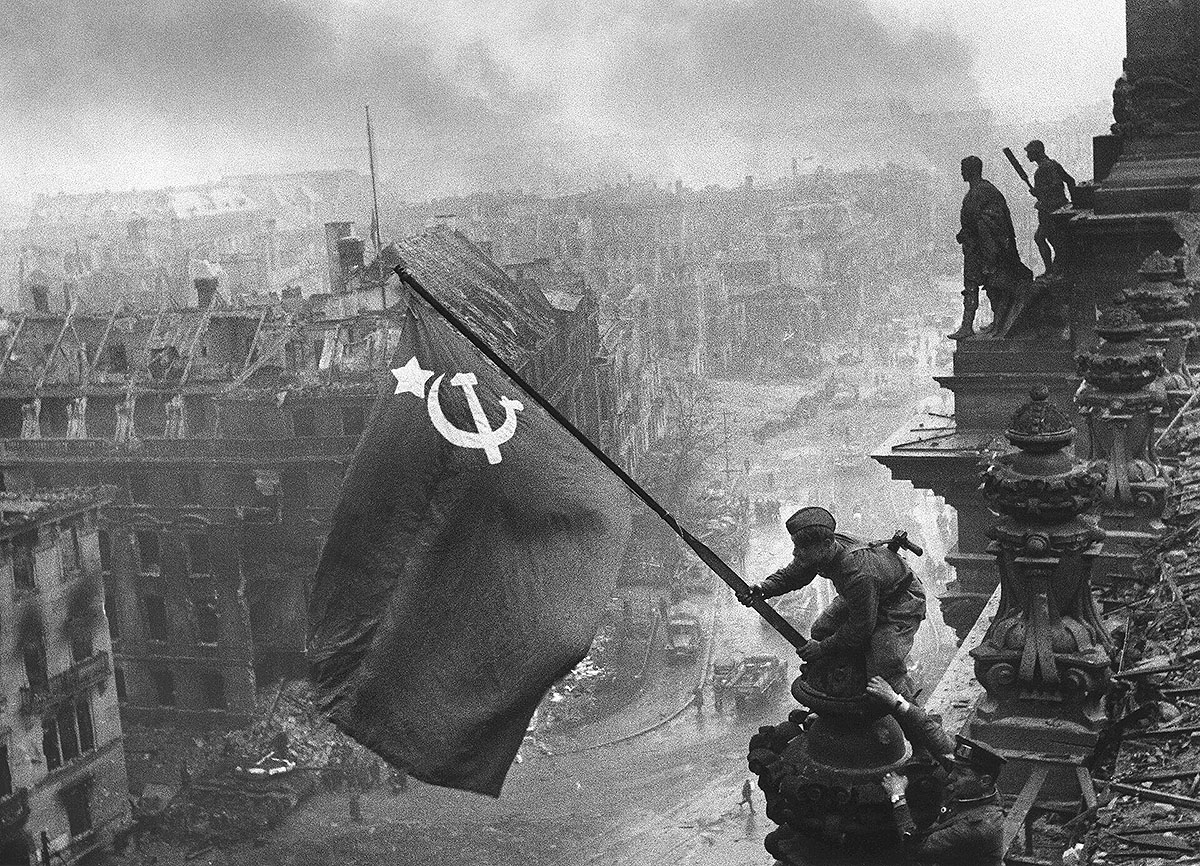
In May 1945, the world witnessed the definitive collapse of the 3rd Reich and the emergence of a superpower. An image symbolized both achievements: in Berlin, a Soviet soldier – Sergeant Meliton Kantaria, of Georgian origin – raised a red flag over the burning Reichstag.
The scene, photographed 81 years ago by Yevgeny Khaldei, captures Victory Day and is one of the most powerful visual documents of the 20th century. With the unconditional surrender of Nazi Germany, the Soviet Union and the Red Army achieved a historic victory over the most destructive war machine humanity has ever known.
Victory Day is remembered on different dates. Most of Western Europe celebrates it on May 8th. Monuments are illuminated, bells ring and war veterans (increasingly rare) receive tributes in public squares from Paris to Warsaw. It’s Victory Day in Europe, VE Day (Victory in Europe Day).
Thousands of kilometers away, the celebration will wait another 24 hours. In Russia and several countries of the former Soviet Union, Victory Day is May 9th. The divergence is due to the time of Germany’s final capitulation, signed on the night of May 8, 1945, in Berlin, the devastated capital of the 3rd Reich. Due to the time difference, in Moscow it was already early in the morning on May 9th.
For Russians, the celebration is the most important in the country. In addition to the traditional military parade on Red Square in Moscow, the program includes civil marches, tributes to soldiers killed in the “Great Patriotic War” and the use of the St. George ribbon. Soviet memory is based on an irrefutable aspect: the decisive center of the war was the eastern front – from the Arctic to Crimea –, where the main effort to destroy Nazism was concentrated.
27 million dead
Adolf Hitler wanted to destroy the Soviet Union, exterminate communism and subject the Slavic peoples to the Nazi colonial project. Seeking to gain time in the face of the prospect of an inevitable war, the Soviet Union signed with Germany, in August 1939, the Molotov-Ribbentrop Pact – a ten-year non-aggression agreement.
But Josef Stalin knew that the Germans would break the pact at any moment – which happened in June 1941. In the largest military invasion in history, more than 3 million German soldiers were mobilized for Operation Barbarossa. The 3rd Reich predicted yet another quick victory, in order to conquer “vital space” and resources, advancing along the eastern front.
It was the beginning of an offensive that lasted four years (1941-1945) and had a colossal human cost. The Soviet Union lost approximately 27 million civilians and military personnel – 14% of its pre-war population. For every American or British soldier lost, 20 Soviet soldiers fell. Only the siege of Leningrad produced human casualties comparable to – and possibly greater than – those suffered by the United States and England throughout the war.
It was the mothers, workers and peasants of the Soviet Union who absorbed the main shock of Nazism. Entire cities were razed to the ground; industrial regions disappeared under bombings; Millions died in sieges, massacres, concentration camps and extermination battles.
However, in the midst of the Russian winter and thanks to the determination of the Red Army, the Soviets defeated the Nazis at the gates of Moscow in January 1942. The failure of Operation Barbarossa called into question the superiority of the Wehrmacht, the unified armed force of Nazi Germany, and marked the first of three setbacks for the 3rd Reich in Soviet territory.
The Soviet industrial epic
With Barbarossa, the Soviet Union lost its most industrialized regions, such as Ukraine, Belarus and the Baltic territories. Faced with imminent collapse, Moscow gambled on a prodigy of industrial engineering: it dismantled more than 1,500 entire factories, loaded them onto trains east of the Urals, beyond German reach, and reassembled them in the middle of winter, on the frozen steppes, in record time.
The audacity had an effect: when the two countries faced each other again in the biggest and bloodiest battles of all time, Soviet tank production – especially the legendary T-34 – already surpassed Germany’s. In Stalingrad (1942-1943), the real turning point of the war, the German 6th Army – which had 300,000 men and was considered invincible – was surrounded and destroyed. Never before had Hitler’s army capitulated en masse.
Already in Kursk (1943), in the largest tank battle in history, the Wehrmacht’s armored capacity was definitively destroyed. When the Allies landed in Normandy in 1944, 80% of the German war machine had already been annihilated in the Soviet Union. Furthermore, 75% of German military losses in World War II occurred on the eastern front, against the Red Army.
Victory Day was the culmination of the counterattack. In 1945, the Soviets took Berlin street by street, bunker by bunker, forcing Germany to surrender and silencing the roar of cannons in Europe. The six-year nightmare that destroyed nations, decimated 70 million lives and exposed the worst of human nature was coming to an end. After a gigantic effort, the Soviet Union crushed Nazism, saved the world and redesigned history.
Communism at its height
Such a feat transformed the Soviet Union into the main moral and military power of the post-war period. It was a socialist state, led by a communist party, that bore the brunt of the fight against Nazi-fascism. While London and Washington delayed the opening of a second front in western Europe, the Red Army practically single-handedly sustained the main shock of the land war against the worst regime in history.
Stalin, previously viewed with suspicion in much of the West, was recognized as the leader who led the defeat of Nazism. Because his country had paid the greatest price, the Soviet leader sat at the Tehran and Yalta conference table as equal or superior to Franklin Roosevelt or Winston Churchill. Called the “Father of Victory”, Stalin became the main face of the Allied victory. Magazines like Time – which had already acclaimed him “Man of the Year” twice during the war – gave him even more prominence.
The Soviet victory also produced a profound change in the world order. Communism was no longer seen as just an isolated revolutionary current and began to appear, to millions of people, as a modern, patriotic, industrializing force capable of defeating fascism. It was a model of society to be followed.
Intellectuals and artists across the Western world joined the communist movement, which was at the height of its historical prestige. Jean-Paul Sartre and Simone de Beauvoir openly sympathized with Marxism. Pablo Picasso joined the French Communist Party. In the years following the war, the communist parties in France and Italy – which led the resistance against Nazi fascism – became major electoral political forces.
Other Marxist-Leninist parties grew rapidly in Greece and China, as well as in several countries in Latin America, Africa and Asia. At the same time, the advance of the Red Army into Eastern Europe opened the way for the emergence of the socialist bloc. Poland, Hungary, Czechoslovakia, Bulgaria, Romania, Albania and East Germany itself joined the Soviet orbit, inaugurating a new global balance of forces.
The new world order
The defeat of Nazism accelerated the decline of former European colonial powers and inspired national liberation movements across the Global South. Revolutions and anti-imperialist processes began to see the Soviet Union as a political and strategic reference. With the socialist rise on a global scale, the dream of a society without exploitation, far from disappearing, spread to a third of humanity.
In 1949, the People’s Republic of China was proclaimed by Mao Zedong, after a civil war in which the communists defeated the nationalists. The Soviet model of revolution had spread to the most populous country on the planet. In 1950, Korea was at war, divided exactly on the border between the two worlds that Yalta had drawn. In 1959, Fidel Castro and Che Guevara arrived in Havana. In 1975, Vietnam unified under a red flag.
Each of these events had distinct roots and their own trajectories. But everyone drank, in some way, from the source of legitimacy that Victory Day had created: the proof, written in blood and fire, that socialism could win.
May 1945 therefore marked the birth of a new era. Along with the defeat of Nazism, a bipolar world emerged, ideologically divided and profoundly transformed by the rise of the Soviet Union. Western capitalism was no longer the only force capable of projecting global power. Socialism began to dispute the direction of humanity on a planetary scale.
Victory Day, celebrated on May 8 or 9, remains as a memory of an unprecedented historical feat: the defeat of Nazi-fascism at the hands of millions of workers, soldiers and Soviet people who resisted, bled and changed the destiny of the 20th century.
Source: vermelho.org.br