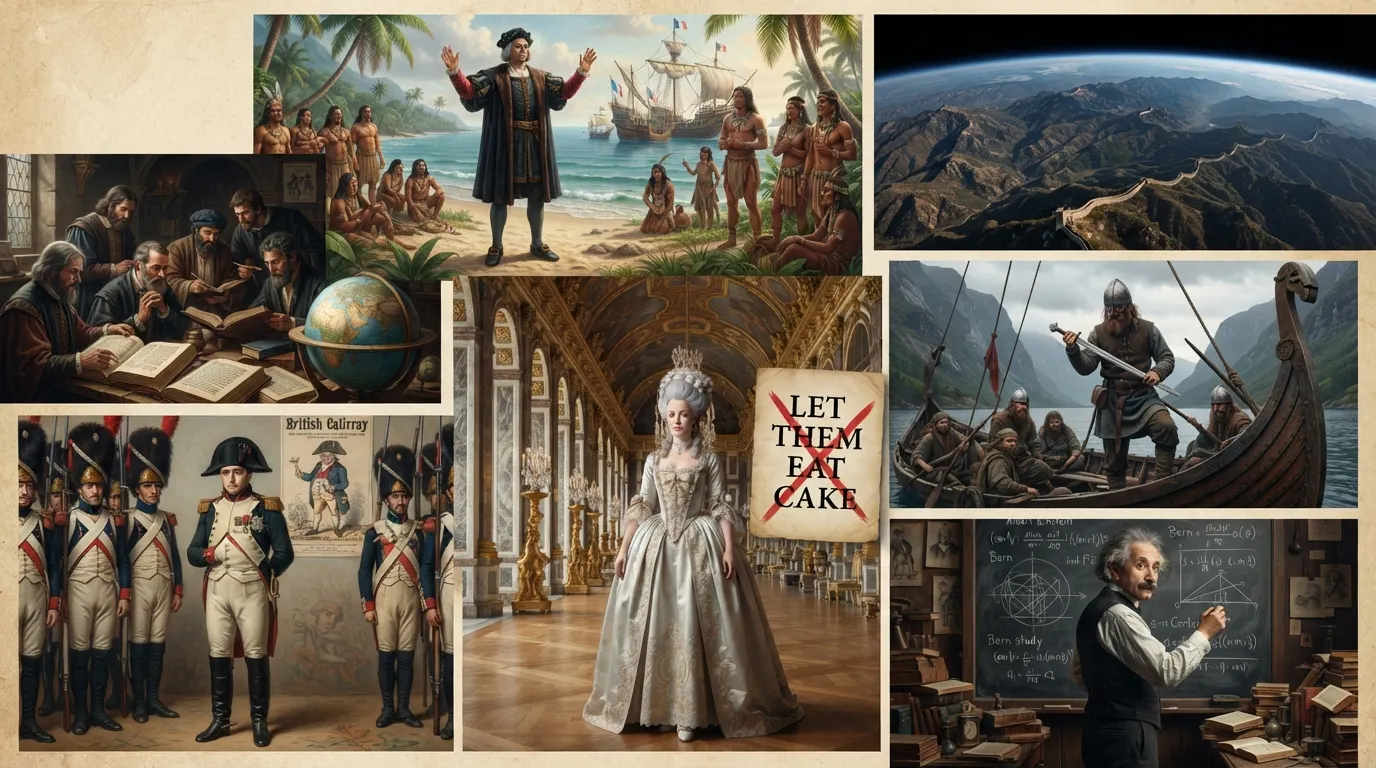
History is often presented as a collection of dates, names, wars, inventions, and famous quotations. But the past is rarely as simple as a textbook timeline suggests.
Some stories survive because they were simplified for students. Others became popular through propaganda, political cartoons, movies, novels, tourism, or generations of repetition. A few are not completely false, but they are so distorted that the version most people remember bears little resemblance to the historical evidence.
Calling these stories “lies” can therefore be misleading. In many cases, there was no deliberate conspiracy to deceive students. Instead, myths became attached to real historical events and were repeated until they sounded like established facts.
Here are seven famous historical claims that deserve a second look.
🌍 1. Christopher Columbus “Discovered America”
Few historical statements are more familiar than the claim that Christopher Columbus discovered America in 1492.
The problem is the word “discovered.”
When Columbus arrived in the Caribbean in October 1492, millions of Indigenous people were already living throughout the Americas. They had established societies, agricultural systems, political organizations, trade networks, religious traditions, and cultures that had developed over thousands of years.
Columbus was not the first human to reach the Americas, either. Indigenous peoples had lived there for millennia, and archaeological evidence places the settlement of the Americas thousands of years before European exploration. There is also evidence that Norse explorers reached parts of North America centuries before Columbus.
So what actually happened?
Columbus was an Italian-born navigator sailing under the Spanish crown. He was attempting to find a western route to Asia. When he reached the Caribbean, he believed he had arrived somewhere in or near Asia. He did not understand that he had encountered continents largely unknown to Europeans.
His voyages nevertheless had enormous historical consequences.
They helped initiate centuries of European exploration, conquest, colonization, forced labor, slavery, and cultural transformation across the Americas. The encounter also unleashed demographic and ecological changes on an extraordinary scale.
The important distinction is this: Columbus did not discover an empty continent. He initiated a new phase of sustained contact between Europe and the Americas.
That may sound like a small change in wording, but it completely changes the story.
Instead of portraying history as a lone explorer finding a forgotten land, the fuller picture recognizes the people who were already there and the enormous societies that existed before European arrival.
🌎 2. Medieval People Thought the Earth Was Flat
The popular image is familiar: medieval Europeans supposedly believed the Earth was flat, and then Christopher Columbus came along and proved that the planet was round.
It makes a great classroom story.
It is also largely wrong.
Educated scholars in medieval Europe generally understood that the Earth was spherical. Ancient Greek thinkers had already developed sophisticated arguments for a round Earth centuries before the medieval period. Medieval European scholars inherited much of that knowledge and continued to discuss the Earth’s shape using astronomy, geometry, and classical sources.
This does not mean every medieval person understood astronomy in the same way. The general population did not have access to modern education, scientific instruments, or contemporary textbooks. But that is very different from saying that medieval civilization believed the Earth was a flat disk.
The myth became particularly influential much later.
Historical writers in the 19th century helped popularize the idea that medieval Christianity had suppressed knowledge and that Columbus had challenged a widespread belief in a flat Earth. The story fit neatly into a broader narrative of humanity progressing from medieval ignorance to modern science.
Reality was considerably more complicated.
Columbus himself was not trying to prove that the Earth was round. He already knew educated Europeans accepted the Earth’s spherical shape. His mistake was largely about the size of the Earth and the distance between Europe and Asia.
In other words, Columbus did not sail west because everyone else thought he would fall off the edge of the world.
He sailed west because he dramatically underestimated the distance involved.
That distinction is one of the clearest examples of how a convenient historical story can replace a complicated reality.
🪖 3. Vikings Wore Horned Helmets
Put the word “Viking” into almost any popular culture setting and you are likely to see the same image: a muscular warrior, a long beard, a battle axe, and a helmet with enormous curved horns.
The horns are iconic.
They are also not supported by archaeological evidence for Viking warriors.
The famous Gjermundbu helmet, discovered in Norway and dating to the Viking Age, has no horns. National Geographic notes that the surviving archaeological evidence does not support the idea that Viking warriors commonly wore horned helmets.
So where did the image come from?
Much of it emerged in the 19th century, when European artists, writers, and costume designers became fascinated with Scandinavian mythology. Horned and winged headgear appeared in artistic representations and theatrical costumes, including productions associated with Richard Wagner’s operas.
Over time, those artistic inventions became attached to the historical Vikings.
The irony is that the real Vikings were already fascinating enough without the horns.
From roughly the late eighth through the 11th centuries, Scandinavian seafarers raided, traded, explored, migrated, and established settlements across an enormous geographic area. Their activities connected Scandinavia with Britain, Ireland, continental Europe, the Mediterranean, Russia, the Middle East, and even North America.
They were not simply wandering barbarians obsessed with battle.
Viking societies included farmers, merchants, craftspeople, political leaders, explorers, and enslaved people. Their history involved commerce and cultural exchange as well as warfare.
The horned helmet myth is therefore more than a funny costume mistake. It illustrates how later artistic traditions can reshape the way entire civilizations are remembered.
🧮 4. Albert Einstein Was Bad at Math in School
This is one of the most popular historical myths because it has such an appealing message.
The story usually goes like this: Albert Einstein was terrible at mathematics as a child, struggled in school, and eventually became one of history’s greatest scientists.
It sounds inspirational.
But the basic claim is false.
Einstein did not fail mathematics in school. Historical records indicate that he performed well in mathematics and science, and accounts of his education show that he had considerable ability in those subjects.
The confusion may have been encouraged by a more complicated fact about his education.
Einstein disliked aspects of the rigid educational system he encountered, particularly its emphasis on memorization and discipline. He eventually left one school in Munich and later took an entrance examination for the Swiss Federal Polytechnic School in Zurich.
He did not pass that entrance examination on his first attempt.
But there is an important detail: he passed the mathematics and physics portions.
He struggled with other subjects, including areas such as languages and biology. He subsequently continued his education and was admitted to the institution the following year.
The myth probably survives because it tells us something emotionally satisfying: even a child who is bad at math can become Einstein.
The real story is arguably more interesting.
Einstein was not a mathematical failure who unexpectedly became a genius. He was a highly capable student who had a complicated relationship with formal education.
That distinction matters because turning Einstein into a school failure creates a completely fictional lesson about his life.
👑 5. Marie Antoinette Said, “Let Them Eat Cake”
Few historical quotations are as recognizable as the supposed response of Marie Antoinette when she learned that poor French people had no bread:
“Let them eat cake.”
There is one major problem.
There is no solid evidence that Marie Antoinette actually said it.
The phrase has a much more complicated history.
The French expression commonly translated as “Let them eat cake” refers to brioche, a rich type of bread. The earliest famous written version appears in Jean-Jacques Rousseau’s Confessions, where he describes an unnamed “great princess” making the remark. Rousseau did not identify her as Marie Antoinette.
Marie Antoinette was born in 1755, while Rousseau’s account was written before she had become the notorious symbol of French royal excess that later generations associated with the quotation.
The phrase was eventually connected to her, but the attribution appeared long after the remark had entered circulation.
That does not mean Marie Antoinette was universally admired or that the French monarchy was innocent of extravagance and political failures. The French Revolution was driven by a complex combination of economic, social, political, and institutional factors.
But historians need to separate documented statements from quotations that became politically useful later.
The supposed cake comment became powerful because it perfectly captured the image revolutionaries and later writers wanted to associate with an out-of-touch aristocracy.
It is a brilliant line.
It just does not appear to be hers.
📏 6. Napoleon Was Extremely Short
Napoleon Bonaparte has become so closely associated with being short that his name is still used in the expression “Napoleon complex.”
But the historical reality is considerably less dramatic.
Napoleon’s height was recorded using French measurements that differed from the British system. His height was described as approximately five feet two inches in the old French system. When converted into modern measurements, that figure comes out to roughly 1.68 meters, or about 5 feet 6 inches.
That was around average for a French man of his era.
So how did Napoleon become the tiny emperor of popular imagination?
One important factor was British political caricature.
During the Napoleonic Wars, British cartoonists frequently portrayed Napoleon as physically tiny while exaggerating his anger and ambition. One of the most influential artists was James Gillray, whose caricatures helped establish the visual image of “Little Boney.”
There was another visual problem.
Napoleon often appeared alongside members of his elite Imperial Guard, whose soldiers were deliberately selected for their impressive physical presence. Standing beside exceptionally tall guards could make an average-height man appear noticeably smaller.
His nickname, “le petit caporal,” has also contributed to the confusion. The expression was not necessarily a literal statement about his height. It was an affectionate nickname connected to his relationship with his soldiers.
The story is a good reminder that historical images can be just as influential as historical documents.
A cartoon created for political mockery can survive for centuries, eventually becoming something people mistake for a photograph of reality.
🌕 7. The Great Wall of China Can Be Seen From the Moon
This may be one of the most persistent geography myths in the world.
The Great Wall of China is extraordinarily long, so it seems logical that it should be visible from space.
But long does not necessarily mean visible.
NASA states that the Great Wall is not visible from the Moon and is difficult or impossible to distinguish with the naked eye from Earth orbit under ordinary conditions. Even astronauts in low Earth orbit may have difficulty identifying it without powerful lenses and favorable conditions.
The myth actually predates the space age.
NASA has traced the idea that the Great Wall could be seen from the Moon to at least the 1930s. Once humans began traveling into space, however, astronauts provided firsthand observations that contradicted the claim.
From low Earth orbit, astronauts can see enormous human-made features under suitable conditions, including cities, roads, bridges, airports, dams, and reservoirs.
The Great Wall is different because it is relatively narrow and often blends into the surrounding landscape.
From the Moon, the problem becomes even more extreme.
The wall may stretch thousands of kilometers in total, but its width is tiny compared with the enormous distance between Earth and the Moon. At that scale, its length does not make it an obvious naked-eye object.
The myth remains popular because it sounds like a perfect symbol of human achievement: an ancient structure so enormous that astronauts can supposedly see it from the Moon.
The actual story is less spectacular but more scientifically interesting.
📚 Why Do These Myths Survive?
The persistence of historical myths tells us something important about how humans remember the past.
First, simple stories are easier to remember than complicated ones.
“Columbus discovered America” takes seconds to understand. Explaining Indigenous civilizations, earlier migrations, Norse exploration, European colonialism, and the consequences of transatlantic contact requires considerably more time.
Second, memorable characters make history easier to teach.
The heroic explorer, the ignorant medieval peasant, the horned Viking, the mathematically hopeless Einstein, the cruel queen, the tiny emperor, and the enormous wall are all easy images to remember.
Real history is usually messier.
Third, propaganda can outlive its original purpose.
Napoleon’s short stature was amplified by political caricature. Marie Antoinette’s supposed quotation became attached to her because it fit a powerful revolutionary narrative. Historical images can survive long after the political circumstances that created them have disappeared.
Fourth, movies and popular culture have enormous influence.
A historically inaccurate costume can appear in thousands of films, television shows, illustrations, video games, and advertisements. After enough repetition, the fictional image begins to feel like photographic evidence.
And finally, some myths contain a small piece of truth.
Einstein did struggle with an entrance examination, just not with mathematics.
Napoleon really was described as “five feet two inches,” but the measurement system was different.
Columbus really did arrive in the Americas in 1492, but he did not discover an empty continent.
The Great Wall really is enormous, but that does not make it visible from the Moon.
These small pieces of truth are precisely what make historical myths so difficult to eliminate.
🧠 History Is More Interesting When the Myths Disappear
Correcting historical myths does not make the past less fascinating.
Quite the opposite.
The real stories are usually more complicated, more surprising, and more revealing than the versions we learn as children.
Columbus’s voyages were not simply a heroic adventure. They became the beginning of a profound transformation involving Indigenous societies, European empires, migration, disease, slavery, trade, and colonization.
The medieval world was not simply an age of people who thought the Earth was flat.
The Vikings were not horned cartoon warriors, but sophisticated seafarers who connected distant parts of the world.
Einstein was not a mathematical failure who magically became a genius.
Marie Antoinette probably did not utter the sentence that became her most famous quotation.
Napoleon was not the miniature emperor portrayed by British caricaturists.
And the Great Wall does not need to be visible from the Moon to be one of humanity’s extraordinary architectural achievements.
Perhaps the biggest lesson is this: history should not be judged by how memorable a story is, but by how well the evidence supports it.
The past is already remarkable without turning it into a collection of legends.
And sometimes, the truth is much more interesting than the lie.
Sources
This article draws on historical and scientific references including HISTORY, National Geographic, NASA, the Smithsonian Institution, and historical research on the subjects discussed.