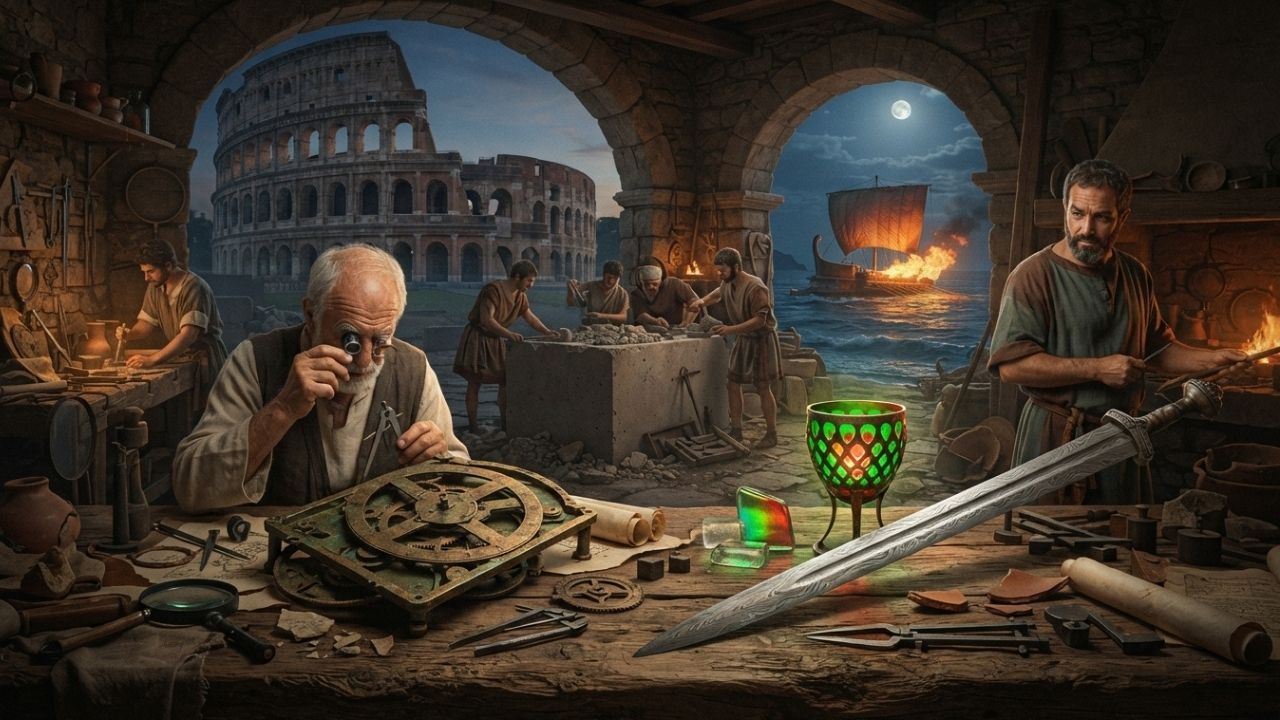
For thousands of years, human beings have developed technologies that seem surprisingly sophisticated for their time. Ancient engineers built enormous monuments without modern cranes, created machines capable of tracking celestial movements, produced materials with remarkable durability, and developed chemical technologies whose exact recipes have disappeared.
Modern science can often explain how these achievements worked in broad terms. In some cases, researchers have even produced functional reconstructions. Yet reproducing the exact materials, manufacturing conditions, craftsmanship, or performance of certain ancient technologies remains difficult.
That distinction is important. It is not accurate to say that modern science is completely incapable of making anything similar to these objects. Instead, the mystery often lies in reproducing the original technology exactly, especially when ancient craftsmen left no written instructions or when the raw materials and production environments have changed over time.
Here are five remarkable ancient technologies that continue to challenge researchers, engineers, archaeologists, and historians.
🏺 1. Roman Concrete: A Building Material That Became Stronger With Age
Few ancient technologies have attracted as much modern attention as Roman concrete.
The Romans used concrete on an enormous scale, from harbors and bridges to temples, aqueducts, baths, and monumental domes. Some Roman structures have survived for roughly two thousand years, often in environments that would be extremely demanding for modern concrete.
The Pantheon in Rome is one of the most famous examples. Its massive concrete dome, completed nearly two thousand years ago, remains one of the largest unreinforced concrete domes ever built.
For decades, researchers believed that Roman concrete was simply an inferior predecessor of modern cement. More recent research has produced a much more complicated picture.
Roman concrete was made using mixtures of volcanic ash, lime, water, and aggregates. The precise composition varied according to location and intended use. In marine structures, for example, volcanic materials interacted with seawater and produced mineral transformations that could contribute to long-term durability.
Scientists have identified minerals and chemical reactions associated with the remarkable resilience of some Roman concrete. One particularly interesting feature is the presence of small lime-rich particles, sometimes called lime clasts. Research has suggested that these particles may have played an active role in the material’s ability to repair certain cracks.
The precise manufacturing process remains an important part of the debate.
Researchers have recreated Roman-style concrete in laboratories, and some modern projects have incorporated principles inspired by ancient mixtures. However, reproducing the exact properties of a particular Roman structure is difficult because the ancient recipes, raw materials, temperatures, mixing methods, and construction conditions varied considerably.
The mystery, therefore, is not whether modern engineers can make concrete. They clearly can. The challenge is understanding exactly why some ancient formulations performed so well for so long.
⚙️ 2. The Antikythera Mechanism: An Ancient Mechanical Computer
In 1901, divers exploring a shipwreck near the Greek island of Antikythera recovered an object that would eventually transform historians’ understanding of ancient technology.
The object became known as the Antikythera Mechanism.
Dating to roughly the second or first century BCE, the device contained a complex arrangement of bronze gears. When researchers began studying the fragments, they discovered evidence that the mechanism was designed to model astronomical cycles.
It could represent movements associated with the Sun and Moon and track important calendar and astronomical periods. Some reconstructions indicate that it could also represent the repeating cycles used to predict eclipses.
What makes the mechanism extraordinary is not simply that ancient people understood astronomy. Ancient civilizations had sophisticated astronomical traditions long before the device was built. The extraordinary feature is the mechanical engineering required to translate astronomical knowledge into a compact geared machine.
The surviving fragments are badly damaged. Much of the original mechanism has disappeared, leaving researchers to reconstruct its design from fragments, inscriptions, gear teeth, and comparisons with ancient astronomical knowledge.
Modern researchers have created working reconstructions based on these clues. These models demonstrate that the fundamental concept is mechanically possible.
Yet an exact reproduction remains difficult.
The original device involved highly specialized metalworking and a sophisticated understanding of gearing. The craftsmen who built it may have belonged to a relatively small technological tradition that left little surviving evidence.
There is also a larger historical mystery. The Antikythera Mechanism is so sophisticated that historians have questioned whether it represents an isolated invention or part of a broader tradition of ancient mechanical astronomy that has largely disappeared.
Only fragments of that technological world remain.
🔥 3. Greek Fire: The Weapon Whose Formula Was Lost
Few ancient technologies are surrounded by as much uncertainty as Greek fire.
The Byzantine Empire used the substance, particularly in naval warfare, from around the seventh century onward. Historical accounts describe a weapon that could be projected onto enemy ships and that was extremely difficult to extinguish with ordinary methods.
Greek fire became especially famous because it could apparently continue burning on water.
The exact composition of the substance has been lost.
Historical sources provide clues, but they do not give modern researchers a complete chemical recipe. Proposed ingredients have included petroleum-based substances, pitch, sulfur, resins, and other combustible materials. Different researchers have proposed different combinations.
The uncertainty is increased by the secrecy surrounding the technology. The Byzantine state treated the formula as a military secret. Unlike an architectural technique that could be observed by many builders, a weapon’s precise manufacturing process could be deliberately restricted.
Modern experiments have demonstrated that various mixtures of petroleum and other combustible substances could produce effects resembling descriptions of Greek fire. However, that does not prove that any particular reconstruction is the historical formula.
There may also have been different formulations used over different periods.
The term “Greek fire” itself can be misleading because historical references to incendiary substances do not necessarily describe one standardized chemical product. Ancient and medieval armies used numerous fire-based weapons, and later writers sometimes used related terminology in different contexts.
What makes Greek fire particularly fascinating is the combination of chemistry, engineering, and secrecy. The technology did not disappear because its physical principles were beyond human understanding. It disappeared because the knowledge required to produce the specific weapon was not successfully transmitted across generations.
In this case, history itself became part of the technological barrier.
🗡️ 4. Damascus Steel: The Legendary Blades of the Medieval World
Few objects have achieved the technological reputation of Damascus steel swords.
Historically associated with blades from the Middle East and South Asia, Damascus steel became famous for its distinctive patterns, sharpness, toughness, and reputation in combat.
The term, however, covers a complicated history.
Some blades traditionally described as Damascus steel were produced from a material known as wootz steel, an advanced crucible steel produced in parts of South Asia. The steel could develop characteristic patterns during forging, resulting from its carbon distribution and microstructure.
For centuries, skilled smiths were able to transform this material into blades with distinctive visual patterns and impressive mechanical properties.
The original production traditions eventually declined and disappeared in many regions.
Modern metallurgists have successfully created pattern-welded steels that look like traditional Damascus blades. But visual similarity does not necessarily mean that the ancient manufacturing process has been perfectly reproduced.
The challenge lies in reconstructing the precise combination of ore, carbon content, furnace conditions, crucible chemistry, cooling rates, forging temperatures, and heat treatments used by historical craftsmen.
Ancient metallurgy was highly empirical. A skilled smith might know that a particular combination of materials and heating conditions produced a superior blade without having any modern understanding of phase transformations or microscopic carbon structures.
In other words, an ancient craftsman could possess practical knowledge without possessing a scientific theory explaining it.
Researchers have identified microscopic structures in historical blades that help explain their characteristics. Some studies have also found relationships between the steel’s properties and tiny structures formed during production.
Modern technology can certainly produce extremely sophisticated steels. The difficulty is reproducing the exact historical material and process that gave certain ancient blades their characteristic properties.
The mystery is therefore less about whether modern metallurgy can surpass ancient steel and more about whether it can faithfully reconstruct a particular lost technological tradition.
🥛 5. The Lycurgus Cup: Ancient Glass With a Remarkable Optical Effect
One of the most visually extraordinary examples of ancient technology is the Lycurgus Cup, a Roman glass vessel dating to approximately the fourth century CE.
At first glance, the cup appears to have a greenish color. But when light passes through it from behind, it can appear reddish or purple.
This remarkable phenomenon is known as dichroism.
The effect is caused by extremely small quantities of metallic nanoparticles incorporated into the glass. Researchers have found evidence that gold and silver were present in the material at tiny concentrations, producing the unusual optical behavior.
For ancient glassmakers, achieving this effect required an extraordinary level of material control.
The concentrations of the metals had to be extremely small. Too much or too little could change the result. The distribution and particle size also mattered.
Modern nanotechnology makes the underlying phenomenon much easier to understand. Scientists know that nanoparticles can interact with light in highly specific ways, and modern laboratories can deliberately engineer materials with controlled optical properties.
Yet reproducing an ancient object exactly is still difficult.
The Roman craftsman who produced the Lycurgus Cup did not possess modern electron microscopes, nanotechnology laboratories, or modern theories of plasmonic behavior. The effect appears to have emerged from a combination of practical glassmaking knowledge and extraordinarily precise material preparation.
The cup is therefore an intriguing example of what might be called technological knowledge without theoretical knowledge.
The craftsman did not need to understand nanoparticles in order to create an object that effectively exploited their optical properties.
🔬 Why Are These Technologies So Difficult to Reproduce?
The biggest misconception surrounding ancient technology is the idea that modern civilization should automatically be able to reproduce everything created in the past.
Modern science has vastly expanded humanity’s ability to analyze materials, simulate physical processes, and manufacture complex objects. But scientific knowledge alone does not guarantee access to every historical production method.
Ancient technologies were often dependent on local resources.
A particular region might contain volcanic ash with a unique mineral composition. A metalworker might use ore from a specific mine. A glassmaker might have access to raw materials that were processed in a particular way. A shipbuilder might rely on timber from forests that no longer exist in the same condition.
Craft knowledge was also frequently transmitted through apprenticeship rather than written documentation.
A master craftsman could spend decades learning how a material behaved under changing temperatures, how a furnace sounded when conditions were correct, or how a blade responded during forging. Much of that information could disappear when a technological tradition collapsed.
Another problem is that archaeological evidence is incomplete.
We rarely recover an ancient technology together with its complete workshop, tools, raw materials, instructions, and finished products. Instead, archaeologists usually encounter fragments.
Researchers then have to reconstruct the missing process.
That makes ancient technology similar to solving a technological detective story. A surviving artifact provides evidence, but it rarely provides the entire explanation.
🌍 Ancient Ingenuity Meets Modern Science
The technologies above also challenge a common assumption about the relationship between ancient and modern societies.
Ancient engineers did not have modern computers, industrial machinery, advanced microscopy, or modern chemistry. Yet they developed highly specialized solutions to problems in construction, astronomy, metallurgy, warfare, and optics.
Their achievements were not necessarily examples of “lost supertechnology.” In most cases, they were the result of careful observation, experimentation, craftsmanship, and generations of accumulated knowledge.
Modern science has helped explain many of the physical processes behind these achievements. Researchers can identify minerals in ancient concrete, reconstruct gear systems, analyze metallic microstructures, and detect nanoparticles inside historical glass.
But understanding a technology and reproducing its original production process are two different things.
That distinction is what makes these artifacts so fascinating.
They demonstrate that technological progress is not always a straight line. Knowledge can be developed, refined, forgotten, rediscovered, and transformed. A society can possess an extraordinary practical technique without understanding it through modern scientific theory, while a later civilization can understand the underlying science without knowing the exact historical process used to create the original artifact.
🏛️ The Technology We Lost, and the Knowledge We Gained
The five technologies discussed here are not proof that ancient civilizations possessed mysterious powers or scientific knowledge comparable to the modern era. They are evidence of something more interesting: human ingenuity has always been capable of producing sophisticated results.
Roman builders discovered durable combinations of minerals and construction materials. Ancient Greek engineers developed complex mechanical systems. Byzantine craftsmen created closely guarded incendiary technologies. Metallurgists developed sophisticated steelmaking traditions. Roman glassmakers manipulated materials at a microscopic scale without knowing the modern science behind the effect.
In several cases, modern researchers can reproduce parts of these technologies. In others, they can explain the chemistry or physics involved. What remains difficult is reconstructing the complete historical chain from raw material to finished artifact.
That is why these ancient technologies continue to attract scientific attention.
The greatest mystery is not whether ancient people were somehow more advanced than modern society. They were not operating with hidden modern technology. The mystery is how much practical knowledge can be achieved through observation, experimentation, craftsmanship, and cultural transmission.
And perhaps the most important lesson is that technology can disappear.
A recipe can be forgotten. A workshop can vanish. A supply chain can collapse. A specialized craft can lose its final practitioners. A civilization can preserve the artifact while losing the instructions that explain how it was made.
Thousands of years later, researchers may find the object and begin the process all over again.
Sometimes, modern science can reconstruct the answer.
Sometimes, it can only get close.
And sometimes, the ancient artifact remains a reminder that humanity has been experimenting with the physical world for far longer than written scientific history suggests.