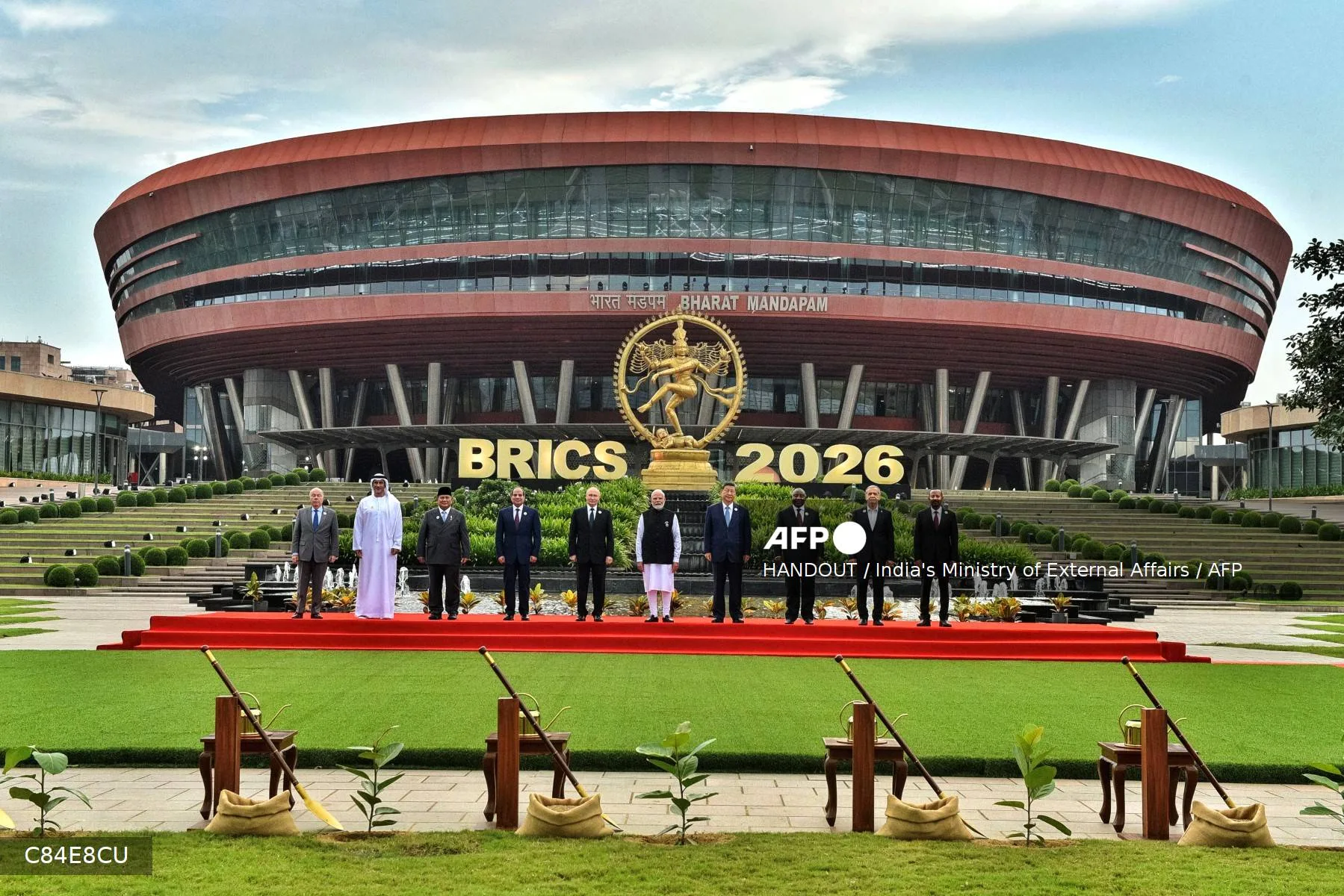
Sovereignty over mineral resources, greater access for countries in the Global South to artificial intelligence (AI) technologies and changes in the institutions responsible for global political and economic governance are among the main points of the New Delhi Declaration, approved this Saturday (12), the first day of the 18th BRICS Summit, in India.
With 140 points, the document establishes the bloc’s common positions on topics ranging from wars and economic sanctions to trade, payment systems, energy and new technologies. The countries defend a “more representative and fair” international order and once again demand greater participation for emerging economies in global decisions.
For researcher at the Brics Policy Center and professor at the Institute of International Relations at PUC Marta Fernandez, one word helps to characterize much of the document: resilience. According to her, the term and its variations appear more than 50 times in the declaration and express the bloc’s concern with expanding the capacity of its members to face conflicts, sanctions, tariffs, climate crises and interruptions in supply chains.
“Resilience seems to mean increasing the capacity of BRICS countries to face conflicts, sanctions, tariffs, climate crises and interruptions in supply chains and reducing dependencies, diversifying partners and suppliers”, says Fernandez.
In the researcher’s assessment, this concern gains weight in light of Donald Trump’s government and the use of tariffs and technological restrictions as instruments of geopolitical pressure. The search for greater autonomy appears on different fronts of the declaration, from the diversification of production chains to the expansion of the use of national currencies and the debate on AI.
The summit occurs at a time of expansion for the bloc. Under the Indian presidency, Brics currently has 11 members: Brazil, Russia, India, China, South Africa, Egypt, Ethiopia, United Arab Emirates, Iran, Saudi Arabia and Indonesia. Together, they account for almost half of the world’s population and around 40% of the global Gross Domestic Product (GDP).
Enlargement makes the construction of common positions more complex, but it also increases the economic and political weight of the grouping. The New Delhi Declaration combines more cautious language on international security issues with attempts to advance financing mechanisms, trade, technology and production chains.
The 18th BRICS Summit continues this Sunday (13). At the end of the Indian presidency, China will take over leadership of the bloc and will host the 19th summit in 2027.
Critical minerals: sovereignty and value addition
One of the excerpts of the document discusses critical minerals, fundamental raw materials for sectors such as energy, electronics, electric vehicles and new technologies.
The countries defend “reliable, responsible, diversified, resilient, fair and sustainable” supply chains, but add two conditions: adding value and economic diversification in countries rich in these resources and preserving the sovereignty of States over their mineral wealth.
The formulation is not restricted to the concern of consumer countries in guaranteeing access to lithium, rare earths and other minerals. The document argues that the countries where the deposits are located must also participate in the highest value stages of the production chains, instead of limiting themselves to the export of raw materials.
Fernandez draws attention to the place occupied by the theme in the organization of the declaration itself. The discussion on critical minerals appears immediately before the sections dedicated to industrialization and the partnership for the new industrial revolution, which, for her, reinforces the connection between access to natural resources and productive capacity.
The researcher considers, however, that the document does not yet present instruments capable of guaranteeing this passage. “There is still a lack of concrete measures to transform mineral resources into local production, technology transfer, jobs and economic diversification”, he states.
The declaration lists minerals critical to energy security and the development of low-carbon technologies. At the same time, it recognizes that oil, gas, coal and other fossil fuels will continue to play a role in the energy matrix, especially in emerging economies, and defends a “fair, orderly, equitable and inclusive” energy transition.
Artificial intelligence and access from the Global South
Brics claims that AI offers opportunities for economic growth and development, but maintains that the benefits of the technology cannot be concentrated in a few countries.
The declaration advocates international cooperation to expand access to AI resources, with special attention to countries in the Global South. The text also mentions security, reliability and inclusiveness of technologies, in addition to the need to make AI systems more energy efficient.
According to Fernandez, the declaration reaffirms the bloc’s previous commitments on international AI governance and moves forward by applying the debate to specific sectors. “The news is that AI now appears applied to sectors such as health, energy, industry, finance and education”, he states.
Another point highlighted by the researcher is the defense of a safe, inclusive and interoperable digital public infrastructure. Interoperability, he explains, allows different systems to communicate and work together.
Fernandez cites Pix, in Brazil, and UPI, in India, as examples of public digital infrastructures capable of expanding access to services and reducing costs. She emphasizes that the declaration does not propose direct integration between the two systems, but opens space for cooperation and exchange of experiences.
The researcher also draws attention to the material dimension of AI. “It has a material base, it depends on data centers that consume large amounts of energy and water, as well as semiconductors and critical minerals”, he says.
For her, this expansion needs to be discussed with its social and environmental impacts and who controls the technologies. “For countries in the South, resilience cannot just mean providing energy and minerals for the global digital economy”, he states.
More space for the Global South at the UN, IMF and World Bank
The demand for changes in international governance is another thread of the declaration. The Brics once again defend a broad reform of the United Nations, including the Security Council, to increase the representation of developing countries in Africa, Asia and Latin America.
China and Russia, the two members of the bloc with permanent seats and veto power in the Council, specifically reiterated their support for Brazil and India’s aspirations to play a greater role in the UN, including in the Security Council.
The same argument appears in relation to international financial institutions. The document states that the participation of emerging countries in the International Monetary Fund (IMF) and the World Bank should better reflect their current weight in the world economy and calls for reforms in the power structures created after the Second World War.
The declaration also incorporates a proposal presented by Brazil and South Africa to create an international panel on inequality. The document states that inequality between and within countries is at the root of a significant part of the problems faced by the international development agenda.
Against unilateral tariffs and sanctions
In a scenario of increasing trade disputes, Brics expresses “serious concern” about the growth of tariffs and non-tariff measures adopted unilaterally and considered incompatible with the rules of the World Trade Organization (WTO).
According to the document, this type of policy can reduce world trade, disorganize production chains and increase inequalities between countries. The group also defends the full resumption of the WTO dispute settlement mechanism.
The declaration goes further in the case of economic sanctions. BRICS condemns unilateral coercive measures contrary to international law, including economic sanctions and secondary sanctions not authorized by the UN Security Council.
The text argues that these measures affect rights such as health, food and development and have a greater impact on the poor population of the affected countries. In a specific section about Latin America, the document also calls for an end to economic, commercial and financial measures against Cuba.
National currencies and own payment systems
Another advance occurs in the financial area. The declaration encourages the expansion of trade and investments carried out in the currencies of the Brics members themselves, but does not address, for example, the creation of an independent payment system.
The document records the studies carried out by the group’s payments task force to increase interoperability between national payment and financial messaging systems. The stated aim is to enable faster, cheaper, more accessible and safer international transfers.
The strategy, therefore, does not involve the creation of a single Brics currency, but rather the gradual advancement of the use of national currencies and the connection between existing financial infrastructures.
The declaration also reinforces the role of the New Development Bank (NDB). Created by Brics in 2015, the institution is encouraged to increase its fundraising capacity, diversify its financing sources and expand loans made in local currencies.
Wars: caution in the Middle East and more explicit position on Gaza
The war in the Middle East was one of the most delicate topics for the construction of a common text. The declaration expresses “deep concern” about the escalation of tensions in the region and calls for “maximum restraint”, avoiding holding the countries involved in the current conflict by name.
Brics calls for protection of civilians and civil infrastructure, respect for the sovereignty and territorial integrity of States and a solution based on dialogue and diplomacy. It also expresses concern about attacks on civilian nuclear facilities subject to International Atomic Energy Agency (IAEA) safeguards.
Regarding Palestine, the document is more specific. The bloc advocates the creation of a sovereign and independent Palestinian state on the internationally recognized 1967 borders, with East Jerusalem as its capital, and opposes any forced displacement of the Palestinian population.
The statement also mentions the provisional measures ordered by the International Court of Justice (ICJ) in the case opened by South Africa against Israel and reaffirms Israel’s obligation to allow humanitarian aid to enter Gaza.
The war between Russia and Ukraine does not appear by name in the New Delhi Declaration. In general terms, the document says it is concerned about conflicts in different regions and the increase in global military spending.
Source: www.brasildefato.com.br