The Library of Alexandria has become one of history’s greatest symbols of lost knowledge. For centuries, stories about its destruction have imagined hundreds of thousands of scrolls disappearing in a single catastrophic fire. Yet the real history is more complicated, and in many ways, more fascinating.
Founded during the Ptolemaic period in the ancient Egyptian city of Alexandria, the library was not simply a room filled with books. It was part of a much larger intellectual institution connected to the Mouseion, or “Museum,” a center dedicated to the Muses and to scholarly research. It brought together writers, mathematicians, astronomers, physicians, historians, philosophers and other specialists from across the Mediterranean world.
But what exactly was inside?
The honest answer is that no complete inventory has survived. Historians cannot identify every scroll that once stood on its shelves, nor can they establish with certainty exactly how large the collection became. Ancient accounts give different numbers, and a single ancient “book” could occupy several scrolls. Nevertheless, surviving evidence allows researchers to reconstruct a remarkable picture of the subjects, texts and intellectual traditions that Alexandrian scholars sought to collect.
The collection appears to have included Greek poetry and drama, philosophy, history, mathematics, astronomy, geography, medicine, law, rhetoric and many other fields. It also contained or had access to works from outside the Greek literary tradition, including Egyptian, Hebrew and Babylonian material.
The library was therefore not just a storehouse of literature. It was an ambitious attempt to gather, organize, compare and preserve the knowledge of the ancient world.
🏛️ A Library Built to Gather the World’s Knowledge
The Library of Alexandria emerged in the early Ptolemaic period, after Alexander the Great’s conquest of Egypt and the establishment of a new dynasty by his successors.
The Ptolemies wanted Alexandria to become a leading cultural and intellectual capital. The library formed part of that ambition. Rather than collecting only local Egyptian writings or books useful to the royal court, its organizers pursued works from across the wider Mediterranean and Near East.
The collection was primarily composed of papyrus scrolls. These were very different from modern books. A long text could be divided among several scrolls, and individual scrolls could contain one or more works.
The Ptolemaic rulers reportedly spent considerable resources acquiring manuscripts. Ancient accounts describe books being purchased from major centers of learning and copies being made from manuscripts that arrived in Alexandria. One famous tradition, preserved by the physician Galen, says that books found on ships entering Alexandria could be taken for copying, with the original retained and a copy returned to its owner.
Whether every detail of this story is accurate is difficult to establish, but it illustrates the extraordinary importance placed on collecting written works.
The ambition was clear: Alexandria wanted to become a place where scholars could find texts that might otherwise be scattered across the ancient world.
📜 Homer, Poetry and the Great Greek Classics
One of the most important parts of the collection was Greek literature.
The Alexandrian scholars were particularly interested in the works of Homer, whose Iliad and Odyssey were among the most influential texts of the ancient Greek world. The library reportedly acquired different copies of Homeric poems from different places so that scholars could compare them.
This was not simply collecting for the sake of possession.
Ancient texts were copied by hand, meaning that errors, alterations and accidental omissions could accumulate over generations. Different cities could therefore possess different versions of the same poem.
Alexandrian scholars compared manuscripts, examined language and attempted to establish reliable versions of important works. Their editorial work became enormously influential in the transmission of Greek literature.
The collection also included Greek lyric poetry. Works associated with poets such as Sappho, Pindar, Hesiod and Callimachus were part of the broader literary culture surrounding Alexandria.
For scholars, preserving poetry meant more than preserving entertainment. Poetry contained mythology, religious traditions, historical memories, linguistic evidence and ideas about the ancient world.
🎭 Tragedies, Comedies and Lost Plays
The shelves also contained Greek drama.
Works by the great tragedians Aeschylus, Sophocles and Euripides were highly valued. The library also sought comedies and dramatic works, including those associated with Aristophanes and Menander.
One famous story concerns official copies of Athenian plays. According to Galen’s account, Ptolemy III reportedly borrowed authoritative copies of the works of Aeschylus, Sophocles and Euripides from Athens by placing a large financial deposit. Instead of returning the originals, the king supposedly kept them and sent copies back to Athens, forfeiting the deposit.
The story may have been embellished, but it reflects the value placed on authoritative manuscripts.
This is particularly important because many ancient plays have disappeared. Hundreds, perhaps thousands, of literary works known to have existed in antiquity are no longer available today.
The Library of Alexandria therefore may have contained texts that have completely vanished from the historical record.
That is one of the most haunting aspects of its history. We cannot make a list of all the lost works because, in many cases, we do not even know their contents.
🧠 Philosophy and the Ideas of the Ancient World
Philosophy was another major component of the Alexandrian intellectual environment.
Works associated with Plato, Aristotle, the Stoics, the Epicureans and earlier Greek philosophers circulated among scholars. Philosophical writings examined questions about nature, ethics, politics, logic, metaphysics and human knowledge.
The library’s importance was not necessarily that every famous philosopher personally worked there. Alexandria became a meeting point where texts from different intellectual traditions could be studied, compared and commented upon.
This distinction matters.
Popular images sometimes portray the library as a giant ancient university where every famous thinker gathered under one roof. The historical reality was more complicated. The Library and Mouseion were institutions supported by the Ptolemaic state, and scholars connected with them worked in different fields and at different times.
Nevertheless, the concentration of intellectual resources was extraordinary.
A philosopher could study works that had been difficult to obtain elsewhere. A literary scholar could compare different versions of Homer. A mathematician could consult earlier mathematical writings. A physician could examine medical traditions preserved in texts.
The library created an environment in which knowledge could interact with other knowledge.
🔭 Astronomy, Mathematics and the Natural Sciences
Perhaps the most impressive material inside the Alexandrian intellectual world was scientific.
The collection included mathematical and astronomical works, while scholars associated with Alexandria conducted their own research.
Euclid became one of the most famous mathematicians connected with Alexandria. His Elements became one of the most influential mathematical texts ever written.
Eratosthenes, who became associated with the library and served as its head librarian, was a mathematician, geographer and astronomer. He famously calculated the circumference of the Earth using observations of shadows and geometry. His result was remarkably close to the actual value.
Aristarchus of Samos, another ancient astronomer whose work circulated in the Alexandrian intellectual world, proposed a model in which the Earth moved around the Sun. That idea was radically different from the Earth-centered model that later became dominant.
The library therefore contained more than literary masterpieces. Its collections supported research into the structure of the universe, the measurement of the Earth and the mathematical description of nature.
🩺 Medicine and the Human Body
Medicine was another important field.
Alexandria became famous for medical research, including anatomical investigations. Physicians such as Herophilus and Erasistratus are associated with the city’s intellectual environment.
Medical writings attributed to earlier traditions, including the Hippocratic corpus, were also part of the broader body of knowledge studied by ancient scholars.
The medical collection would have included discussions of anatomy, diseases, treatments, pharmacology and theories about how the human body functioned.
Some Alexandrian physicians challenged older assumptions and relied on observation and dissection.
This illustrates an important feature of the institution: the library was not merely preserving old ideas. It could also provide researchers with the written foundation from which new ideas developed.
🌍 Geography, History and the Known World
The Library of Alexandria also held historical and geographical material.
Historians recorded wars, rulers, migrations and the histories of different peoples. Geographical writings described coastlines, cities, trade routes and distant regions.
This was particularly valuable in Alexandria, a major Mediterranean port and one of the most cosmopolitan cities of the ancient world.
The Ptolemies governed Egypt but belonged to a Macedonian Greek dynasty. Their kingdom was connected to Greece, the eastern Mediterranean, North Africa and the Near East.
A library designed to collect knowledge from across this world naturally became interested in geography and foreign cultures.
The result was a collection that potentially allowed scholars to compare different civilizations rather than studying Greek culture in isolation.
🕎 Egyptian, Hebrew and Other Traditions
The Library’s collection was not exclusively Greek.
The Ptolemaic kingdom ruled an overwhelmingly Egyptian population, while Alexandria itself contained communities from many backgrounds.
Texts connected with Egyptian traditions were of interest to scholars. The Egyptian priest Manetho, for example, wrote a history of Egypt in Greek and organized the country’s rulers into dynastic sequences that influenced later understandings of Egyptian history.
The Greek translation of the Hebrew scriptures, commonly known as the Septuagint, is also strongly associated with the intellectual world of Ptolemaic Alexandria. According to the Letter of Aristeas, Jewish scholars were invited to translate Hebrew scriptures into Greek.
The historical details of the story are debated, but there is strong evidence that Alexandria became a major center for Greek-speaking Jewish scholarship.
The broader collection could therefore bring Greek, Egyptian and Near Eastern intellectual traditions into the same scholarly environment.
🗂️ How Did Anyone Find Anything?
With potentially hundreds of thousands of scrolls, finding a specific text would have been impossible without an organizational system.
This is where Callimachus became especially important.
Callimachus was a poet and scholar associated with Alexandria who compiled the famous Pinakes, usually translated as “Tables.” The work is traditionally described as a vast bibliographical catalog organized by authors and subjects.
The complete Pinakes has been lost, and historians cannot reconstruct its exact structure with certainty. Ancient evidence nevertheless shows that Alexandrian scholarship placed enormous importance on cataloging and organizing written material.
This was an intellectual achievement in its own right.
The librarians had to determine who wrote a work, what the work was called, what subject it belonged to and, in some cases, whether different manuscripts represented the same text.
They were dealing with a problem that modern libraries still face: how do you organize an enormous amount of information so that people can retrieve it?
Their solution helped establish principles of bibliography and literary classification that would influence later scholarship.
🏺 What Did the Library Itself Look Like?
This is where historical certainty becomes much weaker.
Despite its fame, archaeologists have not identified a surviving building that can confidently be labeled the Great Library itself. Ancient descriptions provide information about the Mouseion and its facilities, but they do not give us a complete architectural blueprint.
The complex appears to have included spaces for scholars, dining, discussion, reading and teaching, as well as areas where scrolls could be stored.
The library should therefore not necessarily be imagined as a gigantic modern reading room with endless rows of wooden bookshelves.
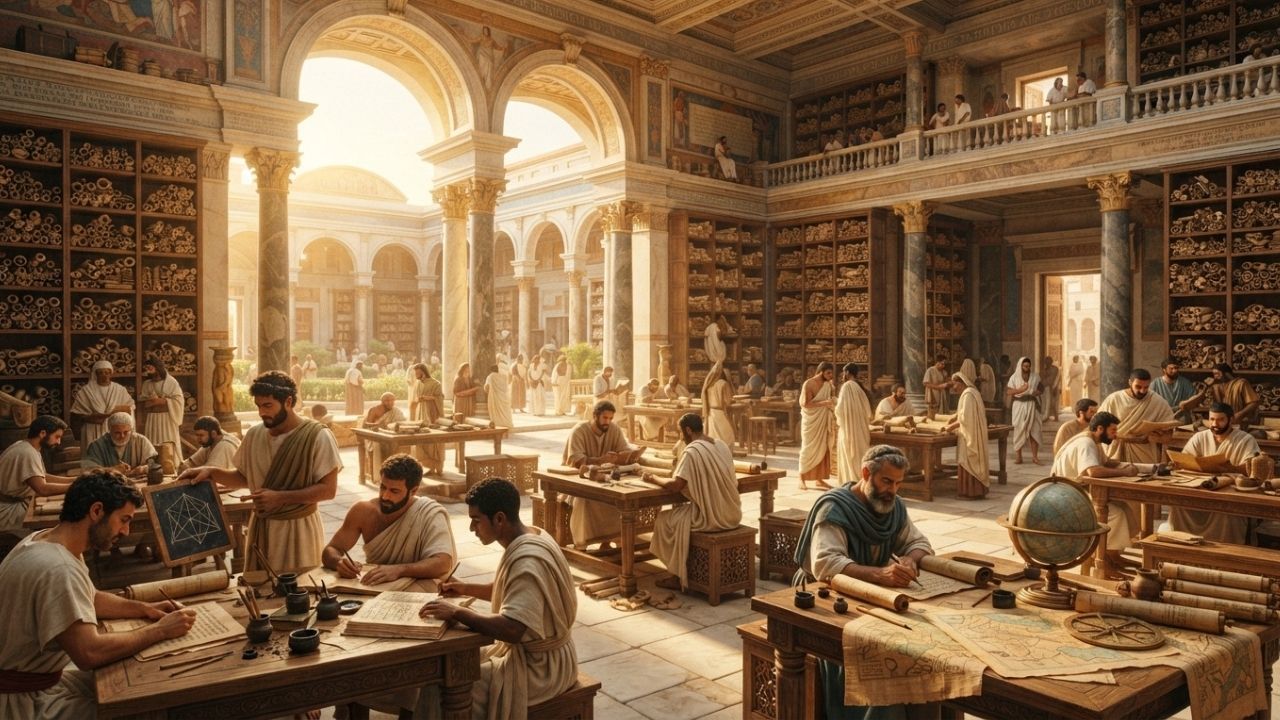
Instead, picture an ancient scholarly complex filled with papyrus rolls, scribes, researchers, teachers and visitors. Scrolls could be stored in organized spaces, while scholars worked nearby, copied manuscripts and debated texts.
The atmosphere would have been less like a modern public library and more like a combination of research institute, archive, scholarly community and royal cultural project.
🔥 Did Julius Caesar Destroy Everything?
Probably not.
The famous story that Julius Caesar burned the Library of Alexandria in one single event is one of the most persistent myths surrounding the institution.
Caesar’s forces set fire to ships in Alexandria during the civil war in 48 BCE, and ancient sources connect the resulting fire with damage to books. However, evidence indicates that collections and scholarly institutions survived afterward.
The library’s disappearance was likely a much longer and more complicated process.
Political changes, declining royal support, institutional transformations, fires and the gradual weakening of the ancient scholarly system may all have contributed.
There may also have been multiple libraries and collections in Alexandria, including the library associated with the Serapeum, often described as a daughter library.
This makes the idea of one spectacular moment when “the world’s knowledge burned” misleading.
The ancient library was probably lost through a combination of events occurring over generations.
📚 How Many Scrolls Were Inside?
This is one of the biggest unanswered questions.
Ancient sources provide different estimates, including figures in the hundreds of thousands. Later traditions often repeat numbers such as 400,000, 500,000 or 700,000 scrolls.
But there is no surviving inventory that allows historians to verify these numbers. Moreover, counting scrolls is not the same as counting modern books. A single literary work could occupy several scrolls.
For that reason, claims that the library contained exactly a particular number of “books” should be treated cautiously.
What can be said with confidence is that the collection was enormous by ancient standards and that its ambition was extraordinary.
🕯️ The Greatest Loss Was Not Only the Scrolls
The most important thing lost from Alexandria may not have been a particular famous book.
It was the network of knowledge surrounding the collection.
A library preserves texts, but scholars give those texts meaning. They compare manuscripts, identify errors, translate languages, write commentaries, debate interpretations and connect ideas.
Alexandria was valuable because thousands of intellectual pieces could exist in the same environment.
Imagine being able to compare several versions of an ancient poem, consult a mathematical treatise, read an Egyptian historical account and then discuss astronomy with another scholar.
That combination was the real power of the institution.
The loss of the library therefore represents more than the destruction of physical scrolls. It represents the disappearance of texts, commentaries, scholarly traditions and intellectual connections that cannot be completely reconstructed today.
🌟 What Was Really Inside Alexandria’s Great Library?
The answer is both simpler and more extraordinary than legend suggests.
Inside were scrolls containing poetry, drama, philosophy, history, mathematics, astronomy, geography, medicine, rhetoric, law, religion and other forms of knowledge. There were different versions of important texts, translations and works from multiple cultural traditions.
There were also scholars who transformed the material they found. They edited Homer, cataloged authors, studied mathematics, measured the Earth, investigated medicine and examined the history of different civilizations.
And there were probably countless works whose titles have disappeared forever.
The Library of Alexandria was never simply a giant warehouse of ancient books. It was an attempt to make the world’s written knowledge accessible to a community of researchers.
Its greatest achievement may therefore have been not the number of scrolls it possessed, but the idea behind them: that knowledge could be collected, organized, compared and expanded when people from different intellectual traditions were brought together.
That idea survived the disappearance of the ancient library.
Modern universities, research libraries, archives and digital databases continue to pursue a remarkably similar dream: to gather the scattered records of human thought and make them available to people who want to understand the world.
The original Library of Alexandria is gone.
But the ambition that created it never truly disappeared.