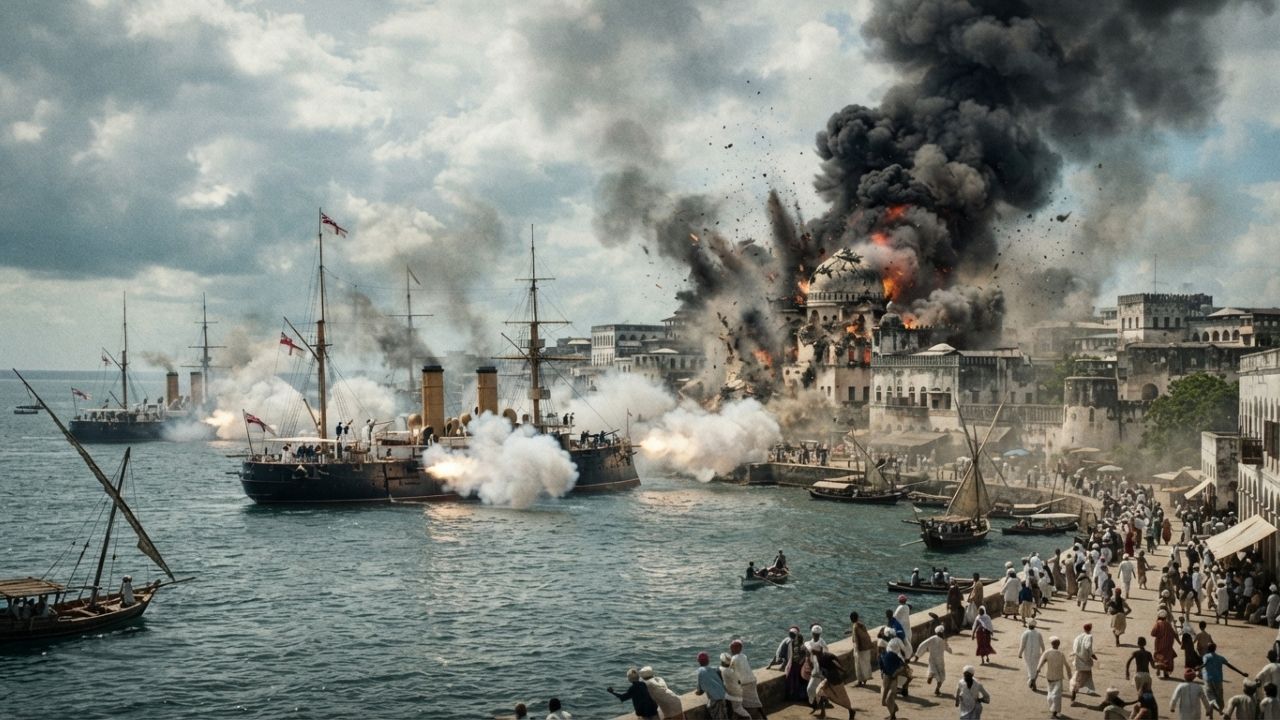
Wars are usually associated with long campaigns, armies crossing borders, sieges lasting for months and battles that reshape nations over years. But on August 27, 1896, a conflict unfolded in Zanzibar that would become famous for almost the opposite reason.
It was over in less than an hour.
The Anglo-Zanzibar War, fought between the British Empire and the Sultanate of Zanzibar, is widely regarded as the shortest war in recorded history. The fighting is commonly cited as having lasted approximately 38 minutes, although historical accounts differ slightly on the exact duration, with estimates ranging from about 38 to 43 minutes.
The conflict was brief, but its consequences were enormous. A palace was bombarded, hundreds of Zanzibaris were killed or wounded, a royal vessel was sunk, a ruler fled into hiding, and Britain’s influence over Zanzibar became even more firmly established.
The battle itself was astonishingly short. The political crisis that produced it was anything but.
👑 The Crisis Begins With the Death of a Sultan
To understand why the guns opened fire that morning, it is necessary to go back two days.
On August 25, 1896, Sultan Hamad bin Thuwaini of Zanzibar died suddenly. Hamad had been regarded by the British as a cooperative ruler, and Britain had significant influence over the island’s political affairs.
His death created an immediate succession crisis.
Hamad’s nephew, Khalid bin Barghash, moved quickly to occupy the royal palace and proclaimed himself Sultan. The British, however, did not accept his accession. They preferred another candidate, Hamoud bin Mohammed, and regarded Khalid as a ruler who was unwilling to accept British authority.
At the time, Zanzibar was formally ruled by its Sultan, but British influence over the island was extensive. Britain had become deeply involved in Zanzibar’s foreign affairs, trade and succession politics. The island was strategically important because of its position in the Indian Ocean and its connections to the East African coast.
Khalid’s decision to seize the palace without British approval therefore transformed a succession dispute into an international confrontation.
Within hours, the British began moving warships into position.
🚢 The Royal Navy Moves Into Zanzibar Harbor
The British response demonstrated the enormous imbalance of military power between the two sides.
Several Royal Navy vessels gathered in Zanzibar harbor, including the cruisers HMS St George, HMS Philomel and HMS Racoon, alongside other naval forces. British marines and sailors were also assembled, while forces loyal to the British-backed political order were positioned to support the operation.
Khalid, meanwhile, gathered thousands of men around the palace.
Accounts commonly estimate that approximately 2,800 Zanzibaris were assembled to defend the Sultan’s position. They included palace guards, armed supporters and civilians. The defenders possessed artillery and machine guns, although their weapons and military organization were no match for the firepower of the British fleet.
Khalid also had the royal yacht HHS Glasgow, which was armed and positioned in the harbor.
The scene was now set for a confrontation.
But Britain still offered Khalid one final opportunity to step down.
⏰ The Ultimatum
British representatives demanded that Khalid leave the palace and surrender his claim to the throne.
The message was clear: if he refused, the British would use force.
Khalid refused.
The British ultimatum expired at approximately 9:00 a.m. on August 27, 1896. The Royal Navy ships were already positioned close enough to bombard the palace.
For a brief period, the harbor remained tense.
Then, at approximately 9:02 a.m., the guns opened fire.
The Anglo-Zanzibar War had begun.
And almost immediately, the outcome was becoming clear.
💥 The Palace Comes Under Fire
The British bombardment was devastating.
The Sultan’s palace was struck by naval gunfire and quickly caught fire. The building, which served as both a political center and a defensive position, was not designed to withstand the concentrated firepower of modern British warships.
Zanzibari artillery attempted to respond, but the defenders were heavily outgunned.
British naval guns destroyed or disabled defensive positions around the palace while shells tore through the buildings. The palace complex began to burn, creating enormous clouds of smoke over Zanzibar’s waterfront.
The destruction was not limited to the palace.
The British fleet also engaged the HHS Glasgow, Khalid’s royal yacht. The vessel fired at the British ships but was quickly overwhelmed. It was eventually sunk in the harbor.
The entire naval action unfolded with extraordinary speed.
The British ships had superior weapons, better naval organization and a tactical position that made sustained resistance extremely difficult.
For the defenders inside the palace, the situation rapidly became impossible.
🏃 The Sultan Flees
As the bombardment continued, Khalid realized that his position could not be maintained.
He left the palace and sought refuge at the German consulate.
The move would allow him to escape immediate capture and eventually leave Zanzibar. Khalid later made his way to German East Africa, on the mainland of what is now Tanzania.
His departure effectively removed the political leadership from the battlefield.
Inside the palace complex, however, the fighting and destruction continued.
The fire spread through the buildings, and casualties mounted.
By the time the palace’s flag was finally lowered, the battle had already transformed the center of Zanzibar’s political power into a devastated ruin.
🕰️ Thirty-Eight Minutes That Changed Zanzibar
The exact length of the war depends on which historical account is consulted.
The most widely repeated figure is 38 minutes, while other accounts give approximately 40 or 43 minutes. The difference comes largely from how historians define the beginning and end of the engagement, including whether the initial bombardment or the final moments of resistance are used as the reference points.
The important fact remains the same: the conflict was extraordinarily short.
The British bombardment began shortly after 9:00 a.m., and the Zanzibari resistance collapsed before the morning was over.
In that tiny window of time, an independent political challenge to British influence had been crushed.
A war that had begun with an ultimatum ended with the Sultan’s palace in flames.
⚰️ Hundreds of Zanzibaris Were Killed or Wounded
The brevity of the conflict should not obscure its human cost.
Estimates commonly put Zanzibari casualties at around 500 killed or wounded, although the exact number and the precise breakdown between combatants and civilians remain uncertain. Many casualties occurred as the palace and surrounding structures were engulfed by fire.
British casualties were dramatically lower.
One British sailor was wounded during the action, according to commonly cited accounts.
The extraordinary difference reflected the technological and strategic imbalance between the two forces.
This was not a conventional battle between two evenly matched armies. It was a demonstration of late 19th-century naval power against a much smaller state caught in the sphere of an expanding empire.
The phrase “shortest war in history” can therefore make the event sound almost anecdotal. In reality, for the people inside Zanzibar’s palace and for those caught in the bombardment, those 38 minutes were catastrophic.
🔥 The Fire Did Not End When the Guns Fell Silent
The destruction continued after the principal fighting had stopped.
The palace and surrounding buildings had suffered extensive damage, and fires spread through parts of the area. British sailors were involved in efforts to control the flames, while additional troops were used to restore order in Zanzibar Town.
The chaos also created opportunities for looting.
Historical accounts describe disorder in parts of the city following the bombardment, including violence and deaths among civilians. The destruction therefore extended beyond the immediate military confrontation.
The physical damage was visible for years in historical photographs and accounts of the ruined palace complex.
But the political damage to Khalid’s position was immediate.
He would not return to power.
👑 A New Sultan Takes the Throne
With Khalid removed, the British-backed Hamoud bin Mohammed became Sultan of Zanzibar.
The change demonstrated that the conflict had never been simply about a palace or a single succession dispute.
It was also about who possessed the practical power to determine Zanzibar’s political future.
Britain had demonstrated that it was prepared to use military force to enforce its preferred political arrangement.
The new Sultan ruled with British support, and British influence over Zanzibar became even stronger after the conflict.
The event therefore became a striking example of what historians often describe in the context of imperial expansion as “gunboat diplomacy,” where naval power was used to support political demands.
🌍 Zanzibar and the Age of Empire
The Anglo-Zanzibar War occurred during a period of intense European competition for territory and influence in Africa.
The late 19th century was the era of the Scramble for Africa, when European powers expanded their control across large parts of the continent.
Zanzibar was strategically significant because of its location in the Indian Ocean and its historic commercial connections with the East African coast.
For centuries, Zanzibar had been an important center of trade. Its position connected East Africa with the Arabian Peninsula, India and the wider Indian Ocean world.
But European powers increasingly sought to control the region.
Britain’s influence was particularly strong, while Germany was also expanding its presence on the East African mainland.
That rivalry formed part of the background to Khalid’s eventual escape to German territory.
The 1896 war therefore cannot be understood simply as an isolated disagreement between a Sultan and a foreign government. It was part of a much larger transformation of political power in East Africa.
🧭 What Happened to Khalid?
Khalid’s story did not end when the palace fell.
After seeking refuge at the German consulate, he escaped to German East Africa. He remained outside Zanzibar for years.
His political career had effectively ended, but his name remained closely associated with the extraordinary conflict.
The British, meanwhile, had achieved their immediate objective. The Sultan they opposed was gone, the palace had been destroyed and a ruler acceptable to British interests was installed.
The entire episode had taken less time than many modern sporting events.
Its political consequences lasted much longer.
📜 Why Is It Called the Shortest War in History?
The Anglo-Zanzibar War occupies a unique place in military history because of the contrast between its enormous political significance and its astonishingly short duration.
Many wars that lasted only days involved complicated campaigns, multiple battles or ceasefires. The Zanzibar conflict was different.
A succession crisis escalated into an ultimatum.
The ultimatum expired.
The Royal Navy opened fire.
The palace was destroyed.
The defending forces collapsed.
The Sultan fled.
And within well under an hour, the conflict was over.
That sequence is why the war has become famous as the shortest recorded war in history, even though historians differ over whether the precise duration should be described as 38, 40 or 43 minutes.
The commonly used figure of 38 minutes remains the one most closely associated with the event.
🏛️ More Than a Historical Curiosity
It can be tempting to remember the Anglo-Zanzibar War simply as an unusual fact: a war that lasted only 38 minutes.
But reducing it to a record overlooks the larger historical story.
The conflict demonstrates how imperial power operated in the late 19th century. It shows how technological superiority, naval power and political pressure could transform a diplomatic disagreement into a military confrontation almost instantly.
It also illustrates the complicated position of Zanzibar during an era when European powers were increasingly determining the political fate of territories across Africa.
The war was short because the military balance was heavily unequal.
For Britain, the bombardment was a rapid demonstration of overwhelming naval power.
For Zanzibar, it was a violent political rupture that left hundreds dead or wounded and resulted in a new Sultan being installed under British influence.
⏳ Thirty-Eight Minutes, But a Much Longer Legacy
At approximately nine o’clock on the morning of August 27, 1896, Zanzibar still faced an unresolved succession crisis.
Less than an hour later, the political landscape had changed completely.
The palace was burning.
The royal yacht lay at the bottom of the harbor.
Hundreds of people had been killed or wounded.
Khalid bin Barghash had fled.
And Britain had secured the political outcome it wanted.
The guns had fallen silent, but the consequences continued for years.
That is what makes the Anglo-Zanzibar War more than an extraordinary record in military history. Its 38-minute duration is memorable, but its real significance lies in what those minutes represented: the collision between a small Indian Ocean sultanate and one of the world’s most powerful imperial states at the height of European expansion.
The war ended almost as quickly as it began.
The transformation it represented did not.
In Zanzibar, the smoke eventually cleared, the ruins remained, and a new political order emerged.
Thirty-eight minutes were enough to change the course of the island’s history.