Published 04/11/2026 11:57
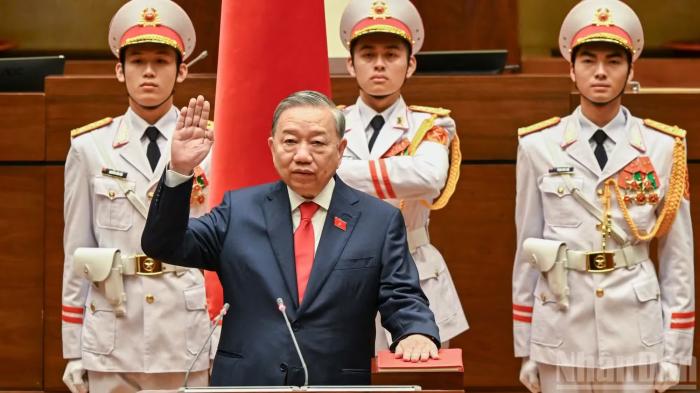
The National Assembly of Vietnam unanimously elected To Lam as President of the Republic for the period 2026-2031. The vote had the support of the 495 deputies present, reflecting political consensus around the new leadership.
After the election, this Monday (6), the head of State took an oath, committing himself to loyalty to the Homeland, the people and the Constitution, in addition to reaffirming his responsibility to the Party and the country’s institutions.
Accumulation of functions and political centrality
In addition to the presidency, To Lam also holds the position of general secretary of the Communist Party of Vietnam, consolidating strong political centralization. With a career linked to State security, he has accumulated experience in the Central Committee and the Political Bureau, in addition to having led strategic structures such as the National Defense and Security Council.
His stay in the leadership group reinforces the continuity of the political line defined by the party.
Re-election in the Legislature reinforces institutional stability
In the same political process, the Assembly re-elected Tran Thanh Man as president of the Legislature for the XVI legislature (2026-2031), also unanimously.
In his speech, he highlighted that the country is experiencing a “historical turning point” and reaffirmed political conduct under the leadership of the Party, emphasizing the importance of institutional cohesion for the new stage of development.
New government projects accelerated growth
The new Prime Minister, Le Minh Hung, presented the government’s guidelines for the next five years. Among the goals, the following stand out:
- Average annual GDP growth above 10%
- Strengthening innovation and digital transformation
- Modernization of public administration
- Intensifying the fight against corruption
According to him, the State’s efficiency will be measured by the satisfaction of the population and companies.
Continuity and strategic goals
Vice-president Vo Thi Anh Xuan was kept in office, reinforcing institutional continuity.
The new political cycle occurs after the internal strengthening of the Communist Party of Vietnam, which, in its last congress, defined the objectives of transforming the country into an upper middle-income economy by 2030 and a developed nation by 2045.
With the new government composition, Vietnam projects a phase of accelerated growth, political stability and deepening of its socialist development model.
Source: vermelho.org.br