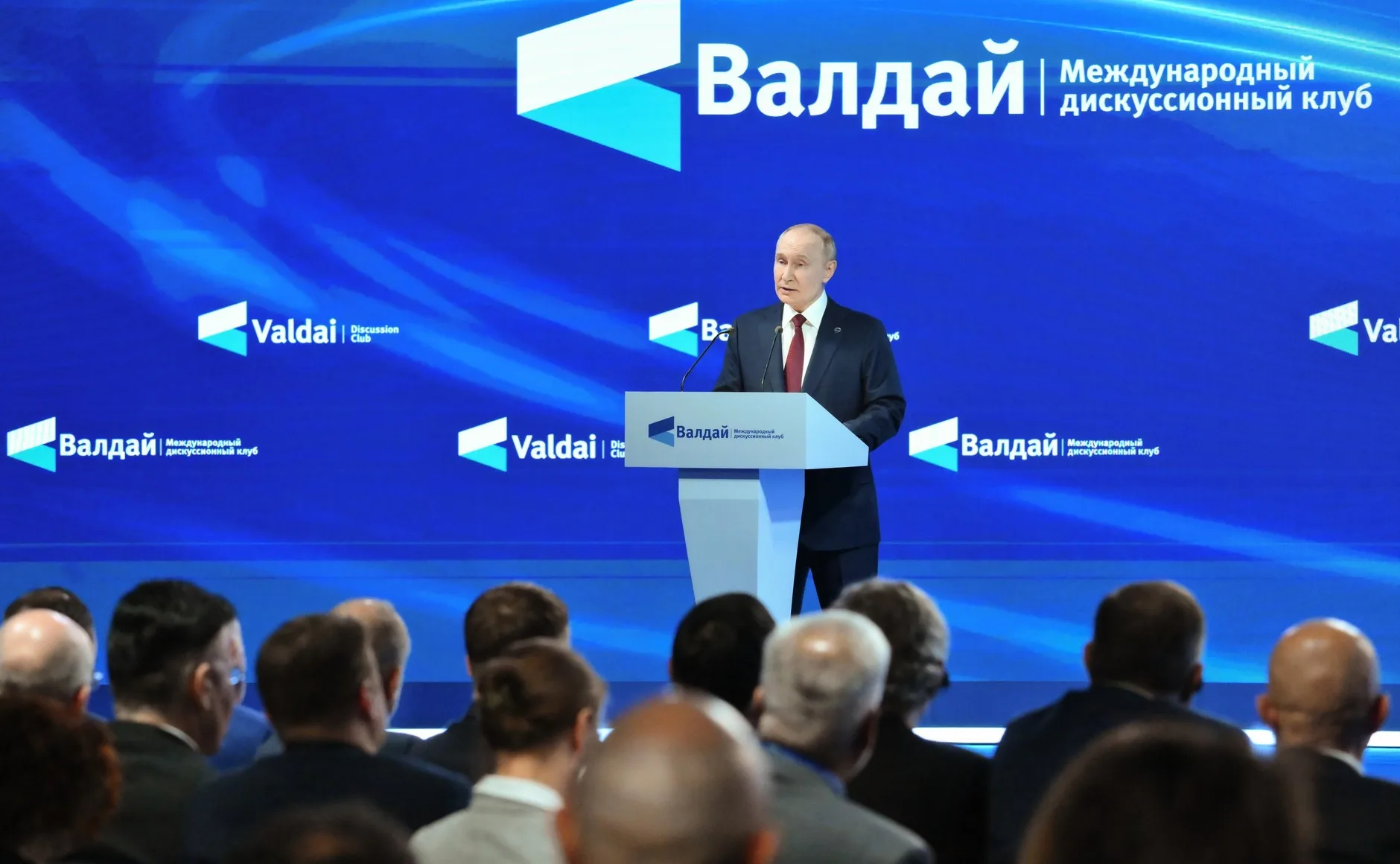
Russian President Vladimir Putin participated this Thursday (1st) in the 23rd Valdai International Discussion Club, and commented on the growing tension with NATO around the Kaliningrad region. During the plenary session of the traditional forum, Putin stated that, if a direct attack on Russia occurs, Moscow will respond with all the weapons at its disposal.
The Russian leader mentioned statements by Western politicians about preparations for a possible conflict with Russia by 2029-2030, Western military exercises in the Baltic Sea and attempts to detain Russian vessels. For Putin, these factors are part of an escalation of tension in relations between Moscow and NATO and around Kaliningrad, a Russian region located between Poland and Lithuania, two NATO member countries, and territorially separated from the rest of Russia.
Tension around Kaliningrad has risen in recent weeks amid intensified NATO military activities near the region. In September, Western military alliance countries such as Lithuania, Latvia and Poland carried out exercises around the Russian region.
Moscow’s concern gained new momentum after Polish Chancellor Radosław Sikorski defended the holding of “aggressive” NATO exercises near Kaliningrad, with the aim of pressuring Russia to move forces from the region. The Kremlin responded by stating that it would take measures to guarantee the territory’s security.
“If there is a direct attack on the Russian Federation — in this case, referring to Kaliningrad and perhaps other territories as well — it is clear that the issue of the use of all weapons at our country’s disposal by the Russian Federation will inevitably and immediately be on the agenda,” he said.
The Russian president commented on statements issued by Russian embassies in countries in Europe during the week, warning NATO countries about the Russian reaction in the event of a threat from the Western military alliance to the Russian region of Kaliningrad.
According to him, Russia “is not intimidating anyone” regarding the tension in the Kaliningrad region and that the document sent by the Ministry of Foreign Affairs was a response to attempts to intimidate Moscow. “Russia only responded to the threats against it”, he adds.
“We are not trying to scare anyone. The statement from the Foreign Ministry and the letters sent to some countries is not intimidation; it is a response to an attempt to intimidate us,” Putin said.
According to him, the letter from the Russian Foreign Ministry on the defense of the Kaliningrad region does not mention nuclear weapons; mentions Russia’s use of all available weapons, the president emphasized.
Furthermore, the Russian leader added that Russia does not pose a threat to anyone and has no intention of attacking anyone, but highlighted that if the country suffers aggression, Moscow will be “forced to respond”.
The 23rd annual meeting of the Valdai International Discussion Club, held in Moscow, between September 28th and October 1st, is a traditional forum that discusses the paths of multipolarity, and brings together more than 120 people from 40 countries, including the United States, China, India and European countries.
The event brought together academics, diplomats and political actors to discuss the main topics on the international agenda and is one of the main events on the Russian foreign policy calendar. This year, the main motto of the discussions was: “Responsibility for the Future: Limits of the Possible or Unlimited Possibility?”.
Origin of the Ukrainian conflict
The Russian president also took advantage of his speech at the Valdai Club to reinforce Moscow’s justification for starting the war in Ukraine, claiming that the so-called “special military operation” (official name for the Ukrainian conflict used by Russian authorities) was a response to “Nato’s military expansion” in historically Russian territories.
“I know, of course, that some in the expert community are asking, ‘Russia talks about peace, but it started a war’. However, I will reiterate in this meeting where the truth lies. The truth is that we didn’t want this and we didn’t start the war; they started fighting us,” he declared.
“They should not have encouraged aggressive nationalism and Russophobia in Ukraine for years with the aim of turning it into a tool in the fight against Russia. NATO should not have initiated the military development of our historic territories for its own benefit, nor planned its own bases there,” he added.
According to him, the beginning of the Ukrainian conflict also has its origins in the Ukrainian coup d’état implemented by radical forces in the country.
Source: www.brasildefato.com.br