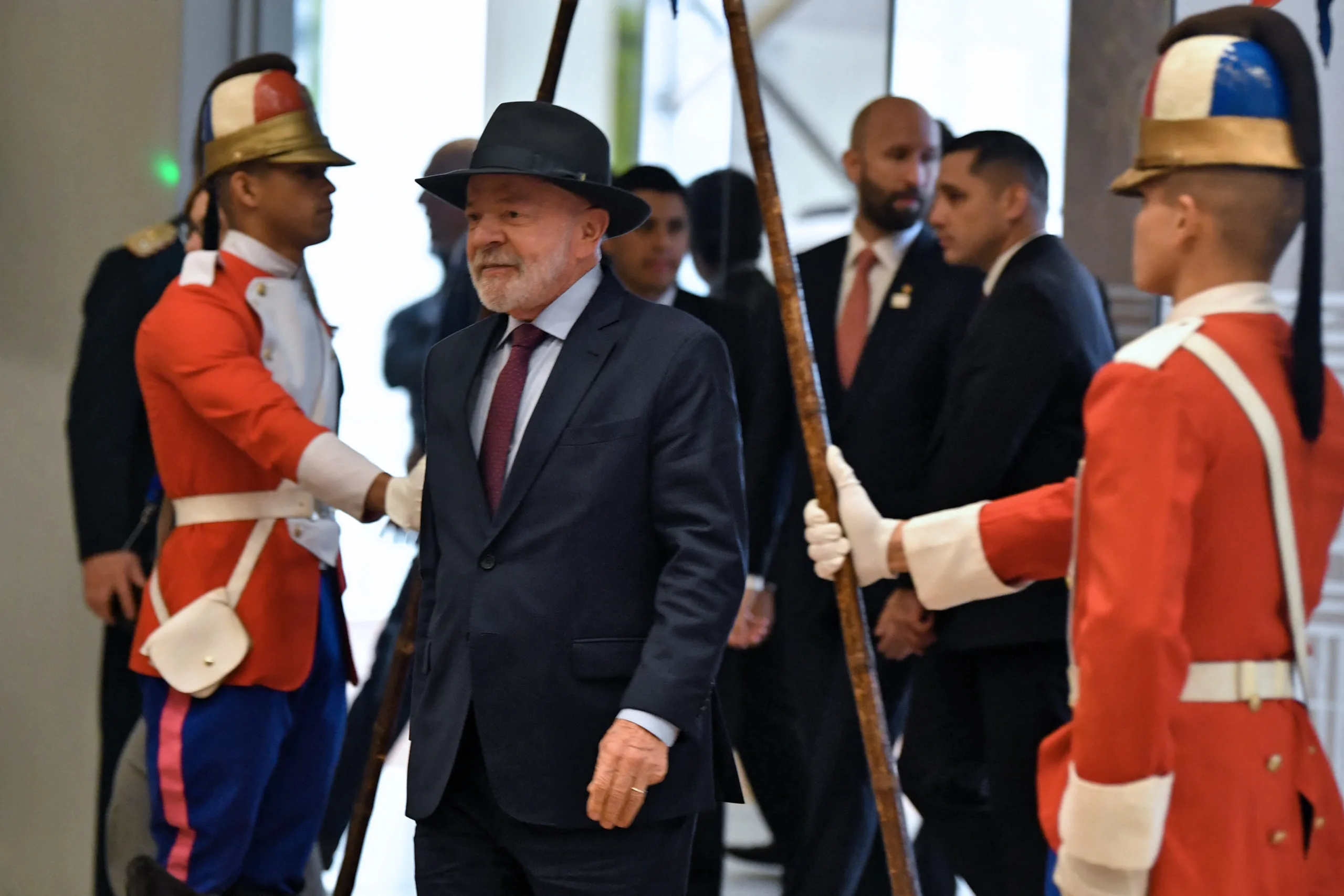
President Luiz Inácio Lula da Silva (PT) defended South American integration, in a speech given this Tuesday (30), during the Mercosur summit meeting in Asunción, Paraguay.
In an indirect message to President Donald Trump — whose government’s foreign policy has been threatening the sovereignty of South American countries —, Lula suggested that no one would “own South America”. The Brazilian president took advantage of the speech to defend Mercosur’s trade negotiations with China.
“No one owns the world. And no one owns South America. No Mercosur country will gain more freedom of action through automatic alignments or exclusionary choices. Our strength will be in the ability to dialogue with everyone, without leaving aside our interests. Diversifying partnerships, expanding cooperation and preserving autonomy are requirements for the region to find its space in a changing world”, said Lula.
“Mercosur is advancing in dialogues with Canada, India and Vietnam. At this summit, we will take another step by launching negotiations for an economic partnership with Japan. Soon, we want to do the same with China and continue to get closer to the most dynamic markets on the planet”, continued Lula.
Brazil has been affected by trade tariffs imposed by Washington. Last year, Trump’s “tariff” required diplomatic efforts on the part of Brasília. This year, the US proposes an additional tariff of 25% on Brazilian products.
In relation to China, Brazil was the country that received the largest volume of Chinese investments in 2025, totaling US$6.1 billion, according to a survey published by the Brazil-China Business Council (CEBC) last May.
Lula even met with Trump in the US capital to discuss the issue. In his speech in Asunción, the Brazilian president pointed to the risks of trade protectionism.
“Wars and conflicts deepen global instability and raise food and energy prices. Protectionism resurfaces as a fallacious response to the complexity of global macroeconomic imbalances. The fragmentation of the world economy poses severe challenges to trade, investments and sustainable development”, assessed Lula.
This year’s summit meeting took place against the backdrop of recent power changes in South America, especially the elections of Abelardo de Espriella, in Ecuador, and Keiko Fujimori, in Peru, names of the South American extreme right.
In his speech, Lula even cited the electoral results, highlighting the democratic institutions of the countries mentioned.
For professor André Araújo, professor of International Relations at the São Paulo School of Sociology and Politics Foundation (FESPSP) and researcher at the Regionalism Observatory, the fact that two right-wing governments join other political governments from the same political spectrum in the region creates tensions for Mercosur. “However, Brazil is not necessarily isolated”, he assesses, in conversation with the Brazil in fact.
“Despite political differences, the leaders sought consensual aspects, above ideological differences.” According to him, the meeting showed a certain unity in relation to Mercosur, especially in relation to the external agenda.
One of the drivers of this cohesion is the Mercosur-European Union agreement, which has partially entered into force. “In recent years, there has been an acceleration in the signing of trade agreements by Mercosur,” says Araújo, highlighting the possibility of a trade agreement being formalized with Canada, in addition to progress in negotiations with the United Arab Emirates, South Korea and Japan.
In the most incisive moment of his speech in Asunción, Lula said that he intends to run for a fourth presidential term so that Brazil “remains a democratic country”.
“Regardless of who is elected in Brazil, Mercosur will continue to be a priority. Mercosur cannot function according to the election of this or that president. Otherwise, we will never have a strong functioning bloc. It will never be able to transform into an economic bloc with great vitality”, explained Lula.
Source: www.brasildefato.com.br