This Tuesday (6) marks 50 years since one of the most serious aerial terrorist attacks in history. On October 6, 1976, two bombs placed aboard Cubana de Aviación Flight 455 exploded just minutes after the aircraft took off from Barbados. The plane was completely destroyed, and the 73 people on board died.
Among the victims were 57 Cubans, 11 Guyanese — six of them selected to study medicine in Cuba — and five citizens of the Democratic People’s Republic of Korea.
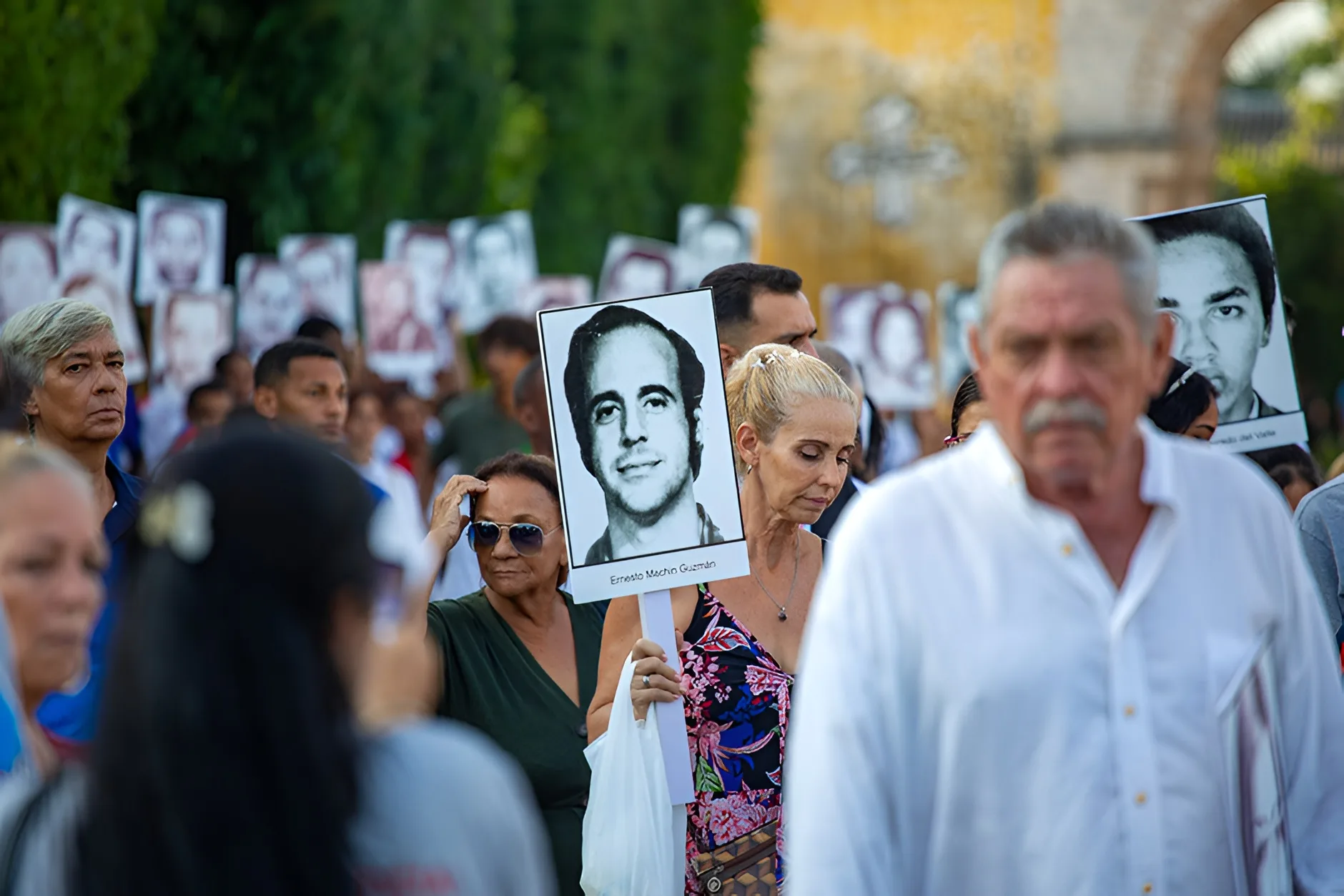
Fifty years after that fateful day, family and friends of the victims participated, this Tuesday (6), in the traditional pilgrimage to the Pantheon of the Revolutionary Armed Forces, in the Colón Cemetery, in Havana, to pay homage to the victims of terrorism.
“We gathered with mourning hearts and burning memories,” said Yadelis Valencia, granddaughter of one of the crew, during the event, representing the victims’ families and accompanied by Cuban government authorities.
Valencia stated that the attack was “calculated and planned by terrorists working for the CIA, the United States intelligence agency, against the Cuban Revolution.” And he classified it as one of the most horrendous crimes in history.
She also recalled that the attack “is part of the thousands of attacks that, financed by the United States government, were committed against our country, leaving a total of more than 3,400 victims”.
The Colón Cemetery, where the Cuban people so often saw their children buried and mourned their dead, once again brought together family and friends of the victims. At the scene, Valencia stated that each name, each face and each story remain engraved in the national consciousness, as victims of the war that the Revolution has faced since its birth.
“Each name, each face, each story that traveled on that flight remains engraved in the national consciousness as a symbol of sacrifice and resistance. They were not just victims: they are heroes who call on us to defend life, justice and truth.”
The average age of victims was just over 30 years old. The captain of the aircraft had been chosen, that same year, as a National Labor Hero. Several of the crew had provided different internationalist services, while the athletes had just won all the gold medals in the regional fencing competitions, held in Caracas, Venezuela.
They were, definitively, part of a generation that was writing the history of the Cuban Revolution.
A planned attack
It was at 5:15 pm local time that Flight 455 took off from Seawell International Airport in Barbados. Less than ten minutes later, the first bomb exploded. Captain Wilfredo Pérez Pérez attempted to return to the runway to make an emergency landing, but the fire and smoke made it impossible to control the plane. To prevent it from crashing onto a populated beach, he directed the aircraft towards the Caribbean Sea, where it ended up crashing a few kilometers from the coast.
The search for truth and justice remains an outstanding demand. In Cuba, every October 6th is remembered as National Day for the Victims of State Terrorism.
The attack was carried out by the Coordination of United Revolutionary Organizations (CORU), a clandestine alliance of paramilitary groups created in June 1976, in the Dominican Republic, to coordinate armed actions and attacks against the government of the Cuban Revolution.
The organization had been created by counter-revolutionary right-wing militants of Cuban origin Orlando Bosch and Luis Posada Carriles, who maintained close relations with the United States intelligence services.
From the beginning, Cuba denounced the actions of these groups. Fidel Castro himself stated, on October 15, 1976, during the farewell ceremony for the victims in Revolution Square, that several counter-revolutionary organizations based in the United States had met months earlier, in Costa Rica, to create the Coordination of United Revolutionary Organizations (CORU).
According to him, its members included people who had worked for the CIA and received training from that agency. “Not only do these groups operate freely and with impunity from United States territory, their main leaders, through the CORU organization, are closely linked to CIA activities against Cuba,” he stated.
Subsequent investigations would determine that the perpetrators, responsible for assembling and placing the bombs on the plane, were Venezuelans Hernán Ricardo and Freddy Lugo. Both worked at Investigaciones Comerciales e Industriales CA (ICICA), a “security” company that Posada Carriles had created in Caracas to carry out his operations.
Just a few days after the attack, Hernán Ricardo and Freddy Lugo were captured in Trinidad and Tobago. Ricardo would be the one who would confess the intellectual authorship of Orlando Bosch and Luis Posada Carriles. Both were extradited to Venezuela to be tried by local courts and, after a judicial process in the civil and military spheres, permeated by all types of political pressure to guarantee their impunity, they were sentenced, in 1986, to 20 years in prison for qualified homicide and terrorism.
On October 14, 1976, the Venezuelan police (DISIP) carried out searches at the offices and residence of Posada Carriles. In the searches, maps, surveillance plans of Cuban diplomatic headquarters and schedules were found that linked it to the CORU network. He was arrested and taken to prison along with Orlando Bosch, and both spent years in a dispute between civil and military jurisdictions without receiving a definitive sentence.
In 1985, Posada Carriles managed to escape from prison with the help of sectors of the ultra-right based in Miami. It is believed that the escape had the support of the Cuban-American National Foundation and businessmen such as Jorge Mas Canosa, who allegedly helped bribe the prison guards.
Once on the run, Posada Carriles returned to participate in different activities against left-wing organizations in Central America. And he once again participated in attacks against Cuba during the 1990s, crimes that he himself would later confess to in interviews. Posada Carriles died unpunished in Miami, in 2018, at the age of 90.
In turn, Orlando Bosch remained imprisoned in Venezuela until he was acquitted in 1987. Upon his release, he traveled to Miami in 1988, where he was detained by federal authorities for violations of his parole related to an attack he had committed in the late 1960s. Finally, a few years later, in 1990, President George HW Bush granted him a pardon. Bosch lived freely in the United States until his death from natural causes on April 27, 2011, at the age of 84.
Source: www.brasildefato.com.br