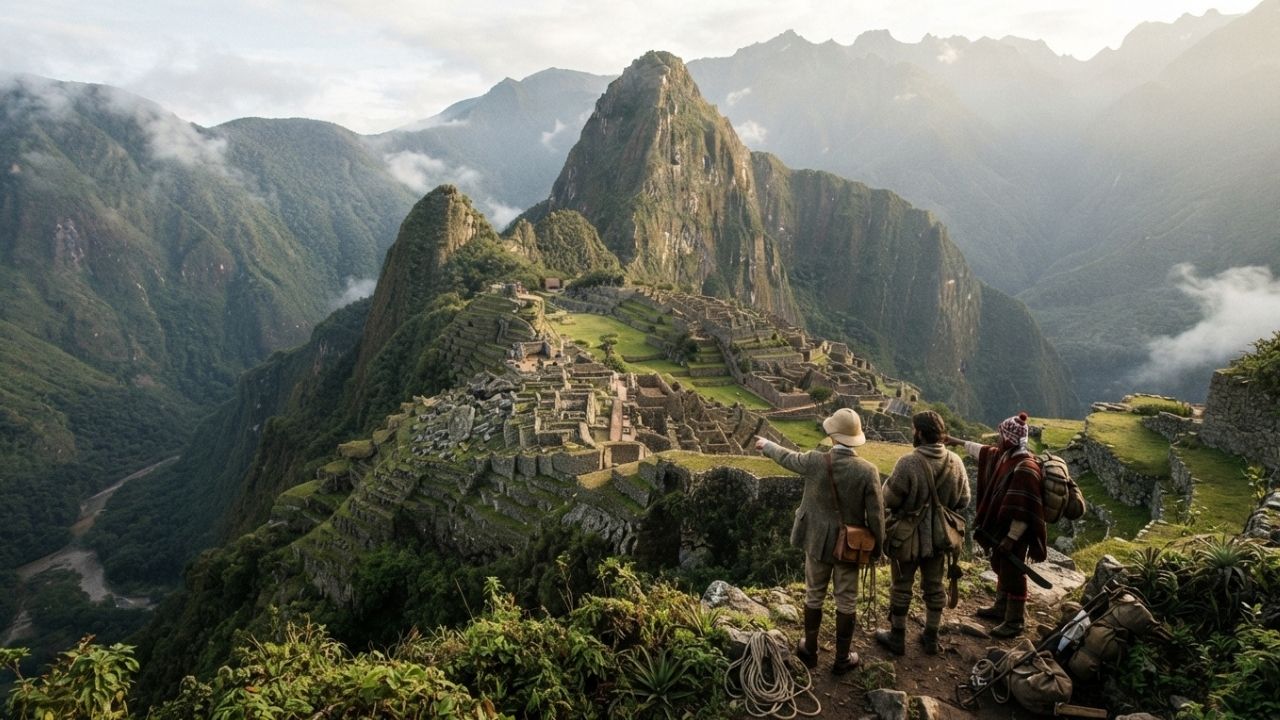
High in the mountains of Peru, surrounded by steep green peaks, deep valleys, and clouds that drift across the landscape, lies one of the most extraordinary archaeological sites in the world. Its stone buildings, agricultural terraces, and mysterious pathways have fascinated historians, explorers, and travelers for more than a century.
This is Machu Picchu, the ancient Inca citadel that became internationally famous after an American explorer reached it in 1911.
Often described as a lost city, Machu Picchu was never completely forgotten. Local people knew about the ruins, and farmers continued to live and work in the surrounding region. Yet, for much of the outside world, the remarkable settlement remained hidden from history, concealed by thick vegetation and the dramatic geography of the Andes.
Its rediscovery became one of the most famous archaeological stories of the 20th century. It was a story of exploration, ambition, local knowledge, and an ancient civilization whose achievements had been largely overlooked by the modern world.
But what made Machu Picchu so important? Why was it built in such a remote location? And how did a place known to nearby communities become a global symbol of the mysteries of the past?
🌿 A City Hidden Above the Clouds
Machu Picchu is located in the Cusco region of southern Peru, approximately 2,430 meters above sea level. The site sits on a mountain ridge between the peaks of Machu Picchu Mountain and Huayna Picchu, overlooking the Urubamba River.
The landscape is spectacular, but it also presented enormous challenges for anyone attempting to reach the settlement. The mountains are steep, the valleys are deep, and the tropical vegetation can quickly cover abandoned structures.
The Incas built their empire across a vast portion of the Andes during the 15th and early 16th centuries. Their territory extended through areas of modern-day Peru, Bolivia, Ecuador, Chile, Argentina, and Colombia.
Despite the absence of modern machinery, the Incas developed sophisticated systems of agriculture, road construction, water management, and stone architecture. Machu Picchu is among the clearest examples of their ability to adapt to difficult mountain environments.
The citadel contains hundreds of structures, including residential buildings, ceremonial spaces, terraces, stairways, and water channels. Many of its walls were constructed from precisely cut stones fitted together without mortar.
This technique allowed buildings to withstand the frequent earthquakes that affect the Andes. Rather than relying entirely on rigid structures, the Incas designed walls that could move slightly during seismic activity without collapsing.
The result was a settlement that combined engineering, architecture, agriculture, and religious significance in a single extraordinary location.
🏛️ Why Did the Incas Build Machu Picchu?
Although researchers have studied Machu Picchu for decades, its exact purpose remains a subject of discussion.
Most archaeological evidence indicates that the site was constructed during the 15th century, probably during the reign of the Inca ruler Pachacuti Inca Yupanqui. Pachacuti is widely recognized as one of the leaders responsible for transforming the Inca state into a powerful empire.
Some researchers believe Machu Picchu served as a royal estate, a retreat where the ruler and members of the elite could enjoy the mountain landscape while participating in religious and administrative activities.
Others emphasize its ceremonial importance, pointing to the presence of temples, carefully aligned structures, and features connected to the movement of the sun.
The site may have served several purposes at the same time. Inca royal estates were not necessarily ordinary cities designed for large permanent populations. They could function as places of residence, agriculture, ceremony, political activity, and elite gatherings.
Machu Picchu’s location may also have had symbolic importance. Mountains held deep spiritual significance in Inca society, and the surrounding peaks may have been regarded as sacred beings or powerful natural forces.
One of the most famous structures at the site is the Intihuatana, a carefully carved stone often associated with astronomical and ceremonial practices. Its precise function is not fully understood, but its design reflects the Incas’ interest in the relationship between architecture, the sun, and the natural world.
The Temple of the Sun is another important feature. Its curved stone walls and carefully positioned openings demonstrate the builders’ attention to solar movement.
Researchers continue to investigate the site because many questions remain unanswered. The Incas did not leave behind a written historical record comparable to modern books, and much of what is known about their civilization comes from archaeology, Spanish colonial accounts, oral traditions, and the study of surviving objects and structures.
🧭 The Spanish Conquest and the Disappearance of a Settlement
The Inca Empire was conquered by Spanish forces in the 16th century, during a period of political instability and civil war within the empire.
In 1532, Spanish conquistador Francisco Pizarro and his forces captured the Inca ruler Atahualpa. Over the following years, the Spanish established control over much of the Inca territory.
The conquest brought devastating changes to Andean society. Warfare, forced labor, epidemics, and the disruption of political and economic systems caused enormous suffering and population loss.
Machu Picchu appears to have escaped direct destruction during the conquest. However, its importance declined, and the settlement was eventually abandoned.
The reasons for its abandonment are not entirely certain. The political upheaval caused by the Spanish invasion may have played a role. Changes in population, disease, and the breakdown of the Inca administrative system may also have contributed.
Once the site was no longer regularly maintained, vegetation gradually spread across its buildings and terraces.
Over time, the settlement became difficult to recognize as a major Inca center. Its remote location helped protect it from extensive development, but it also meant that the outside world had little knowledge of its existence.
The city was not necessarily lost in the literal sense. Local residents in the surrounding area knew about the ruins, and evidence suggests that some people continued to visit or use parts of the site after the Inca period.
What disappeared was its place in the wider historical imagination.
🧑🌾 Local Knowledge That Predated the Famous Discovery
The popular story of Machu Picchu often begins with Hiram Bingham, an American explorer who arrived at the site in July 1911.
However, describing Bingham as the person who discovered Machu Picchu from nothing is misleading.
Local people were aware of the ruins before his arrival. Farmers lived in the surrounding region, and the site was not entirely unknown to those who knew the mountains.
In fact, Bingham was guided to the ruins by a local farmer named Melchor Arteaga. A young boy, often identified in historical accounts as Pablito, also helped guide Bingham through the area.
This detail is important because it changes the way the story should be understood. The citadel was not simply stumbled upon by an explorer wandering through an untouched wilderness. Local knowledge made the journey possible.
The story of Machu Picchu’s rediscovery is therefore also a story about whose knowledge gets recognized in history.
For generations, the surrounding communities had lived in an environment that outsiders considered difficult and inaccessible. Their familiarity with mountain paths, rivers, and abandoned structures was essential to Bingham’s expedition.
Without local assistance, the famous explorer might never have reached the site.
🔎 Hiram Bingham’s Unexpected Journey
Hiram Bingham was born in Hawaii in 1875 and became a historian, lecturer, and explorer. He developed an interest in the final strongholds of the Inca civilization, particularly the places associated with the resistance against Spanish rule.
Bingham was searching for Vilcabamba, a settlement believed to have been the last refuge of the Incas during the Spanish conquest.
In 1911, he traveled through the Andes with the intention of investigating historical sites and locating important Inca remains.
On July 24, 1911, Bingham reached Machu Picchu after being guided through the mountainous terrain.
What he encountered surprised him.
The ruins were heavily covered with vegetation, but the outlines of stone buildings, terraces, and walls were still visible. The scale and sophistication of the site suggested that it had once been a significant settlement.
Bingham later described the experience in his writings, helping introduce Machu Picchu to a much wider audience.
He initially believed that he might have found Vilcabamba, the final Inca refuge. That interpretation was later challenged by other researchers, who identified the ruins at Espiritu Pampa as a stronger candidate for the historical Vilcabamba.
Even though Bingham’s original identification was incorrect, his expedition helped bring international attention to Machu Picchu.
His work also encouraged further archaeological research and documentation.
📸 The Photographs That Changed the World
One of the most important contributions of Bingham’s expedition was the photographic documentation of Machu Picchu.
At the beginning of the 20th century, photographs played a powerful role in shaping public understanding of distant places. Images could transform a remote archaeological site into a subject of international fascination.
Bingham’s photographs showed terraces rising along the mountainside, stone buildings emerging from the vegetation, and a settlement that appeared almost impossibly positioned above the surrounding valleys.
For readers in North America and Europe, these images offered a dramatic glimpse into a civilization that had built remarkable structures centuries earlier.
The photographs helped generate interest in Inca history and archaeology. They also contributed to the popular image of Machu Picchu as a mysterious city hidden in the clouds.
However, the photographs did not represent the beginning of the site’s history. They represented a new chapter in its relationship with the outside world.
The settlement had existed for centuries before cameras arrived. Its buildings, agricultural terraces, and ceremonial spaces were the result of generations of Inca knowledge.
The rediscovery story is therefore best understood as the moment when Machu Picchu became widely known internationally, rather than the moment when the ruins first became known to anyone.
🧱 How Did the Incas Build Such an Extraordinary Place?
One of the most remarkable aspects of Machu Picchu is its construction.
The site was built on a steep mountain ridge where the terrain was difficult to farm and even more difficult to develop.
The Incas responded by creating extensive terraces. These agricultural platforms helped stabilize the slopes, manage water, and provide areas for growing crops.
The terraces were not simply flat patches of soil. They were carefully engineered systems that included layers of stone, gravel, and soil. This arrangement helped improve drainage and reduce erosion during heavy rainfall.
The mountain environment receives substantial rainfall, and uncontrolled water could have damaged the structures or caused landslides.
The Incas also developed channels and fountains to transport water through the settlement. Some of these systems remain visible today.
The stonework is equally impressive.
Many buildings feature walls made from carefully shaped stones that fit together with remarkable precision. The construction required skilled labor, planning, and an understanding of the local geology.
The Incas did not use iron tools or wheeled construction vehicles. Instead, they relied on stone tools, bronze implements, organized labor, and techniques developed over generations.
The placement of the city itself may also have been deliberate. The ridge offered views of surrounding mountains and access to natural resources.
The combination of architecture and landscape makes Machu Picchu different from an ordinary abandoned settlement. It appears to have been designed as an integrated environment in which buildings, agriculture, water, and mountains formed a connected system.
🌞 The Mystery of the Sun and the Stars
The Incas had a sophisticated understanding of the natural world, including the movement of the sun and the changing seasons.
Agriculture depended on rainfall, temperature, and seasonal cycles. Observing the sky was therefore important for both practical and ceremonial reasons.
At Machu Picchu, several structures appear to have been positioned with attention to solar events.
The Temple of the Sun is particularly notable. Its design includes curved stonework and openings that allow sunlight to enter at specific times.
The Intihuatana stone is another feature associated with astronomical interpretation. Its shape and position have led researchers to examine possible connections with the sun’s movement.
However, popular descriptions sometimes exaggerate what is known about these structures. Their exact functions remain uncertain, and not every alignment proves that a building was designed as a precise astronomical observatory.
Archaeologists continue to study the site’s architecture, orientation, and surrounding landscape to better understand how the Incas viewed the relationship between the heavens and the earth.
The enduring mystery is part of what makes Machu Picchu so compelling. It is a place where evidence can reveal much about Inca society, while still leaving room for questions about beliefs, rituals, and daily life.
🗺️ A Lost City That Was Never Truly Lost
The phrase “lost city” is powerful because it evokes adventure, mystery, and discovery. But in the case of Machu Picchu, it requires some explanation.
The site was not unknown to everyone before Bingham arrived. Local residents knew of the ruins, and people had visited the area for generations.
The word “lost” mainly reflects the fact that the wider world had largely forgotten the settlement’s importance.
This distinction matters because archaeological history has often been told through the experiences of foreign explorers, while local communities received less recognition.
The rediscovery of Machu Picchu shows how historical narratives can change when researchers examine the people who lived near ancient sites.
It also demonstrates that the discovery of an archaeological site is rarely a single moment. It is usually a process involving local knowledge, earlier visits, historical records, fieldwork, excavation, and interpretation.
Bingham’s expedition was a major event in the history of Machu Picchu, but it was not the beginning of the site’s story.
The ancient settlement existed long before the Spanish conquest, survived centuries of changing conditions, and remained part of the surrounding landscape even after its political importance declined.
⚠️ The Controversy Surrounding the Excavations
Although Bingham’s expedition brought global attention to Machu Picchu, his work also generated controversy.
During his expeditions, archaeological materials were removed from Peru and taken to Yale University in the United States for study.
The collections included ceramics, bones, and other objects associated with the Inca site.
The removal of these materials became a major issue in discussions about cultural heritage and the rights of countries to control archaeological objects found within their territory.
Peruvian authorities and cultural institutions argued that important materials should be returned to Peru.
After years of negotiations, Yale University returned substantial collections to Peru, including objects associated with Machu Picchu.
The controversy reflects a broader international debate about archaeology, colonialism, and museum collections.
Who has the right to study ancient objects? Where should they be kept? How should researchers balance scientific investigation with the cultural and historical interests of local communities?
These questions remain relevant around the world.
Machu Picchu’s history is therefore not only about an ancient civilization and an explorer. It is also about the responsibilities of modern institutions when studying and displaying cultural heritage.
🌎 From Archaeological Site to Global Symbol
After Bingham’s expeditions and subsequent research, Machu Picchu became increasingly famous.
Its location, architecture, and connection to the Inca Empire attracted historians, travelers, photographers, and archaeologists.
In 1983, UNESCO designated Machu Picchu as a World Heritage Site, recognizing its cultural and natural importance.
The site later became one of the most recognizable landmarks in South America.
Its image appears in travel magazines, documentaries, books, and educational materials around the world.
Visitors travel to Peru to see the stone terraces, explore the ancient pathways, and experience the landscape that once surrounded the Inca settlement.
The international fame of Machu Picchu has brought economic opportunities to the region, particularly through tourism.
At the same time, the popularity of the site has created challenges.
Large numbers of visitors can place pressure on ancient structures, pathways, and the surrounding environment. Conservation requires careful management to reduce erosion and protect the archaeological remains.
Authorities have introduced measures to regulate access, manage visitor movement, and preserve the site for future generations.
The challenge is to make Machu Picchu accessible while ensuring that its historical and environmental value is not damaged by the very attention that made it famous.
🧬 What Archaeology Has Revealed About the People
For many years, popular accounts of Machu Picchu focused mainly on the architecture and the mystery of its purpose.
More recent research has also examined the people who lived and worked there.
Archaeologists have studied human remains, artifacts, buildings, and agricultural systems to understand the site’s population.
Evidence suggests that Machu Picchu was home to a diverse community rather than a settlement made up exclusively of people from the immediate surrounding area.
Some individuals may have come from different parts of the Inca Empire. This reflects the broader movement of people within the Inca state.
The site may have included royal attendants, agricultural workers, craftsmen, religious specialists, and other members of the community.
Understanding the daily lives of these people is essential to understanding Machu Picchu as more than a beautiful collection of ruins.
Behind the stone walls were homes, kitchens, workplaces, storage areas, and ceremonial spaces. People cultivated crops, prepared food, maintained buildings, and participated in the social and religious life of the settlement.
Archaeology helps reconstruct these activities, although many details remain uncertain.
The study of human remains and artifacts has also raised important questions about scientific research, cultural sensitivity, and the treatment of ancestral remains.
Modern archaeological work increasingly emphasizes collaboration with local communities and respect for the cultural significance of ancient sites.
📚 Why the Story Still Fascinates the World
The story of Machu Picchu continues to attract attention because it combines several powerful themes.
It is a story about a civilization that achieved remarkable engineering without modern technology.
It is a story about a settlement that declined and became less visible to the wider world.
It is a story about local people whose knowledge helped an outsider reach an extraordinary place.
It is a story about the challenges of interpreting the past when historical records are incomplete.
And it is a story about how a remote archaeological site became a symbol of human creativity and the endurance of cultural heritage.
The mystery of Machu Picchu is not simply that a city was hidden in the mountains.
The deeper mystery is how a society managed to build such a complex place, why it chose that location, and what life was like for the people who lived there.
Each new archaeological discovery adds another piece to the story.
Researchers continue to investigate the site’s water systems, agricultural terraces, surrounding roads, and relationship with other Inca settlements.
Modern technology, including aerial mapping and remote sensing, has helped archaeologists identify features that may not be visible from the ground.
These discoveries demonstrate that even a famous archaeological site can still contain unanswered questions.
🔍 The Legacy of a Remarkable Rediscovery
Machu Picchu’s international rediscovery in 1911 changed the way many people viewed the Inca civilization.
It helped bring attention to the achievements of a society that had been overshadowed in popular history by the Spanish conquest.
The citadel became a reminder that the Andes were home to sophisticated communities with their own political systems, technologies, traditions, and cultural achievements.
At the same time, its history demonstrates the importance of recognizing local knowledge and questioning simplified stories of exploration.
The ruins were not created for the benefit of modern tourists or explorers. They were built by the Incas for purposes that remain partly understood.
Their survival across centuries is a testament to the skill of the builders and the protection offered by the mountain environment.
The continued study of Machu Picchu allows historians and archaeologists to explore the complexity of Inca society while also confronting the challenges of preserving cultural heritage.
🏔️ A City That Remains Part of the Living Landscape
Today, Machu Picchu stands as one of the world’s most famous archaeological destinations.
Visitors arrive from many countries to see its stone buildings, walk along ancient paths, and look across the mountains of the Andes.
But the site is more than a spectacular tourist attraction.
It is a place connected to the history, culture, and identity of Peru. It is also part of a living landscape in which local communities, researchers, conservationists, and visitors share an interest in protecting the past.
The story of its rediscovery reminds us that history is rarely as simple as it first appears.
A city can be abandoned without being forgotten by everyone. A discovery can be celebrated while also raising questions about who was already there. And an ancient civilization can continue to reveal new information centuries after its political power has disappeared.
Machu Picchu was built by the Incas hundreds of years ago. It survived conquest, abandonment, and the gradual return of vegetation.
When Hiram Bingham reached the ruins in 1911, he helped introduce the site to the modern international world.
But the true story of Machu Picchu stretches far beyond that expedition.
It belongs to the people who built it, the communities who knew it, the researchers who continue to study it, and the generations who will inherit the responsibility of preserving it.
The lost city that was found by accident was never truly lost.
It was waiting in the mountains, holding the remains of a remarkable civilization, until the world was ready to look again.