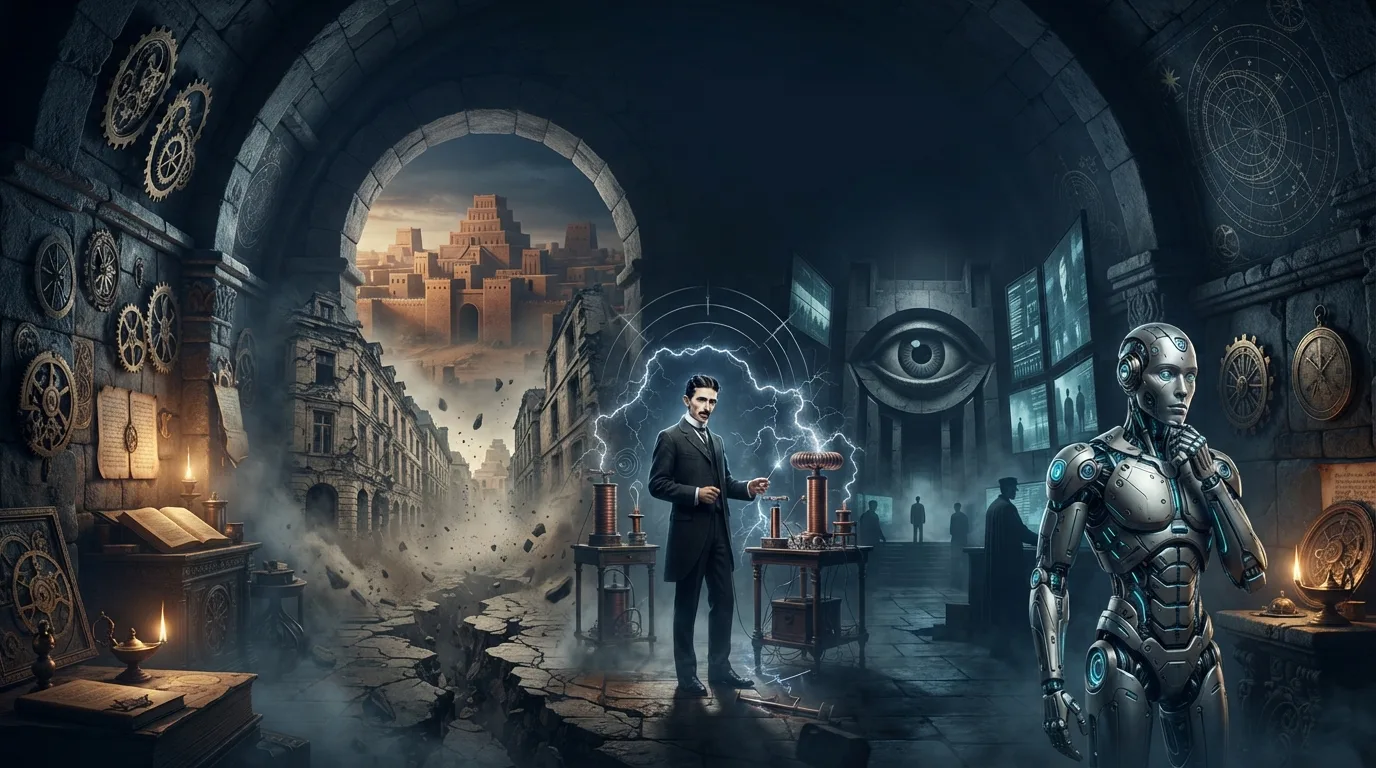
From ancient predictions of a powerful king to warnings about artificial intelligence, these five prophecies and forecasts have become associated with events that later happened. But how accurate were they really?
Throughout history, humanity has been fascinated by the possibility of seeing the future. Kings consulted oracles before battles, religious leaders interpreted visions as signs of coming events, and writers imagined societies transformed by technologies that did not yet exist.
Some predictions have become famous because they appear to describe events that happened decades or even centuries later. Others gained attention only after the event, when people searched old texts for passages that seemed to match reality.
The distinction matters. A prediction that accurately describes a future event before it happens is different from a vague statement that can be interpreted in several ways. Likewise, a scientific forecast based on evidence is not the same as a supernatural prophecy.
Still, history contains several remarkable examples of predictions that either corresponded closely to later events or anticipated developments long before they became reality.
Here are five of the most compelling cases, along with the evidence, the controversies, and the reasons they continue to attract attention.
🔮 1. The Fall of Babylon in the Book of Isaiah
One of the most discussed examples of an apparently fulfilled prophecy comes from the Hebrew Bible, particularly the Book of Isaiah.
The ancient city of Babylon, located in modern-day Iraq, was one of the most powerful centers of the ancient world. Under King Nebuchadnezzar II, it became famous for its monumental architecture, impressive walls, and political influence across Mesopotamia.
The Book of Isaiah contains passages concerning Babylon’s downfall. Isaiah 13 describes the destruction of the city and portrays Babylon as a place that would eventually become desolate. Isaiah 14 also speaks of the fall of the Babylonian king.
For many religious readers, these passages represent a prophecy that was fulfilled when Babylon lost its power and gradually declined.
What happened?
Babylon was conquered by the Persian ruler Cyrus the Great in 539 BCE. The conquest ended the city’s position as the capital of the Babylonian Empire and brought it under Persian control.
The city continued to exist for centuries. It did not disappear overnight, nor was it immediately abandoned. However, its political importance declined over time, especially after the rise of other centers of power.
By the early centuries of the Common Era, Babylon had largely fallen into ruin. Later historical accounts describe the remains of the once-great city as a shadow of its former importance.
Today, the archaeological site of Babylon is recognized as one of the most important remnants of ancient Mesopotamian civilization.
Was it really a prophecy?
The answer depends partly on how the biblical text is dated and interpreted.
Traditional religious interpretations understand Isaiah’s passages as predictions of Babylon’s future destruction. Some scholars, however, argue that parts of the Book of Isaiah were written or edited during different historical periods, including around the time of the Babylonian exile.
This creates an important question: Were the passages written before the events they describe, or did some of the relevant material take shape after Babylon’s decline had already begun?
There is no single scholarly answer that resolves every issue surrounding the text.
Nevertheless, the story remains significant because Babylon was genuinely one of the ancient world’s great powers, and its eventual decline is a well-documented historical development.
The prophecy’s enduring appeal comes from the apparent contrast between Babylon’s extraordinary power and its later ruins.
The takeaway: The fall of Babylon is a compelling example of a prophecy associated with a real historical outcome, although the precise dating and interpretation of the biblical passages remain debated.
🌊 2. The Prediction of the Great Lisbon Earthquake
On November 1, 1755, a devastating earthquake struck Lisbon, Portugal. The disaster became one of the most important natural catastrophes in European history.
The earthquake, followed by a tsunami and fires, destroyed large parts of Lisbon and caused widespread destruction in surrounding areas. Thousands of people died, and the disaster shocked European society.
The event is often connected to the prophecies of the French physician and astrologer Michel de Nostredame, better known as Nostradamus.
The Nostradamus connection
Nostradamus published Les Prophéties, a collection of cryptic verses, in the 16th century. The writings contain hundreds of quatrains, many of which refer to wars, disasters, rulers, and political upheaval.
After the Lisbon earthquake, some readers claimed that Nostradamus had predicted the disaster.
One of the passages frequently associated with Lisbon describes a major earthquake affecting a city and causing suffering. However, the connection is not straightforward.
Nostradamus did not clearly name Lisbon in a specific, unmistakable prediction of the 1755 earthquake. Instead, later interpreters have connected several of his broad references to the event.
Why the claim became popular
The Lisbon earthquake occurred on a religious holiday, and the destruction of churches and other sacred buildings provoked intense debate among philosophers and theologians.
The disaster also attracted attention from writers such as Voltaire, who used it to question traditional explanations of suffering and divine providence.
As public interest in the earthquake grew, so did attempts to find earlier predictions that appeared to anticipate it.
Nostradamus became a natural candidate. His reputation as a prophet, combined with the ambiguous language of his verses, allowed later readers to connect his writings with numerous historical disasters.
The problem with the evidence
The main difficulty is specificity.
A genuine prediction of an earthquake would ideally identify the location, approximate date, and nature of the event before it occurred. Nostradamus’ verses generally do not provide that level of detail.
Many of his writings use symbolic language that can be applied to different historical situations. Earthquakes, wars, fires, and the fall of rulers are recurring themes in history, making them especially easy to match with old predictions.
There is also a broader issue: many popular Nostradamus predictions circulating online are inaccurate translations, altered quotations, or passages that were never written by him.
That does not mean his work has no historical value. It does mean that claims of precise supernatural forecasting should be treated cautiously.
The takeaway: Nostradamus’ writings are often linked to the Lisbon earthquake, but there is no widely accepted evidence that he specifically predicted the disaster with reliable accuracy.
⚡ 3. Nikola Tesla’s Vision of Wireless Communication
Not every famous prophecy came from religion or astrology. Some came from scientists and inventors who imagined technologies that did not yet exist.
Nikola Tesla, the Serbian American inventor whose work helped shape modern electrical systems, made several predictions about the future of communication.
In the early 20th century, he described a world in which people could communicate across great distances using wireless technology. His ideas were extraordinary at a time when radio was still developing and long-distance communication depended heavily on wired systems.
A world connected without wires
In a 1926 interview published in Collier’s magazine, Tesla described a future in which wireless communication would transform daily life.
He imagined people carrying small devices that would allow them to communicate across the world. He also suggested that people would be able to receive information instantly and that wireless technology would make the world more connected.
Tesla’s vision included devices that could be carried in a pocket and used for communication. He anticipated a future in which people would not need to depend on large, fixed communication systems.
Today, smartphones perform many of the functions he described.
People can make calls across continents, send messages instantly, access information, watch live events, and communicate with millions of others through wireless networks.
Did Tesla predict the smartphone?
It would be an exaggeration to say Tesla described the modern smartphone in exact technical terms.
He did not provide a detailed design for a touchscreen device with a mobile operating system, cameras, and internet applications.
However, he correctly anticipated several important principles:
- Communication would become increasingly wireless.
- Devices would become smaller and more portable.
- Information could travel rapidly across the globe.
- People would be able to communicate while moving rather than remaining connected to fixed equipment.
These ideas were particularly striking because they appeared before the development of modern cellular networks and consumer smartphones.
A prediction based on technology
Tesla’s forecast differs from supernatural prophecies because it was grounded in scientific developments already underway.
Radio, electrical engineering, and telecommunications were advancing rapidly during his lifetime. Tesla understood that technological progress could eventually make communication more portable and accessible.
His prediction was not a random guess. It was an extrapolation from existing scientific possibilities.
This is an important distinction when discussing prophecies that came true. Some of the most impressive predictions are not supernatural at all. They are examples of people recognizing the direction in which technology is moving.
The takeaway: Tesla’s vision of wireless communication was remarkably forward-looking and anticipated several features of today’s connected world, although it was not a complete prediction of the modern smartphone.
🧠 4. George Orwell’s Warning About Mass Surveillance
In 1949, British writer George Orwell published Nineteen Eighty-Four, a dystopian novel about a society controlled by an authoritarian government.
The story takes place in a fictional state where citizens are monitored, information is manipulated, and independent thought is treated as a threat.
The novel introduced concepts that later became part of everyday political and technological discussions, including mass surveillance, government propaganda, and the manipulation of public information.
The world of Big Brother
In Orwell’s fictional society, the government uses surveillance systems to monitor citizens. Televisions and other devices are used not only to broadcast information but also to observe people.
The central figure, Winston Smith, lives under the constant presence of Big Brother, the symbolic leader of the ruling Party.
The government controls historical records, changes public narratives, and uses language as a tool of political power.
Although the novel was written as a warning about totalitarianism, many readers later recognized similarities between Orwell’s fictional world and developments in modern society.
How the prediction appears to have come true
Modern surveillance technology has expanded dramatically since Orwell’s novel was published.
Cameras are common in public spaces. Smartphones collect information about location and activity. Online platforms track user behavior to personalize content and advertising. Governments and private companies possess powerful systems for storing and analyzing data.
Artificial intelligence has also made it possible to process enormous amounts of information, identify patterns, and monitor activity at a scale that would have been difficult to imagine in Orwell’s time.
These developments have led researchers, journalists, and policymakers to revisit the novel’s central warning.
The concern is not simply that people can be watched. It is that surveillance can influence behavior, restrict privacy, and give powerful institutions extraordinary control over information.
Not an exact forecast
Orwell did not predict the internet, smartphones, or modern artificial intelligence.
His novel was primarily a political and social warning rather than a technical forecast.
The fictional technology in Nineteen Eighty-Four also differs from modern systems. The novel describes a centralized authoritarian government, while today’s surveillance environment involves a mixture of governments, corporations, platforms, and individuals.
Nevertheless, the broad concern about technology being used to monitor and influence society remains highly relevant.
Orwell’s success as a predictor lies in his understanding of power. He recognized that controlling information and observing citizens could become essential tools of political influence.
The takeaway: Orwell anticipated important social and political risks associated with surveillance and information control, even though the technologies of today differ from those in his novel.
🤖 5. Isaac Asimov and the Rise of Artificial Intelligence
Few science fiction writers have imagined the future of technology as extensively as Isaac Asimov.
The Russian American author and biochemist wrote influential stories about robots, computers, and artificial intelligence throughout the 20th century.
His work is especially interesting today because many of his fictional ideas resemble technologies now being developed and used around the world.
Robots as intelligent machines
Asimov’s robot stories explored the possibility that machines could become intelligent, autonomous, and capable of interacting with humans.
In his fictional universe, robots were not merely mechanical tools. They could reason, follow instructions, solve problems, and sometimes struggle with questions involving ethics and responsibility.
His famous Three Laws of Robotics were introduced as fictional rules designed to prevent robots from harming humans.
Although the laws are not real technical safeguards, they became an influential way of discussing the ethical challenges of intelligent machines.
From fiction to modern AI
Today, artificial intelligence systems can perform tasks that once seemed limited to science fiction.
They can generate text, translate languages, recognize patterns, analyze images, assist with programming, and answer questions.
Some systems can also operate tools, support scientific research, and help businesses automate complex processes.
These developments echo Asimov’s broader vision of machines becoming increasingly capable of performing intellectual tasks.
His stories also anticipated several challenges that remain central to AI discussions:
- How should humans control intelligent machines?
- What happens when a machine follows instructions in an unexpected way?
- Who is responsible when an automated system causes harm?
- Can technology become so powerful that society struggles to manage it?
These questions are now being debated by scientists, governments, technology companies, and the public.
Did Asimov predict ChatGPT?
Not exactly.
Asimov did not describe modern large language models in the technical sense. His fictional robots were often embodied machines with distinct personalities and physical abilities.
Modern AI systems can operate through software and do not necessarily possess consciousness or independent intentions.
Still, Asimov anticipated the idea that machines could perform sophisticated intellectual work and that humans would need to develop rules for interacting with them.
His work also helped popularize the notion that technological progress creates ethical problems that cannot be solved through engineering alone.
Why the prediction matters
The most significant aspect of Asimov’s fiction is not that every detail became reality. It is that his stories encouraged readers to think about the consequences of technologies before they existed.
That is one of the most valuable functions of speculative fiction.
A successful prediction does not always have to identify a precise invention. Sometimes it can identify a future dilemma.
The takeaway: Asimov anticipated the rise of increasingly capable intelligent machines and many of the ethical questions surrounding AI, although modern systems differ considerably from his fictional robots.
📜 Why Do Some Prophecies Seem So Accurate?
The five examples above reveal an important pattern.
Some predictions are based on scientific observation. Others are literary warnings. Still others are religious statements or historical claims interpreted by later generations.
Their apparent accuracy can come from different sources.
1. Specificity
A prediction is more impressive when it identifies a specific event, location, or time before it happens.
A statement such as “a great city will fall” is easier to match with history than a prediction naming a city and describing a particular disaster.
2. Dating
The date of a text matters enormously.
If a passage was written before an event, it may represent a genuine prediction. If it was written afterward, it may be a historical interpretation presented as prophecy.
Scholars often disagree about the dates of ancient texts, making this question especially important.
3. Interpretation
Many famous prophecies use symbolic or ambiguous language.
This allows readers to connect them to multiple events. The same passage may be interpreted as referring to a war, an earthquake, a political crisis, or a natural disaster.
4. Selective memory
People tend to remember predictions that appear to come true and forget the many that do not.
This creates a powerful illusion of accuracy.
For example, a famous prophet may have made hundreds of statements, but only a small number are remembered because they seem to match later events.
5. Scientific forecasting
Some predictions succeed because they are based on evidence.
Tesla’s vision of wireless communication and Asimov’s ideas about intelligent machines were influenced by technological developments already underway.
These examples demonstrate that anticipating the future can be a product of observation, imagination, and logical reasoning.
The Enduring Fascination With the Future
The appeal of prophecy is unlikely to disappear.
People want to understand what comes next, whether the subject is war, technology, climate, politics, or civilization itself.
The five examples discussed here show why predictions remain so powerful. Some appear to have anticipated historical events. Others imagined technological developments that later became reality. Still others warned about social dangers that continue to shape modern life.
But the most useful lesson is not that every prophecy should be believed.
It is that predictions should be examined carefully.
What did the original text actually say? When was it written? Was the event genuinely predicted beforehand? How specific was the statement? Could it be interpreted in several different ways?
These questions help separate remarkable foresight from coincidence and hindsight.
The future remains uncertain, but history shows that people can sometimes anticipate it with extraordinary insight. Whether through science, literature, or religious tradition, the desire to understand tomorrow continues to influence how humanity thinks about today.