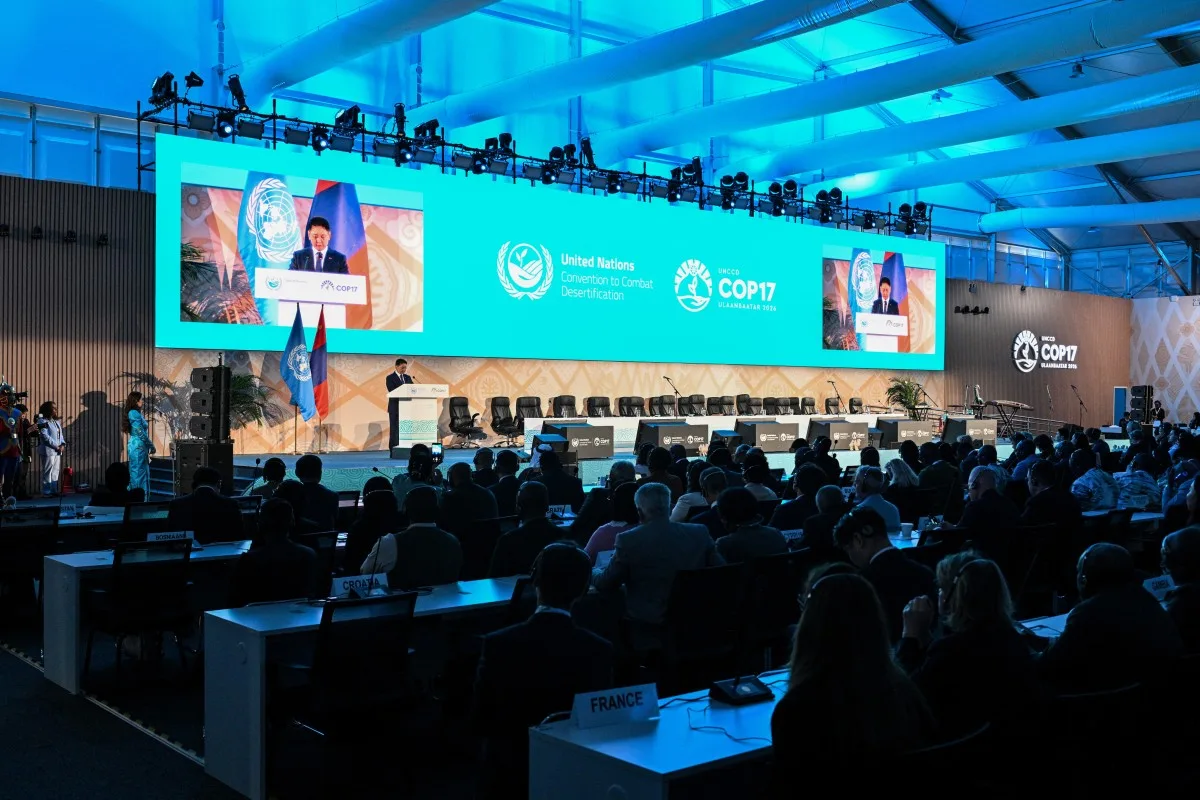
During the 17th session of the Conference of the Parties (COP17) of the United Nations Convention to Combat Desertification (UNCCD), held in Ulaanbaatar, a ministerial dialogue dedicated to innovative financial mechanisms to promote soil health and increase resilience to drought was organized. The meeting brings together delegates from signatory countries to the Convention, as well as representatives from governments, the business sector and civil society.
As host country, Mongolia announced the launch of a flagship grassland initiative. The project envisages the sustainable management and recovery of these areas, the creation of a global coalition on pastures and livestock, as well as the establishment, in Mongolia, of a Eurasian Climate Resilient Grassland Center.
Countries presented different strategies to finance land recovery. The debate also addressed ways to integrate issues related to sustainable land use and drought resilience into the programs of multilateral development banks and institutional investors.
“At the World Bank Group, our approach is focused on two fundamental and at the same time complementary priorities. One is strengthening the land system. The other is considering land as a productive capital asset,” said Chen Guangzhe, World Bank Group Vice President of the “Planet” department.
According to him, the organization invested more than US$3 billion (around R$15.4 billion) in 31 countries to create land registration and cadastre systems, considered an essential condition for efficient management of land resources.
China proposed that its experience be seen as a process of gradual transformation. Speaking to participants, Zhang Liming, deputy head of China’s State Administration of Forestry and Grassland, detailed three stages of this process.
“Firstly, we moved from a purely budgetary approach to a bilateral model, which combines budgetary and financial instruments. […] Second, we move away from a state-centered approach to one that is state-oriented but market-determined. Third, we are moving from a management-based approach to a breeding and management-oriented approach,” said Zhang Liming, deputy head of China’s State Administration of Forestry and Grassland.
Brazil’s Minister of Environment and Climate Change, João Paulo Capobianco, stated, in an exclusive comment to TV Bricsthat the main task of the dialogue is to strengthen the United Nations Convention to Combat Desertification and transform commitments into concrete actions. According to him, financing continues to be one of the main gaps to be overcome.
“The BRICS countries have a great responsibility, as their territories concentrate a significant portion of the world’s biodiversity, landscapes, population, food production and water resources. Therefore, we have the opportunity to serve as an example for other countries. We have our development bank [Novo Banco de Desenvolvimento — nota da redação]which can demonstrate and develop new ways of financing programs. We can reduce the risks for private capital in order to stimulate investments in land recovery and combating desertification”, said João Paulo Capobianco.
South African Deputy Minister of Forestry, Fisheries and Environment, Bernice Swarts, presented the Expanded Public Works Programme, a large-scale initiative of the South African government. Under the project, public resources are allocated to the removal of invasive species and land restoration, while participants receive not only employment but also new professional qualifications.
“As an example, based on the invasive plants that we remove, we have an integrated sustainable furniture production program, in which we use this material. Across the country, the government invests US$582 million [cerca de R$ 3 bi] per year in programs aimed at caring for and restoring land,” said Bernice Swarts, South African Deputy Minister of Forests, Fisheries and Environment.
India’s Minister for Environment, Forests and Climate Change, Bhupender Yadav, stated that the country’s integrated green financing system directs resources towards climate change adaptation actions and sustainable land use. Among the instruments adopted are the issuance of sovereign green bonds and a green credit program, granted after five years of recovery work, as long as canopy coverage reaches at least 40%.
The environmental compensation mechanism also directs payments resulting from the conversion of forest areas to other uses towards reforestation and the recovery of ecosystems.
The special representative of the President of Russia for climate issues and water resources, Ruslan Edelgueriev, drew the participants’ attention to the fact that the success of any mechanism should not only be measured by the volume of financial resources, but also by the quality of management.
“We support the development of practical instruments that allow transforming national priorities into concrete and economically based projects: financing through subsidies and concessional lines, guarantees, insurance, risk reduction mechanisms and voluntary public-private partnerships. […] We consider it essential that financial approaches are developed taking into account the conditions and legislation of each country. The Convention should not establish universal prescriptions in areas such as taxation, subsidies, carbon pricing, sovereign debt and corporate reporting,” said Ruslan Edelgueriev.
During the dialogue, participants agreed to expand the Business4Land (B4L) platform, which connects consumption, production and finance through green value chains, environmental and social standards and financial products aimed at preserving natural capital.
COP17 is held under the motto “Restoring the land. Restoring hope”. The conference takes place during the period proclaimed by the UN General Assembly as the International Year of Pastures and Shepherds, an initiative proposed by Mongolia.
The theme of land recovery will also be continued in a documentary project by TV Brics. On August 26, during COP17, the film “Earth. Lines of Life” will be shown for the first time, which concludes the network’s media campaign in support of the “Silk Road Caravan” initiative of the United Nations Convention to Combat Desertification. The documentary presents successful practices in sustainable pasture management, biodiversity conservation and rational water use using examples from three regions of Russia: Dagestan, Kalmykia and the Astrakhan region.
Source: www.brasildefato.com.br