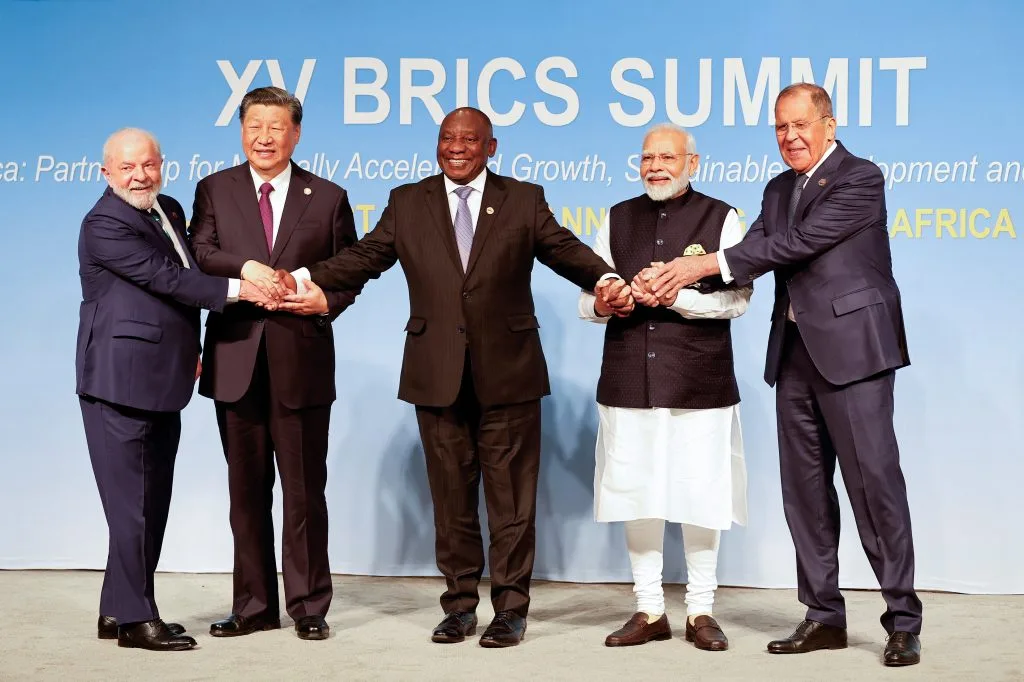
Monetary sovereignty is the watchword in Brics. If the idea serves as a kind of beacon for the alliance of countries that represent around 40% of the global Gross Domestic Product (GDP), the instruments to get it off the ground are many.
One of them is known as Brics Pay, presented last year, and could serve as an instrument to bring countries’ instant payment systems closer together, facilitating transactions. Earlier this month, the president of the Central Bank of India, Sanjay Malhotra, acknowledged that the issue has progressed and will be discussed at the next BRICS summit, scheduled to take place in September in New Delhi. India, in fact, holds the temporary presidency of the group.
“The proposal is to create a kind of digital bridge for direct settlements in local currencies, without intermediaries such as the dollar and the SWIFT system [Society for Worldwide Interbank Financial Telecommunication, sociedade internacional com sede em Bruxelas criada para facilitar transações entre bancos de diferentes países]”, he explains to Brazil in fact researcher Diego Pautasso, PhD in Political Science from the Federal University of Rio Grande do Sul (UFRGS), research director at the Brazil-China Center for Advanced Studies and creator of the “Fios de China” network.
For at least a decade, the Brics countries, internally, have advanced robust settlement mechanisms, expanding the use of national currencies in bilateral trade. Brazil, for example, has Pix as a popular and solid tool. In commercial transactions with China, Brazil has already started using local currencies, such as the real or the yuan.
For Pautasso, the Brics Pay project, from a technical point of view, is already viable. “In countries, there are already their own digital systems. There is blockchain technology, which allows secure and traceable transactions. Cards, QR Codes and all these technologies are now available”, he explains.
The debate is economic and technological, but it is on the political level that it becomes even denser. As a backdrop to the discussion is the imperative to reduce dependence on the dollar as the main reference in commercial transactions. This new stance towards the US currency is only possible due to the increase in the economic vigor of the Brics member countries, the best example of which is China.
“It is the only country that, in fact, has a sovereign digital ecosystem”, says the political scientist. “It is also the country that has the greatest intentions and initiatives to internationalize the yuan. China already has the digital yuan and is expanding commodity contracts in yuan, especially in oil trade. But China also does not want to carry out an abrupt internationalization of its currency. It wants to do this gradually, maintaining control over its currency. It is a slow process”, ponders Pautasso.
At Brics, options are on the table
In the context of Brics, the discussion aims to try to answer the following question: how to integrate payment systems and how it would be possible to use digital currencies from central banks in member countries (known as CBDCs, an acronym in English for Central Bank Digital Currency)? Previously, the group even considered creating its own currency, which did not go ahead.
“Cross-border payments are an area of interest for all of us, including the BRICS countries, as we believe there is great potential to reduce costs,” the Indian central bank governor said at a banking industry event in Mumbai last week. “Several options are under discussion, but are still in the debate phase, including CBDCs and integrations between fast payment systems,” explained the authority.
As the BRICS countries together have more than a third of global GDP in Purchasing Power Parity (PPP), Pautasso considers that this condition helps to ensure that the bloc’s initiative has material support. According to the researcher, this ballast can be explained “in function of the dominance over trade and natural resources, such as oil, ores, land and other resources”.
New times, renewed instruments
Much of the financial architecture refined in recent decades is based on the notion that international and commercial flow mechanisms are designed, in principle, for large-scale businesses. This premise remains true, but increased economic and financial interdependence has stimulated greater exchanges of resources between individuals. Brics, whose member countries account for almost half of the world’s population, pays special attention to such changes.
When exercising the presidency of the group, in 2024, Russia proposed the creation of a settlement platform, the Brics Bridge. Basically, it could enable international payments without depending on the United States’ banking infrastructure. The tool would serve as an alternative to the SWIFT system. Russia, sanctioned since 2022 due to the war in Ukraine, maintains maximum interest in the proposal.
During the Brazilian presidency of the bloc, in 2025, the agenda on de-dollarization and strengthening alternative mechanisms to the dollar made less progress than expected. The reasons were external and internal. Brasília, aware of the effects of the Donald Trump government’s tariff artillery, opted for caution. Domestically, India preferred to curb enthusiasm with a more openly anti-Western agenda.
In any case, the fact that the United States and Europe, since 2022, have blocked more than US$300 billion in reserves from the Russian Central Bank, in addition to having excluded Moscow from the world’s main payments system, has exposed a notion, already known for decades by those who depend most on Washington, that the dollar, more than a currency, is a store of value. This condition often causes the US to use its own currency as an instrument of coercion against countries that do not respond or threaten not to respond to its interests.
When dealing with the topic, Pautasso includes another important element: American dominance “over monetary compensation systems, over a series of financing mechanisms, and over institutions such as the IMF and the World Bank”.
It is necessary to be able to finance a process of independence in relation to the dollar. China, in full economic expansion for decades, already settles more than a third of its foreign trade in yuan, according to a balance sheet from the People’s Bank of China. Looking at the other side of the story, the world is experiencing a crisis of confidence in relation to the American economy, a result of the credibility problems installed by Trump upon his return to the White House. This combination of factors has driven the price of gold to unprecedented levels. Beijing, for example, has been expanding its gold reserves uninterruptedly for almost two years.
Furthermore, China already uses its digital yuan (e-CNY) integrated into payment platforms such as Alipay and WeChat Pay, and has expanded pilot programs in international commercial transactions. Brazil, in turn, is already working on the idea of establishing an “International Pix”. Currently, transfers of this type are already accepted for countries such as Argentina, the United States and Portugal, but the operation is partial. India, in turn, uses the UPI payments system, while testing the digital rupee (e-Rupee) on a large scale.
In Pautasso’s understanding, the advancement of the debate in Brics would have two direct implications for member countries. “The first is to remove the 3% to 5% fees and reduce the clearing time that exists when a transaction passes through the dollar. The second is to have a margin of maneuver in the face of the US siege and sanctions capacity, something that became even more evident, not only in the case of Cuba and Venezuela, but also in the war in the Middle East”, he says.
American reaction?
Considering creating alternatives to the main pillar of the American empire is an action that does not occur without reaction. On more than one occasion, Trump has already threatened to apply tariffs to countries that align with Brics guidelines.
In the Brazilian case, the account is even more complex. As the diffuse reasons used by Washington to present the set of measures against the country since 2025 were no longer enough, the US saw Pix, a domestic system, as a threat to US interests, and included the Brazilian tool in the list of justifications for the current 25% tariff, which is under Section 301.
These moves by Washington do not happen by accident: in recent times, the dollar has been diminishing its position as the main global reserve, which it had maintained unshakable for decades. The movement is gradual but significant. A survey by the Official Monetary and Financial Institutions Forum (OMFIF), a London-based research group, showed that, for the first time, there are more central banks in the world planning to reduce their dollar reserves than wanting to increase them in the next decade. The dollar continues to be the beacon of global reserves, but this percentage is falling: from 71% in 2001 to just over 50% last year.
“The USA, with its status as hegemon, does not seem willing to accept this very calmly. Not only because of its opposition to the Brazilian PIX, but because the USA has already declared that it opposes any type of Brics payment system, and is opposed to the Brics, as a whole. We are facing a systemic crossroads, an arm wrestling match that will determine the direction of the international system”, reflects Pautasso.
Source: www.brasildefato.com.br